

A sudden toothache at 10 p.m. feels different from the kind of pain people think they can “wait out.” It throbs, the gum looks puffy, the jaw starts to ache, and every sip of water seems to hit a nerve. By midnight, many people in Amanda, Lancaster, Circleville, and Carroll are doing the same thing: searching for an emergency dentist abscess and trying to figure out whether they need a dentist, an ER, or just a safe way to get through the next few hours.
That uncertainty is often the hardest part. A dental abscess can be painful and unsettling, but it’s also treatable. The right next step depends on the symptoms, how quickly swelling is changing, and whether the infection still appears limited to the tooth and gum or may be spreading more widely. For families trying to manage urgent care, scheduling, and who to call first, resources on Simbie AI's patient access insights can also help explain why clear access pathways matter so much during a health emergency.
Table of Contents
- Your Guide Through a Dental Emergency in Amanda, Ohio
- Recognizing the Signs of a Dental Abscess
- Immediate At-Home Steps for Pain and Swelling
- When to Visit an Emergency Dentist vs the Hospital ER
- What to Expect During Your Emergency Abscess Treatment
- Your Local Partner for Emergency and Family Dental Care
Your Guide Through a Dental Emergency in Amanda, Ohio
Dental abscess pain tends to arrive at the worst time. It often starts as a deep ache in one tooth, then shifts into pressure, swelling, bad taste, and pain that spreads into the jaw or ear. A person may go to bed hoping it settles down and wake up realizing it’s worse.
That’s when calm decisions matter most. Not every abscess means a hospital trip, but it’s also not something to ignore. The practical goal is to sort the problem into one of three lanes: safe home care for a short bridge, urgent dental treatment, or immediate ER care.
Why this feels so alarming
An abscess is an infection. Pressure builds inside tissue that doesn’t have room to expand, which is why the pain can feel sharp, throbbing, or constant. Swelling inside the gum can also make a tooth feel taller than the others or make chewing feel risky.
People also worry because abscess pain can change quickly. A sore tooth in the morning can turn into visible swelling by afternoon. That change doesn’t always mean the worst, but it does mean the tooth needs prompt attention.
A dental emergency doesn’t always require panic, but it does require action.
What patients in the Amanda area usually need first
Those searching for a dentist near me during an abscess episode want three things immediately: pain relief, a clear safety plan, and a fast path to treatment. That’s reasonable. The next hours should focus on reducing swelling safely, avoiding common mistakes, and watching for warning signs that move the problem out of the dental office category.
For households in Amanda, OH, Lancaster, OH, Circleville, OH, and Carroll, OH, the local reality matters too. Travel time, childcare, work schedules, and after-hours timing can make the gap between symptoms and treatment feel longer. A good emergency plan accounts for that gap instead of pretending everyone can be in a dental chair right away.
Recognizing the Signs of a Dental Abscess

A dental abscess is a pocket of infection linked to a tooth or the surrounding gum tissue. It may begin deep inside a tooth after decay or trauma, or it may develop around the gum and supporting structures. What matters to the patient is simpler: it hurts, it swells, and it won’t resolve safely without proper dental treatment.
This isn’t a rare issue. Dental abscesses account for 37.4% of over 900,000 dental-related emergency department visits in the U.S. each year, based on the HCUP statistical brief on dental conditions and emergency visits. That number shows how often delayed care turns into a crisis.
What a dental abscess actually is
The infection creates pus, inflammation, and pressure. That pressure is what drives the pounding sensation many people describe. Sometimes the swelling stays close to one tooth. Sometimes it spreads into nearby gum, cheek, or jaw tissue.
An abscess can also cause referred pain. Someone may think the problem is in the ear, temple, or entire side of the face when the source is one infected tooth.
Common symptoms to check
Use this as a basic self-check if an emergency dentist abscess seems possible:
- Throbbing tooth pain that doesn’t settle and may wake someone from sleep.
- Swollen gum or cheek near one tooth, especially if the area feels tender or tight.
- Pain with biting or the feeling that one tooth is “high.”
- Sensitivity to hot or cold that lingers instead of fading quickly.
- Bad taste or bad smell in the mouth, especially if fluid seems to drain from the gum.
- Jaw soreness or difficulty opening comfortably, particularly when swelling increases.
For patients also dealing with head pressure or facial pain, this guide on an abscessed tooth and headache connection can help explain why the discomfort may seem larger than the tooth itself.
Practical rule: If pain is paired with swelling, don’t assume it’s “just a cavity.” Swelling changes the urgency.
Not every painful tooth is abscessed, and not every abscess looks dramatic at first. A small gum bump, tenderness when chewing, or a bad taste can be the clue that the infection is already active.
Immediate At-Home Steps for Pain and Swelling
When someone can’t get into a dental chair that minute, bridge care matters. These steps don’t cure the infection, but they can make the hours before treatment safer and more manageable.
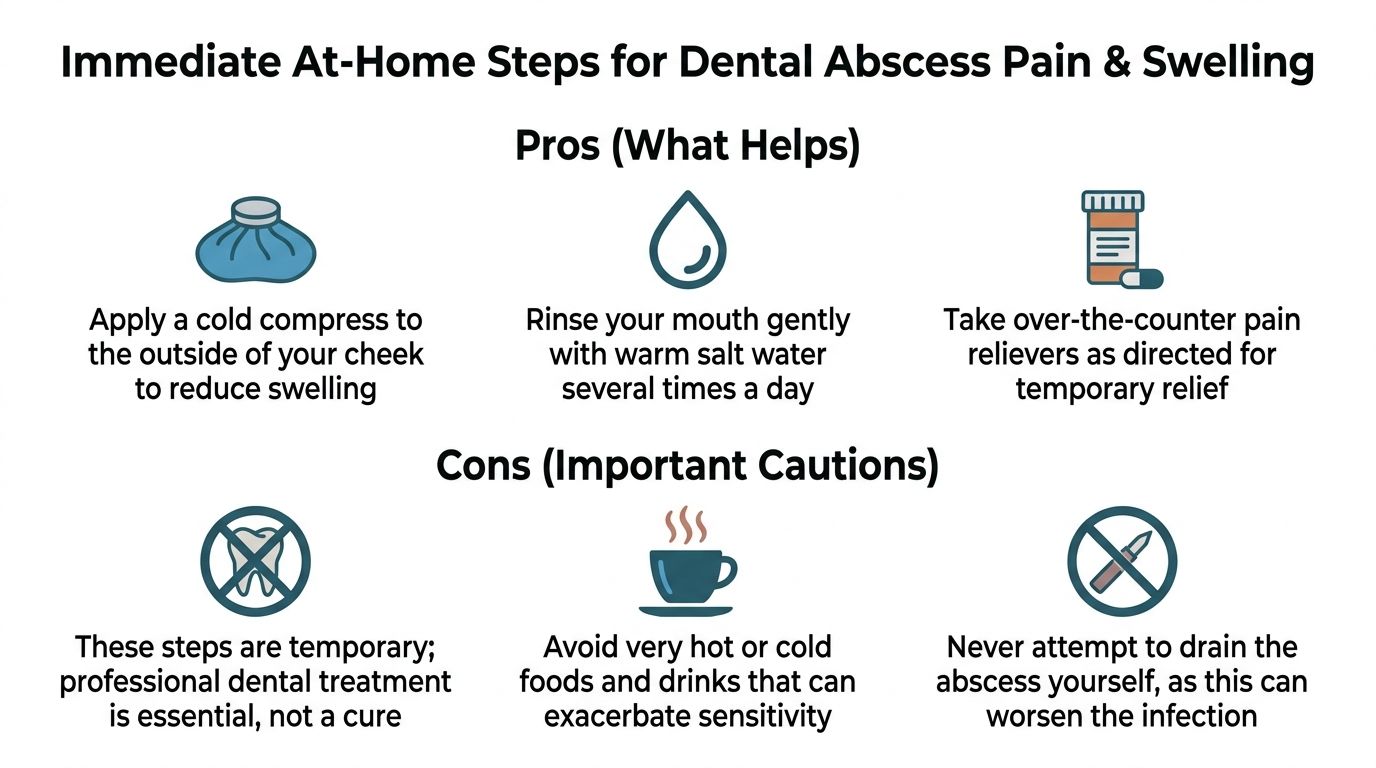
What to do in the next few hours
A practical home protocol should be simple and repeatable.
Rinse gently with warm salt water. A measured approach is best. The verified guidance allows 1 teaspoon of salt in 8 ounces of warm water every two hours, and trials cited by Albano Dental Group’s emergency dentist guidance report swelling reduction of up to 40% with this approach.
Use a cold compress on the outside of the face. Apply it for 15-minute intervals, then remove it. Cold helps numb pain and may limit visible swelling during the wait for care.
Keep the mouth as clean as possible. Brush gently around the area if it’s tolerable. If it isn’t, rinse instead of forcing the toothbrush directly into swollen tissue.
Choose bland, softer foods if eating is possible. Try to chew on the other side. Very hot drinks and ice-cold foods often trigger more pain.
Rest with the head raised. Lying completely flat can make pressure feel worse for some patients.
What not to do
Some home habits make abscess pain worse, not better.
- Don’t place aspirin on the gum. It won’t treat the infection and can irritate the tissue.
- Don’t apply heat to the face. Heat can encourage more swelling in an already inflamed area.
- Don’t poke, squeeze, or try to drain it. That can worsen tissue injury and spread contamination.
- Don’t rely on symptom relief as proof the problem is gone. If an abscess starts draining, pressure may drop, but the infection still needs treatment.
If home care lowers the pain but swelling remains, the situation is still active. Relief is not the same as resolution.
A quick comparison helps:
| Situation | Safer response |
|---|---|
| Gum feels swollen and tender | Saltwater rinse and cold compress |
| Cheek feels puffy | Cold compress outside the face |
| Biting hurts sharply | Avoid chewing on that side |
| Pain briefly improves after drainage taste | Still arrange urgent dental care |
These steps are a short bridge. They buy time. They don’t remove infected tissue, drain the source properly, or seal the tooth.
When to Visit an Emergency Dentist vs the Hospital ER
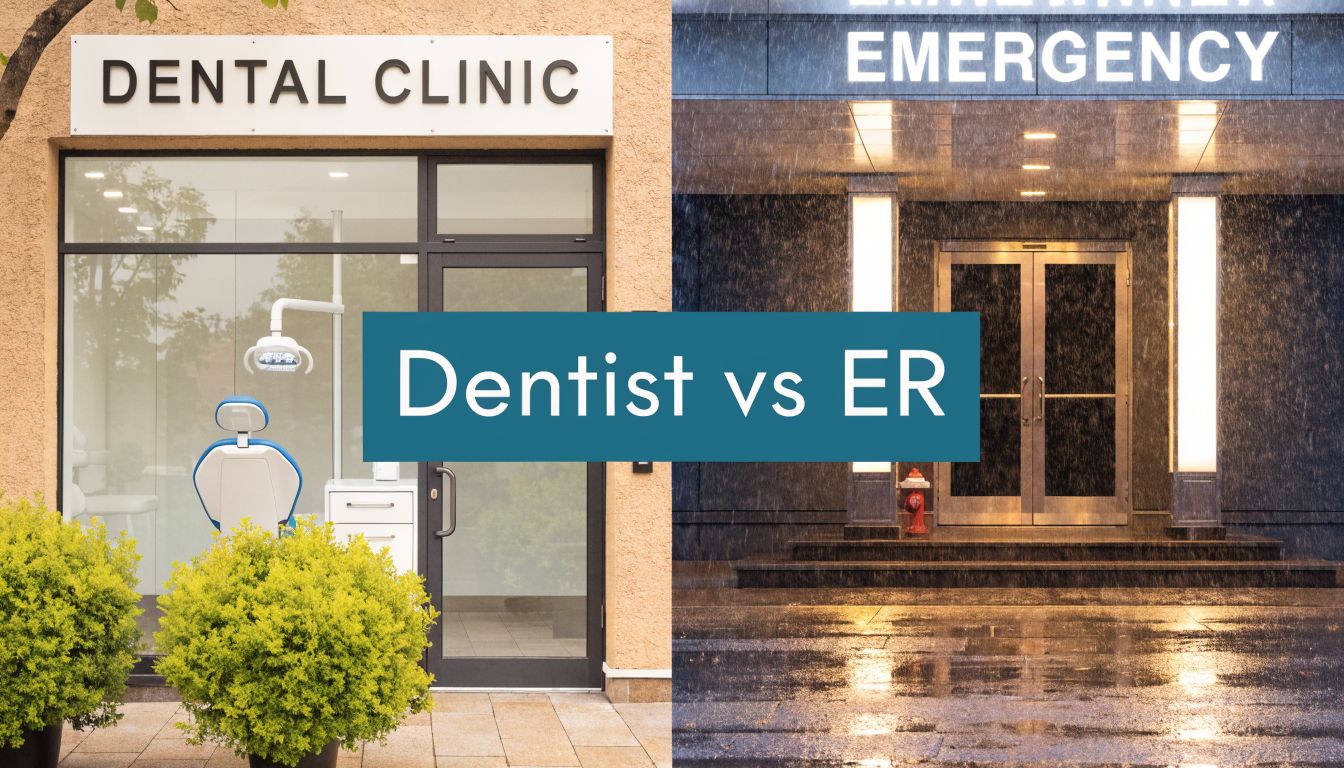
A dental abscess sits in a gray area for many families because it starts in the mouth but can become a broader medical emergency. The key question isn’t just “Does it hurt?” It’s “Does this still look localized, or does it seem to be spreading?”
That distinction matters because severe untreated infections can become dangerous. A 2025 analysis reports that severe, untreated dental infections can carry a mortality rate of up to 40% if they spread and cause systemic conditions like sepsis, and that 1 in 2,600 people in the U.S. are hospitalized for dental infections, according to this dental abscess statistics review.
Signs that usually fit a dental office visit
These symptoms generally point toward an urgent dental problem that should be seen by an emergency dentist as soon as possible:
- Localized tooth pain with gum soreness around one tooth
- Swelling limited to the gum or a small part of the cheek
- Pain with chewing
- A bad taste from drainage in the mouth
- Temperature sensitivity centered on one area
For patients wondering how dangerous spread can become, this page on blood infection from a tooth abscess explains why worsening symptoms shouldn’t be brushed aside.
Signs that mean go to the ER now
A hospital ER is the right choice if the infection may be affecting breathing, swallowing, or deeper facial spaces.
| Symptom | Better destination |
|---|---|
| Tooth pain and local gum swelling | Emergency dentist |
| Facial swelling that’s rapidly increasing | ER |
| Trouble swallowing | ER |
| Trouble breathing | ER |
| Fever with worsening swelling and feeling ill overall | ER |
| Swelling around the eye or that affects eye opening | ER |
The practical rule is simple. If the infection appears to be interfering with the airway, throat, eye area, or general physical stability, skip the dental office and go straight to the ER.
A short video can help reinforce that decision-making process:
Go to the ER now if swallowing, breathing, or facial swelling is getting worse in real time.
What to Expect During Your Emergency Abscess Treatment
The office visit should reduce uncertainty, not add to it. Most emergency abscess appointments follow a straightforward pattern: locate the source, relieve pressure, control infection, and decide how the tooth can be treated definitively.
The first part of the visit
The appointment usually starts with a focused exam and digital X-rays. Those X-rays help show whether the infection appears to be around the root, tied to deep decay, or affecting nearby supporting bone. The swollen area is also checked for tenderness, drainage, and how far the infection seems to extend.
A good emergency exam isn’t just about finding the sore tooth. It’s about deciding whether the tooth can be saved, whether drainage is needed that day, and whether any swelling suggests a larger medical risk.
How the infection is treated
If pus has collected in a way that can be accessed safely, incision and drainage may be the immediate procedure. This is the standard emergency approach because it removes the built-up purulence and reduces the pressure causing much of the pain.
The verified clinical guidance from SAEM’s abscess incision and drainage procedure overview notes that I&D provides the most dramatic immediate pain relief, and that most patients have significant symptom improvement within 48 to 72 hours when drainage is combined with antibiotics. That timing matters for anxious patients. It means relief often starts quickly, even if the area still needs a few days to settle.
Drainage treats pressure. Definitive dental care treats the reason the pressure formed in the first place.
Needle aspiration is sometimes discussed online, but it has limits. It may not fully evacuate the infected material, which is one reason direct drainage is often more dependable when the abscess anatomy allows it.
Root canal or extraction
Once the acute pain is controlled, the next decision is whether the tooth should be preserved or removed. If the tooth structure is still salvageable, root canal therapy is often the definitive treatment because it removes infected pulp tissue, disinfects the canal system, and seals the tooth to prevent re-entry of bacteria.
The verified endodontic guidance reports that root canal therapy has a success rate exceeding 90% in reducing postoperative pain from moderate-to-severe levels to mild or no pain, and that many patients feel significant relief within 24 to 48 hours, with full recovery in less than a week when healing progresses normally. That information appears in the American Association of Endodontists emergency guidance.
If a patient is preparing for that possibility, this guide on how to prepare for a root canal can make the process feel more predictable.
Extraction becomes the better option when the tooth is too damaged, too unstable, or too compromised by infection to support a long-term restoration. That’s a practical decision, not a failure. The right treatment is the one that resolves the infection safely and gives the patient a durable outcome.
Your Local Partner for Emergency and Family Dental Care
A dental abscess rarely arrives at a convenient time. In Amanda, I often hear the same concerns first. "Can I be seen today?" "Do I need the ER?" "How do I get through the next few hours safely?" Those questions matter just as much as the treatment itself, because people delay care for practical reasons, not just fear.
Local support should make those decisions clearer. Amanda Family Dental provides family and emergency dental care for patients in Amanda, Lancaster, Circleville, and Carroll, with digital X-rays, root canal treatment, extractions, flexible payment options, and a Power Plan Membership. For a patient with swelling and pain, that combination matters because the office can assess the source, explain whether the tooth can be saved, and start care without adding confusion.
Comfort matters too.
Abscess patients are often tired, sore, and anxious before they even sit down. Clear treatment planning, a calm exam, and options such as sleep dentistry can make urgent care feel manageable. Good emergency care is not only about removing infection. It is also about helping a patient stay steady enough to get the right treatment done safely.
For practices trying to make urgent dental care easier to find online, Transactional.net on AI SEO providers offers a useful look at how service businesses improve visibility so patients can locate help faster when time matters.
After the immediate problem is under control, the focus shifts to preventing the next crisis. Routine cleaning and exams, new patient exams, dental X-rays, and early restorative treatment often catch the cracked filling, deep cavity, or failing tooth before it turns into swelling and lost sleep. Some patients will need follow-up care such as a crown or replacement planning after an extraction. Others only need consistent family dental care and a clear maintenance plan.
The practical goal is straightforward. Get through the waiting period safely, know when symptoms have crossed into an ER problem, and then get definitive dental treatment as soon as possible.
If tooth pain, gum swelling, or facial pressure suggests an abscess, contact Amanda Family Dental to request care. Patients in Amanda, OH, Lancaster, OH, Circleville, OH, and Carroll, OH can reach out for guidance on the next step, whether that means urgent dental treatment, follow-up restorative care, or help deciding if symptoms require the hospital ER.