

If a temporary crown is loose or has fallen out, never forcefully pull or pry it off yourself, because doing so can permanently damage the prepared tooth. Keep the crown safe if it has detached, protect the exposed tooth, and contact a dentist for professional guidance.
A temporary crown can feel alarming when it wiggles during a meal, catches on floss, or suddenly lands in the mouth. The safest response is calm triage, not an internet removal hack. Patients in Amanda, Lancaster, Circleville, and Carroll, Ohio, can contact a local dental office for advice about whether the crown needs urgent attention, replacement, or removal as part of planned restorative care.
Amanda Family Dental provides complete dental care, including cleaning and exams, dental X-rays, restorative dentistry, crowns, root canals, cosmetic dentistry, and dental implants. Whether someone is searching for a dentist near me, an emergency dentist, or dental implants near me, the immediate priority is protecting the tooth beneath the temporary restoration.
Table of Contents
- Assessing Your Temporary Crown Safely
- Why Professional Removal Protects Your Tooth
- Immediate Steps When a Crown Falls Out
- Dangerous DIY Removal Mistakes to Avoid
- What to Expect During Your Dental Visit
- Scheduling Emergency Care in Fairfield County
Assessing Your Temporary Crown Safely
A temporary crown that feels loose doesn't always need to be pulled off. It may be partly attached, completely detached, fractured, or moving because the underlying tooth or the restoration has changed. Those situations look similar to a patient but can require different treatment.
Start with a gentle check
First, stop chewing on that side and avoid repeatedly touching the crown with the tongue or fingers. If the crown is still sitting over the tooth, don't twist it, rock it, pull upward, or insert a fingernail, toothpick, tweezers, or another object beneath its edge.
Look for the following without applying force:
- Fully detached crown: Retrieve it carefully and place it in a clean container.
- Partially attached crown: Leave it in place and call the dental office.
- Sharp or fractured edge: Avoid biting on it and report the change promptly.
- Exposed prepared tooth: Expect possible sensitivity to air, pressure, or temperature and arrange professional care.
- Severe symptoms: Severe pain, swelling, bleeding, or an inability to bite normally warrants urgent contact.
A temporary crown is intentionally retained with weaker cement so a dentist can remove it during the planned treatment. That doesn't make home removal safe. The Academy of General Dentistry patient education material/gendent_so17_bajunaid.pdf?sfvrsn=2) explains that forceful pulling, twisting, or tool use can harm the prepared tooth, gums, or restoration.
Practical rule: If any part of the crown is still attached, the patient shouldn't try to finish the removal at home.
Patients who need a dentist in Amanda, OH, or who are traveling from Lancaster, Circleville, or Carroll should call before attempting to re-cement or remove the crown. A brief phone assessment can help determine whether the issue is routine, urgent, or appropriate for emergency dental services.
Why Professional Removal Protects Your Tooth
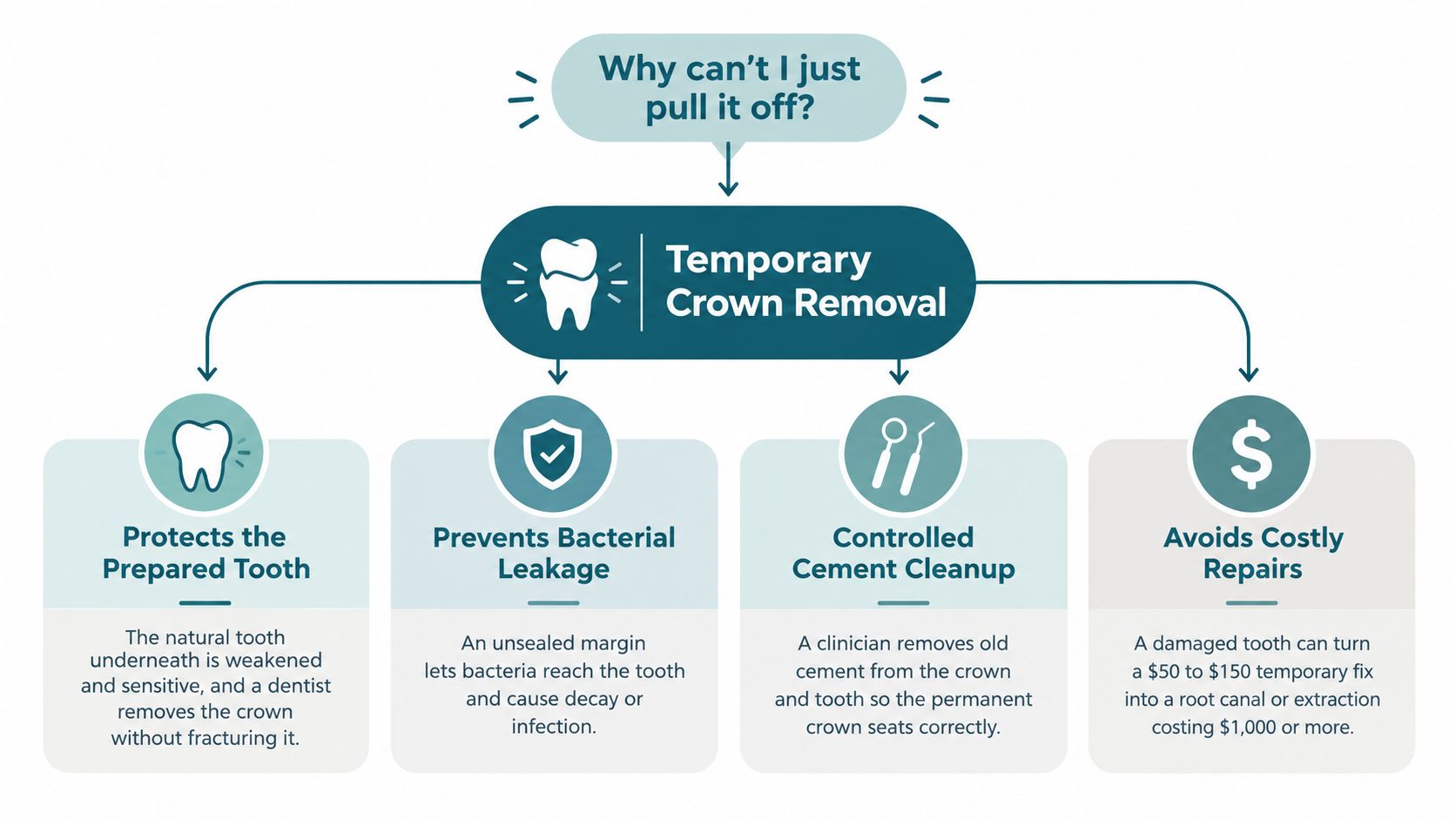
“Temporary” describes the restoration's role in the treatment plan, not the absence of risk. A provisional crown covers a tooth that has already been shaped, and that tooth may have less protective structure than it had before preparation. Removing the crown requires a force direction and technique that protect both the prepared surface and the restoration.
Removal force isn't predictable
The force required to remove a temporary crown changes with cement chemistry, crown material, preparation geometry, and time in service. Laboratory testing of provisional crowns after seven days measured mean removal forces of 44.5 N for Temp-Bond, 51.6 N for Freegenol, and 35.9 N after Duraphat varnish treatment. The study found no statistically significant difference among those three mean values, while combinations of varnish and cement changed retention in opposite directions, including a reported 69–145% increase for Duraphat with Temp-Bond. These findings come from the indexed in-vitro study, not from a home-removal setting.
A patient can't reliably judge that force by how loose the crown feels. Excessive rocking can fracture a ceramic margin, dislodge core material, or injure the remaining tooth. If resistance is high, repeated levering can turn a temporary inconvenience into a damaged preparation that needs further restorative treatment.
Controlled force protects the final crown
A dentist assesses occlusion, crown mobility, marginal integrity, symptoms, and the likelihood that the crown is held by bonded or highly retentive cement. The clinician also protects the airway and isolates the field before selecting an approach.
The key difference is control. A dentist may use crown-removal forceps or another method that applies axial traction rather than uncontrolled sideways force. If the provisional won't release safely, sectioning or a specialized technique may be more appropriate than repeated attempts to lift it.
A temporary crown that feels stuck shouldn't be treated like a loose piece of jewelry. The prepared tooth, gingiva, core, and future final-crown fit all matter.
Immediate Steps When a Crown Falls Out
A crown that has completely detached is different from one that remains partly connected. Once it is out, the patient can protect the area while arranging care, but the crown and the exposed tooth still need professional assessment.
A simple protective sequence
- Find the crown. Handle it by the outside and place it in a clean, protective container.
- Rinse the crown gently. Use water only. Don't scrub it aggressively or apply household chemicals.
- Protect the tooth. Avoid chewing on that side, especially hard, sticky, very hot, or very cold foods.
- Clean gently. Brush nearby teeth and gums carefully. Don't aggressively scrub the prepared tooth.
- Contact the dental office. Explain whether the crown is intact, whether the tooth is sensitive, and whether there is pain or swelling.
- Don't use household adhesive. Superglue and similar products can damage tissue, complicate removal, and make proper treatment harder.
An over-the-counter temporary dental cement product or denture adhesive may sometimes be discussed with a dental professional as a very short-term protective measure, but it shouldn't be used to force a crown into place or substitute for an appointment. Incorrect seating can interfere with the permanent crown, trap material near the gum, or change the bite.
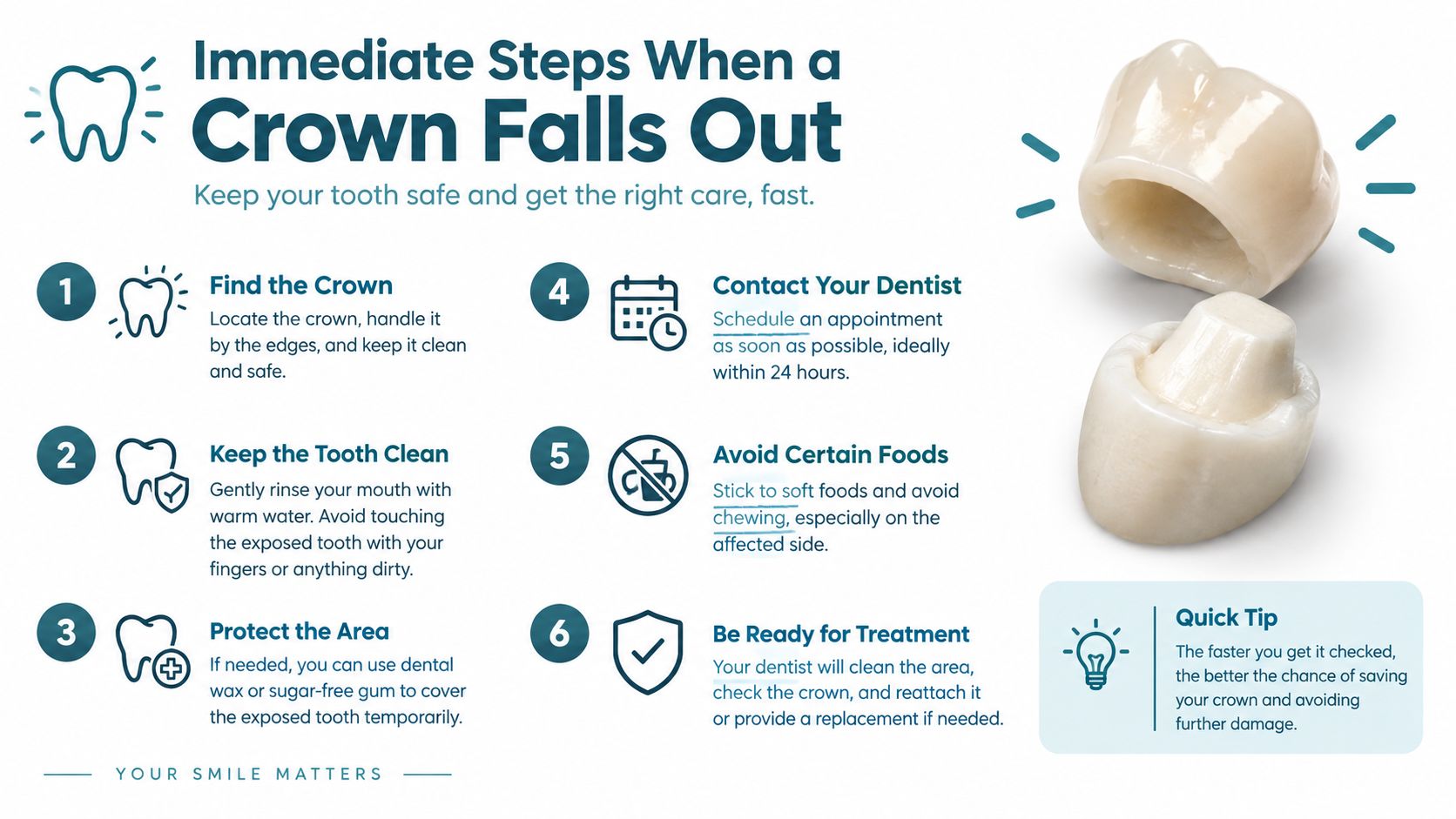
The guidance for a temporary crown that has fallen off reinforces the importance of reporting a loose, fractured, sharply edged, or uncomfortable crown rather than ignoring it. Exposure can contribute to sensitivity, movement, irritation, or contamination, as described in the British Dental Journal review.
If the exposed tooth causes severe pain, swelling, bleeding, or a sharp edge prevents normal biting, the patient shouldn't wait for the originally scheduled crown appointment. Those symptoms justify prompt dental advice.
Dangerous DIY Removal Mistakes to Avoid
Online suggestions often make removing a temporary crown sound like a household repair. Pliers, nail tools, metal picks, and improvised pressure are particularly risky because the patient can't see the preparation clearly or control the direction of force.
A metal instrument placed between the crown margin and tooth can act like a wedge. That pressure may damage the preparation or alter the shape needed for the final crown. Dentists avoid this approach and use controlled axial traction to reduce slippage and tissue injury, as described in the published crown-removal technique.

What not to try
- Pliers or household tools: These can crush the crown, slip into the gum, or fracture the remaining tooth.
- Metal prying: Levering at the margin can damage the preparation and affect the final-crown fit.
- Cutting at home: A patient may cut the tooth, gum, or core instead of the temporary material.
- Forceful twisting: Rotation can transfer stress to a weakened tooth or dislodge supporting material.
- Ignoring a hanging crown: A partly detached restoration can trap food and irritate the gum while remaining difficult to remove safely.
- Superglue: Household adhesive isn't dental cement and can create a more complicated clinical problem.
Saving a short trip or avoiding a dental call isn't worth risking the tooth underneath. If the crown won't come off easily, the correct next step is professional guidance from an emergency dentist or restorative dental office.
What to Expect During Your Dental Visit
A scheduled crown appointment and an urgent visit may begin similarly. The dental team first asks what happened, checks the crown and tooth, and considers whether the restoration is loose, fractured, contaminated, or still attached.
Removal is controlled, not improvised
The dentist may assess the bite and crown margins before applying carefully directed force. Crown-removal forceps, specialized traction, ultrasonic energy, resin devices, or other clinical methods may be considered according to the restoration and the tooth. A published technique describes a rubber-dam retainer clamp positioned near the crown margins with Steiglitz forceps to remove loosened provisional or full-cast crowns while reducing uncontrolled slippage.
After the crown is removed, the clinician eliminates residual cement with an explorer and water-pumice cleaning. The preparation is then inspected for cracks, caries, exposed pulp, soft-tissue trauma, and adequate clearance before recementation or definitive cementation.
That cleaning step matters. Residual temporary cement can interfere with seating, margins, contacts, or bonding of the final restoration. Patients can review the broader sequence in Amanda Family Dental's dental crown procedure steps.
The plan may change after inspection
A replacement temporary crown may be needed if the original is fractured, distorted, or no longer fits. The dentist may also need to address sensitivity, inflamed gum tissue, a changed bite, or an unexpected problem in the prepared tooth before proceeding.
A 2025 clinical study of long-term temporary restorations reported fracture in 14.1% and decementation in 18.1% over a median observation period of 362 days, with decementation significantly more likely for temporarily or self-adhesively luted restorations than for adhesively luted restorations. Those findings don't represent ordinary short-term temporary crowns, but they demonstrate why inspection, cement removal, and fit confirmation remain important. The findings are reported in the 2025 clinical study of temporary restorations.
Scheduling Emergency Care in Fairfield County
Most loose temporary crowns need a dental conversation, not panic. A crown that has fallen out completely should be saved and reported, while a partially attached crown should remain undisturbed until a clinician advises otherwise.
Same-day attention becomes more important when there is severe pain, swelling, bleeding, a sharp exposed tooth, or an inability to bite normally. A dental office can determine whether the patient needs temporary protection, a replacement provisional, treatment for the tooth itself, or a scheduled visit for final crown placement.
Amanda Family Dental serves families seeking a dentist in Amanda, OH, as well as patients traveling from Lancaster, Circleville, and Carroll, Ohio. The practice offers new patient exams, digital X-rays, personalized treatment plans, restorative care, cosmetic dentistry, dental implants, tooth extraction, and emergency dental services. Patients can review the emergency dentist services and contact the office for guidance rather than attempting removal with tools at home.
Amanda Family Dental can assess a loose or missing temporary crown, clean and inspect the prepared tooth, and plan the next restorative step with comfort in mind. Patients in Amanda, Lancaster, Circleville, and Carroll can visit Amanda Family Dental to request a consultation or schedule an appointment.