

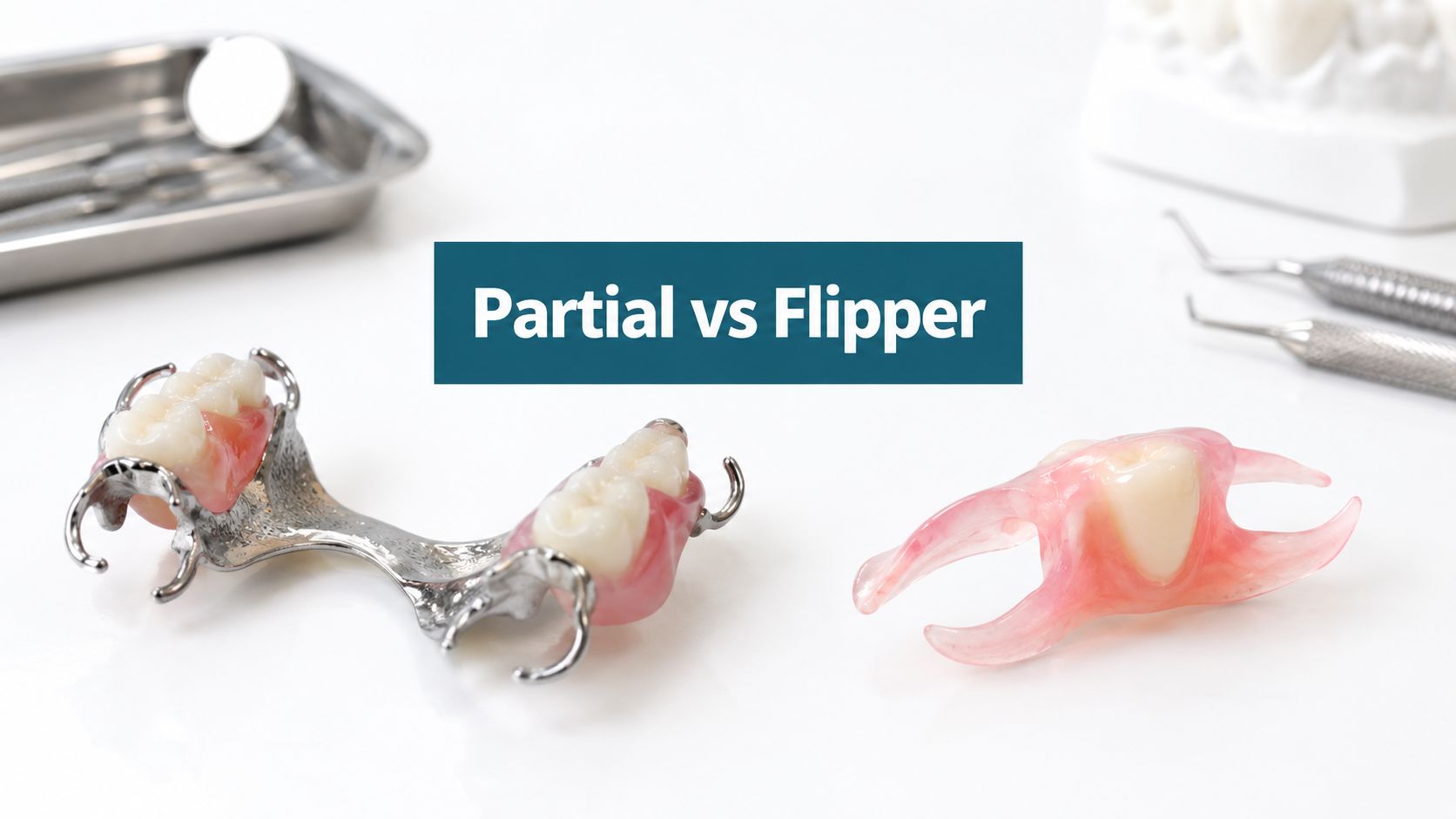
You're staring at a visible gap, a calendar full of plans, and a decision that needs to be made fast. Maybe the tooth came out in an accident, maybe it was extracted, or maybe you've already been told that a more permanent fix like dental implants will have to wait. For patients looking for a dentist near me in Amanda, OH, Lancaster, OH, Circleville, OH, or Carroll, OH, the key question isn't just what fills the space today, it's what makes sense for the next several months, or the next several years.
A partial denture vs flipper conversation should be blunt. A flipper is built for speed and appearance, a partial denture is built for steadier daily function. One is a bridge to the next step, the other is often the step you stay with.
| Criterion | Flipper (Acrylic Interim) | Partial Denture (Cast Framework) |
|---|---|---|
| Stability while eating | Light, can move more during chewing | More stable and secure |
| Speech comfort | Usually good for short-term wear, but can feel loose | Typically better once adjusted |
| Durability in months | Temporary, not meant for long haul | Designed for ongoing use |
| Aesthetic match to natural teeth | Good for quick cosmetic coverage | Usually more consistent and refined |
| Upfront cost range | Lower initial cost | Higher initial cost |
| Daily maintenance effort | Simple, but delicate | More involved, but predictable |
| Ease of repair | Easier in some cases, but wear happens faster | Repair depends on framework and damage |
| Typical wear timeline | Short-term interim use | Long-term daily wear |
Table of Contents
- When a Missing Tooth Meets a Real Decision
- What a Flipper and a Partial Denture Actually Are
- Comparing Flipper and Partial Denture Side by Side
- Longevity, Upkeep, and the Real Cost Picture
- Matching the Right Option to Your Situation
- When a Flipper Is the Right Call and When It Is Not
- What to Expect at Your Local Family Dental Visit
When a Missing Tooth Meets a Real Decision
A 42-year-old calls Monday morning after getting hit in the mouth during basketball. The front tooth is gone, the gap is obvious, and there's a wedding in six weeks. That's not a theoretical case, that's the kind of decision a family dentist has to solve quickly, and the answer is rarely “just pick the cheapest option.”
A flipper makes sense in that kind of moment because it restores the smile fast and gives the patient time to get through the event. A cast partial makes more sense when the goal is to wear something every day without constantly worrying about movement or fragility. The right choice depends on timing, anatomy, and how much upkeep the patient can realistically manage, not on cost alone.
What a dentist is actually weighing
The first question is whether the tooth replacement needs to be temporary or durable. If the gum tissue still has to heal, or if an implant or bridge is still being planned, a flipper often fills the gap cleanly while the next step is sorted out. If the mouth needs an appliance that can handle routine chewing and repeated wear, a partial denture moves ahead.
The second question is how many teeth are involved and where they're missing. A visible front gap and a back-tooth chewing problem are not the same clinical problem. That distinction matters because a flipper can hide a gap quickly, but it isn't built to solve every situation.
Practical rule: If the plan is “hold the space for now,” a flipper fits. If the plan is “live with this every day,” a real partial deserves serious attention.
For patients in Amanda and nearby communities, this is the kind of decision that gets discussed during a new patient exam or after a tooth extraction when the next step needs to be clear. The rest of this guide breaks down what each appliance is, how they compare, and what the local appointment process looks like when you're trying to make a smart decision, not a rushed one.
What a Flipper and a Partial Denture Actually Are
A flipper is a temporary removable appliance made from lightweight acrylic. It usually replaces one to three missing teeth and sits lightly on the gums, so it's fast to make and easy to wear while the area heals or while a more durable solution is planned. In plain terms, it's a cosmetic and functional placeholder, not a long-term workhorse. Aspen Dental's overview of dental flippers
A partial denture is built for more structured use. Conventional partials usually rely on a metal or acrylic framework and are designed to stay in place more securely, especially when several teeth are missing or when the goal is daily use over time. They're not just there to cover a gap, they're there to restore function in a way that can hold up.
How they sit and why that matters
A flipper rests more loosely and often uses a small wire clasp or gum contour for retention. That loose, temporary feel is part of the trade-off, it lets the appliance be made quickly, but it also means it won't feel as locked in during chewing or speaking. A partial denture is shaped more deliberately around the mouth and usually offers a steadier fit after adjustment.
The difference shows up in the chair and in daily life. Patients often like the lighter feel of a flipper at first, especially when the main concern is hiding a front gap. Patients who need to chew with confidence usually do better with a partial because the framework is built to handle repetitive use.
When each one is normally used
A flipper is commonly used after extraction, during healing, or while a patient is waiting on a more permanent plan like implant treatment. A partial denture is the better fit when multiple adjacent teeth are missing or when the patient wants a more durable removable appliance. For patients comparing restorative dentistry options in Lancaster or Circleville, that distinction usually decides the conversation before cost even enters it.
Comparing Flipper and Partial Denture Side by Side
The simplest mistake is comparing only the sticker price. A flipper can look attractive because it's fast and lighter on the budget, but that only tells part of the story. A partial denture usually asks for more upfront planning, and that extra step buys better daily performance.
| Criterion | Flipper (Acrylic Interim) | Partial Denture (Cast Framework) |
|---|---|---|
| Stability while eating | Acceptable for light use, but can flex | Better for routine meals and broader use |
| Speech comfort | Often fine for short-term wear | Usually more consistent once adjusted |
| Durability in months | Short-term appliance | Built for longer wear |
| Aesthetic match to natural teeth | Good for quick cosmetic coverage | More consistent, especially for daily use |
| Upfront cost range | Lower | Higher |
| Daily maintenance effort | Simple, but delicate handling matters | More structured cleaning routine |
| Ease of repair | Can be quicker to replace in some cases | Repairs depend on framework and damage |
| Typical wear timeline | Interim use | Ongoing daily wear |
A flipper can be the right answer when the goal is to look normal at an event or through a healing phase. It's not the appliance to choose if someone expects to eat a normal dinner without thinking about the prosthesis. That's where patients get frustrated, because the fit that works in a mirror doesn't always hold up at the table.
A partial denture takes more commitment, and it usually earns that commitment. The framework gives it better stability, which matters for chewing and for keeping the appliance from feeling like a loose placeholder. That's why a cast partial is often the smarter option for patients who plan to wear something every day.
Acrylic is fast, framework is steadier. That's the trade-off in one sentence.
For patients who are also considering cleaning and exams, dental x-rays, or longer-range restorative dentistry, the partial often fits into a bigger plan instead of standing alone. The next question is whether the lower upfront cost of a flipper stays lower once replacement and upkeep are counted.
Longevity, Upkeep, and the Real Cost Picture
The true cost question isn't “which one is cheaper today.” It's “which one stays usable long enough to justify the money spent on it.” A flipper is the faster, less expensive entry point, but it's also the one most likely to need replacement sooner because it's thinner and more temporary by design. An acrylic or cast partial takes more planning up front, but it usually pays off in fewer do-overs.
Satisfaction matters here too. A systematic review of 35 studies found RPD satisfaction rates ranging from 50% to 81%, and outcomes were influenced by prior denture experience, age, gender, number and location of missing teeth, and design type. That's a wide spread, and it tells the truth patients don't always hear, fit and maintenance matter just as much as appearance. Systematic review on removable partial denture satisfaction
Maintenance changes the value equation
Flippers need careful handling. They're thin, they're temporary, and they don't tolerate rough use well. They're also not the appliance to ignore in a bathroom drawer, because once they're worn inconsistently or cleaned poorly, odor and wear show up fast.
Partials demand more structure, but they also reward it. Brushing after meals, soaking overnight when appropriate, and showing up for adjustment visits helps the appliance stay functional longer. A well-maintained removable prosthesis can be far more satisfying than a neglected one, which is why maintenance is part of the cost, not an optional extra.
The cheapest appliance on paper can become the more expensive one if it has to be remade more than once.
For readers looking into a full pricing picture, the office's missing tooth replacement cost page is a useful starting point. The key point is simple: sticker price matters less once you factor in replacement risk, upkeep, and how often you'll wear the appliance.
| Factor | Flipper | Partial Denture |
|---|---|---|
| Upfront fee | Lower | Higher |
| Replacement risk | Higher over time | Lower when well maintained |
| Ongoing care | Light but delicate | More structured and durable |
| Total value over time | Better for short-term use | Better for longer wear |
Matching the Right Option to Your Situation
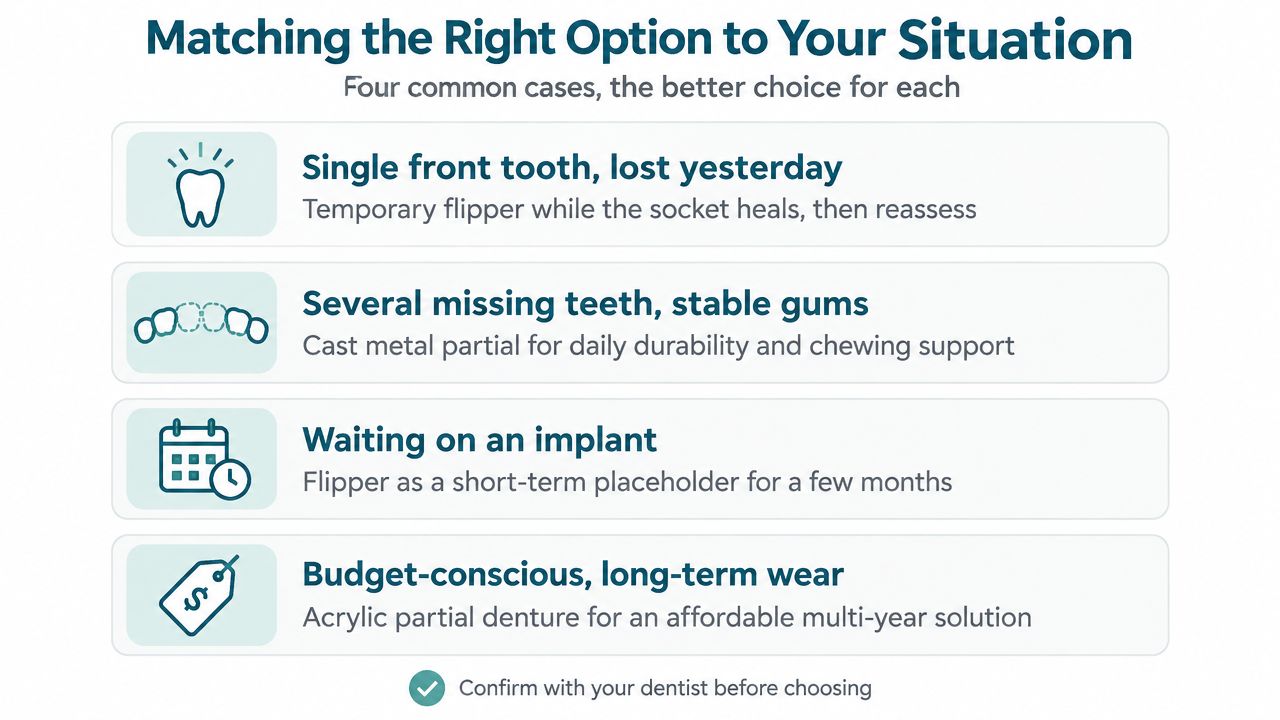
A single front tooth lost the day before a meeting or wedding usually points to a flipper. The reason is simple, appearance and speed matter most in that window, and the gums may still need time before any more permanent work is finalized. A temporary flipper can get the patient through the event without committing to a larger restoration too soon.
Multiple missing back teeth with stable neighboring teeth point in the other direction. That's where a partial denture often becomes the clearer long-term answer because chewing load, stability, and everyday wear all matter more than a quick cosmetic fix. A flipper can hide a gap, but it won't make back-tooth function feel normal for long.
Four common scenarios that change the recommendation
- Single front tooth, lost yesterday: A flipper is the practical short-term choice while the socket heals and the next plan is discussed.
- Several missing teeth, stable gums: A cast partial usually gives better daily durability and chewing support.
- Waiting on an implant: A flipper works as a short-term placeholder while the site is healing or treatment is staged.
- Budget-conscious and needs something today: An acrylic partial can make sense if the patient understands the appliance is interim, not forever.
The deciding factors stay the same: gum healing status, number of missing teeth, bone support, opposing teeth, and the patient's actual timeline. If the mouth is still changing, a temporary solution may be smarter. If the mouth is stable and the goal is daily function, the more structured appliance is usually the better call.
For patients who also need help with dental implants near me planning or emergency dental services, the treatment path should be chosen around the healing timeline first, not around convenience alone. The internal planning conversation for dentures and implants is available here: dentures and implants.
When a Flipper Is the Right Call and When It Is Not
A flipper is the right call when the patient needs a temporary bridge to the next step. That includes short windows before a wedding, a work presentation, an implant workup, or the healing period after extraction. It also makes sense when the patient can't tolerate a more involved prosthesis right away, either medically or practically.
A flipper is the wrong call when someone expects it to carry years of daily wear. That's where the material and design start working against the patient, because acrylic fatigue, loosening, and repeated repairs become part of the story. It also falls short when multiple chewing teeth are missing or when the gum condition calls for a more stable, cleaner framework.
A simple two-question test
- Is this appliance a stopgap while something more durable heals or gets planned?
- Or is this expected to be the answer for years?
If the honest answer is the second one, a partial denture should move up the list. If the answer is the first one, a flipper can do its job without pretending to be something it isn't.
The mistake patients make is stretching a temporary appliance beyond its purpose. Once that happens, the flipper stops being a convenience and starts becoming a source of frustration. That's why a clear timeline matters more than wishful thinking.
What to Expect at Your Local Family Dental Visit
At a local visit, the dentist first checks the healing site, the remaining teeth, and the bite. In Amanda and Lancaster area appointments, that usually starts with an exam and diagnostic imaging, then impressions or scans if a flipper or partial is being considered. For a clear overview of how a dental evaluation is handled, see what does a dental exam include.
A flipper can often be placed faster, while a custom partial usually takes more steps, including a fitting visit and follow-up adjustment. Insurance verification is part of the process too, because patients deserve to know what's covered before they commit. If the office needs to coordinate next steps quickly, resources like dental practice phone coverage 2026 can help practices stay responsive when patients call with urgent concerns.
For patients in Amanda, OH, Lancaster, OH, Circleville, OH, and Carroll, OH, the right next move is a consultation that looks at the mouth first and the appliance second. That's how a practical recommendation gets made, and that's what keeps a short-term fix from becoming a long-term mistake.
Amanda Family Dental helps patients compare partial dentures vs flipper options with a straightforward exam, clear guidance, and a treatment plan that fits the healing timeline and daily use. If you're dealing with a missing tooth, a recent extraction, or a gap that needs attention now, visit Amanda Family Dental to request a consultation and get a recommendation that makes sense for your smile.