

A lot of people don't search for dental care with a polished phrase. They type what's fastest. Sometimes that's “dentist near me.” Sometimes it's “emergency dentist.” And sometimes it's “oh.”
That tiny search can mean two things at once. It can mean Ohio, especially when someone in Amanda, Lancaster, Circleville, or Carroll is trying to find care close to home. It can also sound like the first reaction to a cracked tooth, sudden swelling, a lost filling, or a smile concern that's been put off too long. Either way, the need behind the search is real. People want care that's nearby, clear, and dependable.
For families in central Ohio, that search often leads to the same practical question. Who can handle routine visits, kids' care, cosmetic concerns, restorative treatment, and urgent problems without sending patients all over the region?
Table of Contents
- The OH Search What It Means for Your Dental Health
- Why a Local Dentist in Central Ohio is Your Best Choice
- Comprehensive Dental Care for Your Entire Family
- Restoring and Enhancing Your Smile with Advanced Dentistry
- A Patient Experience Designed for Your Comfort
- Schedule Your Visit at Amanda Family Dental Today
The OH Search What It Means for Your Dental Health
Typing “oh” into a phone search bar may look vague, but the intent usually isn't. In local healthcare searches, it often means a person wants help in Ohio, and they want it without scrolling through pages of broad directory listings.
A common example is someone dealing with pain late in the day and searching “emergency dentist OH” or “dentist in Amanda, OH.” That kind of search isn't casual. It usually happens when chewing hurts, a crown feels loose, or a child wakes up complaining about a tooth.

Why local search accuracy matters
Rural access shapes what patients can realistically do next. Recent dental access studies from 2025 to 2026 report that rural Ohio counties face 25 to 30% higher rates of untreated dental disease due to provider shortages, and only 45% of Fairfield County residents are within 30 minutes of a full-service family practice (underserved dental access context). That matters because a search result isn't useful if it sends a patient to a provider too far away or one that doesn't offer the needed service.
Practical rule: The best search result is the one that matches the actual problem, the location, and the kind of patient who needs care today.
A parent searching from Carroll may need pediatric care. An adult in Lancaster may need tooth extraction or a crown. Someone in Circleville may be comparing cosmetic dentist options while also hoping the office can handle future restorative work. Broad state-level results don't solve those decisions very well.
Patients also benefit from clear educational content that connects oral health to daily wellness, including resources like this overview of oral health and overall wellness. Strong local communication matters too, which is one reason healthcare practices often pay attention to how patients find and evaluate online information through resources such as Helbling Digital Media dental solutions.
What works and what doesn't
Here's what usually works when searching for dental help in central Ohio:
- Specific location terms: Search for a dentist in Amanda, OH, Lancaster, OH, Circleville, OH, or Carroll, OH.
- Problem based phrases: Terms like emergency dentist, tooth extraction, dental implants near me, or cosmetic dentist near me narrow the results.
- Full service intent: A family often needs one office that can handle both preventive and more advanced care.
What usually doesn't work is searching too broadly, then trying to sort through offices that don't fit the need, the age group, or the urgency.
Why a Local Dentist in Central Ohio is Your Best Choice
A local dentist does more than shorten the drive. Local care tends to work better because it fits how families use dental services. Parents juggle school schedules. Older adults may need easier access and simpler follow-up. Working adults want one place that can manage cleanings, repairs, and cosmetic concerns without unnecessary handoffs.
That matters in Ohio, where community needs span generations. About 19.1% of Ohio residents are age 65 and older, which is above the national average of 18% according to Ohio population data from USAFacts. A community with more older adults needs dental care that's practical, accessible, and family-oriented, not built around one narrow service line.
Local care supports better decisions
Choosing a nearby practice often leads to better continuity. A team that sees children, parents, and grandparents in the same community can catch changes earlier and keep treatment plans simpler. That's especially important when a patient moves from routine cleanings to fillings, crowns, dentures, or discussions about replacing a missing tooth.
A local office also understands the difference between a problem that can wait a week and one that shouldn't. That kind of judgment is hard to get from a generic listing.
Nearby care is more than convenience. It makes follow-up easier, reduces missed visits, and keeps treatment from stalling halfway through.
What patients should look for
Not every nearby office is the right fit. Patients in Amanda, Lancaster, Circleville, and Carroll should look for a few practical signs:
| What to check | Why it matters |
|---|---|
| Full family services | Reduces the need to split care across multiple offices |
| Preventive and restorative options | Helps the office manage routine care and complex needs |
| Comfort focused approach | Makes it easier for anxious patients to stay on schedule |
| Clear treatment planning | Avoids confusion about next steps |
For practices, trust is built through clear communication, patient retention, and local reputation. Industry resources such as Netco Design LLC's guide to dental practice growth highlight how visibility and patient experience work together, but from the patient side, the actual test is simpler. Can the office provide dependable care close to home, and can it do that consistently?
In central Ohio, that local connection still matters. It often makes the difference between putting care off and getting it handled.
Comprehensive Dental Care for Your Entire Family
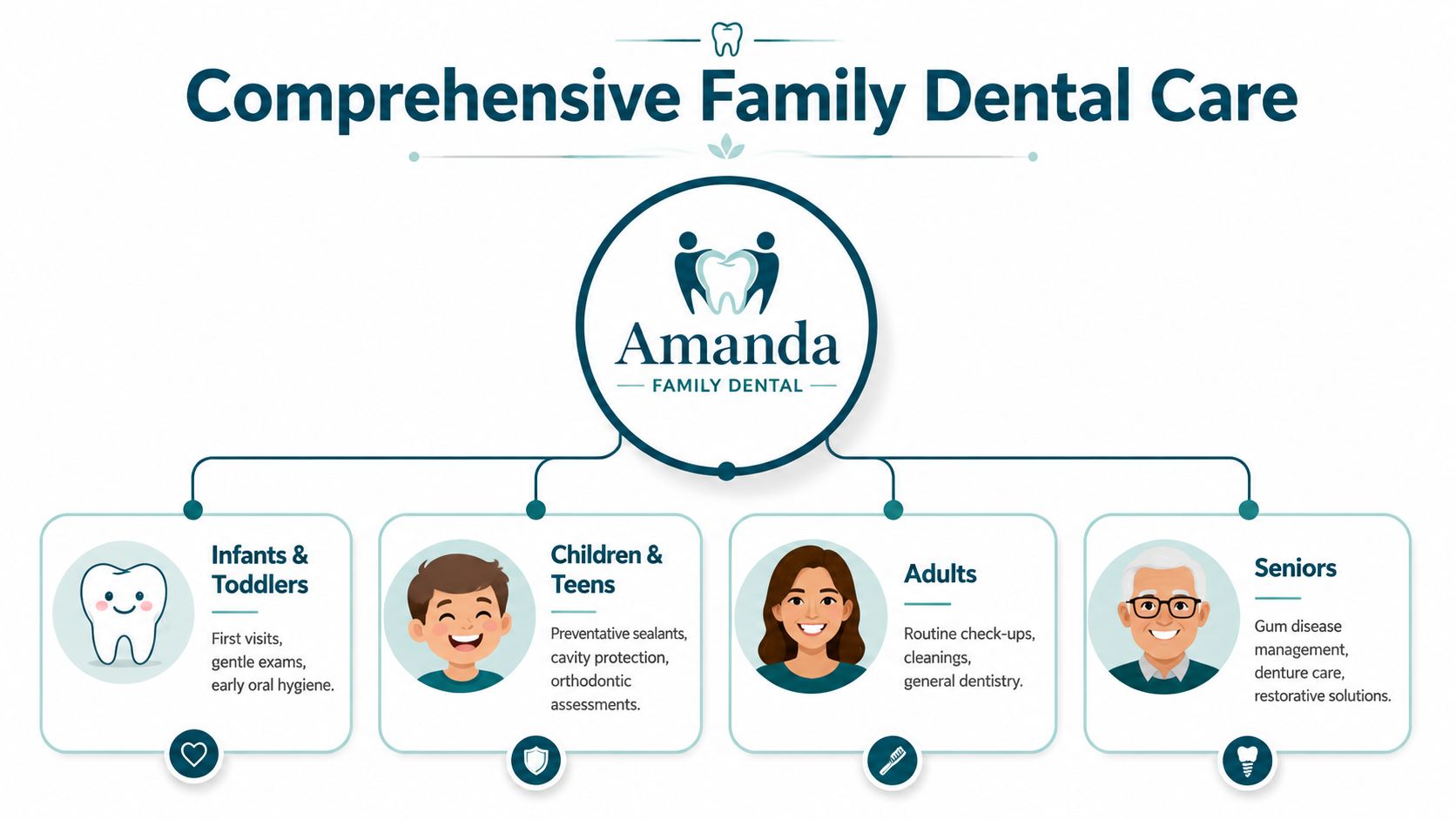
Families rarely need just one kind of dental service. A child may need a first exam, a teen may need guidance on bite or alignment, a parent may want whitening, and a grandparent may need restorative support. The most useful dental office is one that can handle those needs under one roof.
That starts with the basics. Preventive care includes cleaning and exams, new patient exams, and dental X-rays that help spot problems before they become painful or expensive to fix. Digital imaging is especially useful because it helps the dentist evaluate teeth, bone, and existing dental work with better clarity than a visual exam alone.
Preventive care keeps small issues small
Routine care works best when it stays routine. A missed exam can turn a simple cavity into a larger repair. A small crack can become a toothache. Gum irritation can progress if no one checks it.
A strong family dental plan usually includes:
- Regular exams: These visits help identify decay, gum concerns, worn restorations, and bite issues early.
- Professional cleanings: Home brushing matters, but cleanings remove buildup that daily care can miss.
- Dental X-rays: Digital X-rays help detect issues between teeth or below the surface.
- New patient visits: These appointments establish a baseline and help create a realistic care plan.
Parents often want to know whether a practice is good with children. That's a fair question. Pediatric dental visits should feel calm, gentle, and age-appropriate. Children benefit when the team explains what's happening in simple language and focuses on consistency rather than fear.
One office for different life stages
Family dentistry is practical because needs change over time. The office should be able to support:
- Young children who are learning brushing habits and getting comfortable with dental visits
- Teens who may need monitoring for crowding, oral hygiene support, or cosmetic guidance
- Adults balancing maintenance with repairs, whitening, or smile improvements
- Older adults managing wear, gum health, missing teeth, or denture care
The best family dental care isn't complicated. It's organized, preventive, and easy to continue year after year.
Patients who want a clearer picture of what all-ages care includes can review family-friendly dental services. That kind of care model helps reduce fragmentation and makes scheduling more manageable for households with different needs.
For many people searching “dentist near me” or “dentist in Amanda, OH,” that's the primary goal. Not just a cleaning. A dependable dental home.
Restoring and Enhancing Your Smile with Advanced Dentistry
When a tooth is damaged, missing, discolored, or out of position, routine preventive care isn't enough on its own. That's where advanced dentistry matters. Restorative treatment helps rebuild function and comfort. Cosmetic treatment improves appearance, and in many cases it also supports confidence in daily life.
Patients often assume these categories are separate. They overlap more than people expect. A crown can protect a weakened tooth and improve how it looks. Invisalign can straighten teeth in a more discreet way while making oral hygiene easier in some cases.
When restorative care makes sense
Restorative dentistry is usually the right path when a tooth is compromised by decay, fracture, infection, or loss. Treatment depends on what can still be saved and what can't.
Common options include:
- Composite fillings for smaller areas of decay
- Crowns when a tooth needs more complete coverage and support
- Root canal treatment when the inside of the tooth is infected or inflamed
- Tooth extraction when the tooth can't be predictably restored
- Dentures or dental implants when a tooth is missing
Dental implants are often the strongest long-term option for replacing a missing tooth because they're anchored in the jawbone. Implants achieve osseointegration over a 2 to 6 month period, which is the time when the implant fuses with the bone, according to this implant overview on osseointegration and design. That healing period is important. Faster isn't always better with implants. Rushing the process can work against long-term stability.
A missing tooth isn't only a cosmetic problem. It can affect chewing, speech, spacing, and the way nearby teeth carry force.
A short overview can help patients understand the implant process before a consultation:
When cosmetic care is the better fit
Cosmetic dentistry is appropriate when the main concern is how the smile looks rather than pain or structural damage. The best treatment depends on the cause of the concern.
| Concern | Often considered treatment |
|---|---|
| Staining or dull color | Professional teeth whitening |
| Chips, shape concerns, small gaps | Veneers or bonding |
| Mild to moderate alignment concerns | Invisalign clear aligners |
| Smile framing and facial esthetics | Botox or Juvéderm in the right setting |
The trade-off is straightforward. Cosmetic treatment works best when the teeth and gums are already healthy. Whitening won't fix decay. Veneers won't solve active gum disease. Invisalign needs a realistic commitment to wearing aligners as directed.
Patients searching for a cosmetic dentist near me or dental implants near me usually do best when they choose an office that can evaluate both appearance and function together. That leads to treatment plans that last and don't create new problems just to improve the surface.
A Patient Experience Designed for Your Comfort
For many patients, the word “oh” sounds less like a state abbreviation and more like a reaction. Oh no, not the dentist. That feeling is common, and it keeps a lot of people from scheduling even when they know they should.
A 2026 ADA survey notes that 28% of Ohio adults avoid dental care due to anxiety, with the rate highest in rural areas. Patient testimonials also show that holistic and comfort-focused approaches can reduce these moments of fear by up to 40% (Ohio dental anxiety context). Anxiety changes how people make decisions. They cancel, delay, or wait until pain forces the issue.
What helps anxious patients most
Comfort-focused dentistry works best when it removes uncertainty. Most anxious patients don't just fear discomfort. They fear not knowing what will happen, whether they'll feel judged, or whether they'll be pushed into treatment before they're ready.
Several things tend to help:
- Clear explanations: Patients feel steadier when the next step is explained in plain language.
- Gentle pacing: Rushing increases tension. A slower, calmer visit often improves cooperation.
- Sleep dentistry options: For some patients, this makes needed care more manageable. Patients can learn more through this overview of sleep dentistry.
- Integrated wellness choices: Mercury-free fillings, fluoride-free options, digital X-rays, and total health screening can matter to patients who want a broader comfort and wellness approach.
A useful outside perspective on physical comfort in the dental setting appears in Sit Healthier's guide for dental professionals. Seating, posture, and room setup aren't the whole answer, but they do affect how relaxed a patient feels during treatment.
What a comfort focused visit looks like
A better dental experience usually starts before treatment begins. The front desk sets the tone. The exam should feel conversational, not rushed. Digital X-rays and findings should be reviewed clearly so the patient understands what's urgent, what can wait, and what the options are.
Then the treatment plan should match the person, not just the tooth. One patient may want the fastest way out of pain. Another may need several shorter visits. A parent bringing in a nervous child needs a different approach than an adult seeking Invisalign or Botox for smile-related esthetics.
Some patients need dentistry to be quieter, slower, and more predictable. When care is delivered that way, they're far more likely to come back before small issues turn into emergencies.
What doesn't work is dismissing anxiety as overreacting. Patients know when a team takes fear seriously, and they know when it doesn't. Comfort isn't a bonus feature. For many people, it's the only reason care becomes possible.
Schedule Your Visit at Amanda Family Dental Today
If the search started with “oh,” the next step should be simple. Find a nearby office that offers the services needed, understands family schedules, and makes care feel manageable.
For patients in Amanda, OH, Lancaster, OH, Circleville, OH, and Carroll, OH, that usually means looking for one place that can handle preventive care, cosmetic dentistry, restorative treatment, and emergency dental services without adding unnecessary complexity. It also helps to choose an office that offers practical support such as flexible payment plans, same-day care when available, and membership options for patients who want a simpler way to manage routine care.
A good appointment request usually starts with the main concern. Tooth pain. A broken tooth. Interest in whitening. Questions about Invisalign. A missing tooth that may need an implant. A child due for a first visit. That information helps the team match the visit to the need and reserve the right amount of time.
A few simple steps make scheduling easier:
- Choose the reason for the visit. Preventive, cosmetic, restorative, or urgent.
- Pick the most convenient location context. Amanda, Lancaster, Circleville, or Carroll.
- Ask about comfort options. This is especially important for anxious patients.
- Discuss payment early. Flexible plans and membership options can make treatment easier to start.
The right dental office should make that process feel clear, not overwhelming. Patients shouldn't have to decode vague answers or guess what happens next. They should know who to call, what to expect, and how to move forward.
If you're looking for compassionate, full-service dental care close to home, Amanda Family Dental serves families and individuals in Amanda, Lancaster, Circleville, and Carroll with preventive, cosmetic, restorative, and comfort-focused treatment. Schedule an appointment or request a consultation to take the next step toward a healthier, more confident smile.