

If dental drills have kept a person from scheduling care, that hesitation makes sense. The noise, vibration, and pressure can turn a simple cleaning, filling, or gum procedure into something people put off for months, especially when they're already juggling work, kids, or a tooth that's starting to ache.
Laser dentistry gives Amanda-area patients another option. At Amanda Family Dental, that can mean a calmer visit, more precise treatment, and in some cases less drilling and anesthesia, which may help anxious children and adults feel more at ease about getting the care they need. That matters for families looking for a dentist near me in Amanda, OH, Lancaster, OH, Circleville, OH, or Carroll, OH.
Table of Contents
- Experience a New Standard of Dental Care in Amanda OH
- What Is Laser Dentistry and How Does It Work
- Key Patient Benefits of Laser Dentistry
- Common Procedures Using Dental Lasers
- Your Laser Dentistry Experience at Amanda Family Dental
- Frequently Asked Questions About Laser Dentistry
Experience a New Standard of Dental Care in Amanda OH
A lot of people know the feeling. A routine visit is overdue, a tooth is sensitive, or a gum area needs attention, and the thought of the drill makes the whole appointment feel heavier than it should. That kind of dread is one reason patients delay care until a small problem becomes a bigger one.
Laser dentistry changes that experience in a practical way. Because lasers can reduce the need for drilling and, in some cases, anesthesia, they may lower anxiety tied to dental work while still preserving healthy tissue and improving comfort as described in this clinical review.
That matters for more than one kind of appointment. Laser technology can be useful when exact margins matter, such as gingival contouring, frenectomy, crown lengthening, and selective caries removal, because the laser can target diseased or excess tissue while minimizing collateral damage according to this review. For local families, that means a procedure doesn't have to feel like a big, rough event just because it involves the gums or a cavity.
Amanda Family Dental takes that same patient-first mindset into everyday care, from cleanings and exams to restorative and cosmetic dentistry. Patients searching for a dentist in Amanda, OH often want more than a chair and a checklist. They want a team that listens, explains options clearly, and uses modern tools when those tools can make treatment gentler. Amanda Family Dental's comprehensive care approach fits that expectation well.
Practical rule: if a treatment can be done more precisely and with less trauma, the visit usually feels easier before, during, and after.
What Is Laser Dentistry and How Does It Work
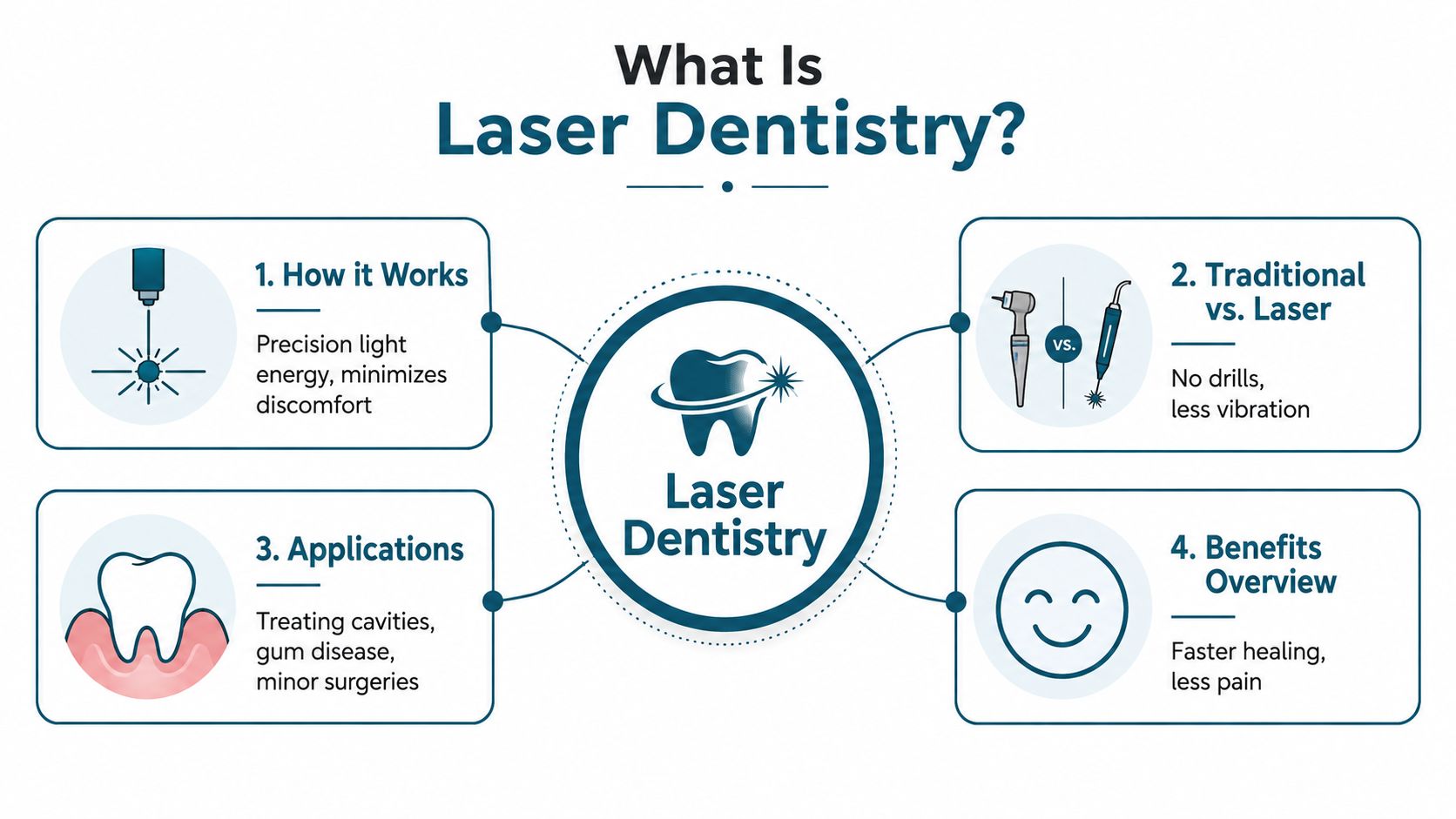
Laser dentistry is easier to understand than the name sounds. Think of it as a highly focused beam of light energy that can do very exact work inside the mouth, whether the dentist is treating hard tissue like enamel or softer tissue like gums. That precision is the reason lasers are used in so many parts of dentistry, including caries prevention, restorative removal, cavity preparation, hypersensitivity treatment, wound healing, tissue removal, and photodynamic therapy as summarized in this review.
The core difference from traditional tools is control. Rather than moving a spinning bur or scalpel across a broader area, the laser targets a smaller zone and helps preserve nearby healthy tissue, which is one reason it's used for selective caries ablation and similar procedures as Cleveland Clinic explains. That selective approach is a major reason many patients view laser treatment as a more refined form of dental care.
For families comparing treatment options, the technology is especially relevant when the dentist wants to work on the gums without creating unnecessary trauma. A good way to think about it is precision first, force second. The laser is there to help the clinician see clearly, remove only what needs to come out, and keep the surrounding area more protected.
Patients who like to compare technologies in other fields may find the concept familiar. A helpful outside reference is the advanced skincare treatment guide from Skin Perfection, which also discusses how targeted light energy is used with precision in non-dental care. The clinical goal is different, but the basic idea is the same, focused energy can be more controlled than older, broader methods.
For patients who want to understand imaging before treatment, digital x-ray advantages can also help show how modern dental tools support accurate diagnosis before a laser is chosen.
Key Patient Benefits of Laser Dentistry
The phrase laser dentistry benefits gets used a lot, but its true value comes down to what a patient feels and what the dentist can protect. Laser treatment is not just about comfort in the chair. It's about cleaner access, more selective tissue removal, and a smoother recovery when the procedure is a good fit.
Enhanced Comfort and Reduced Anxiety
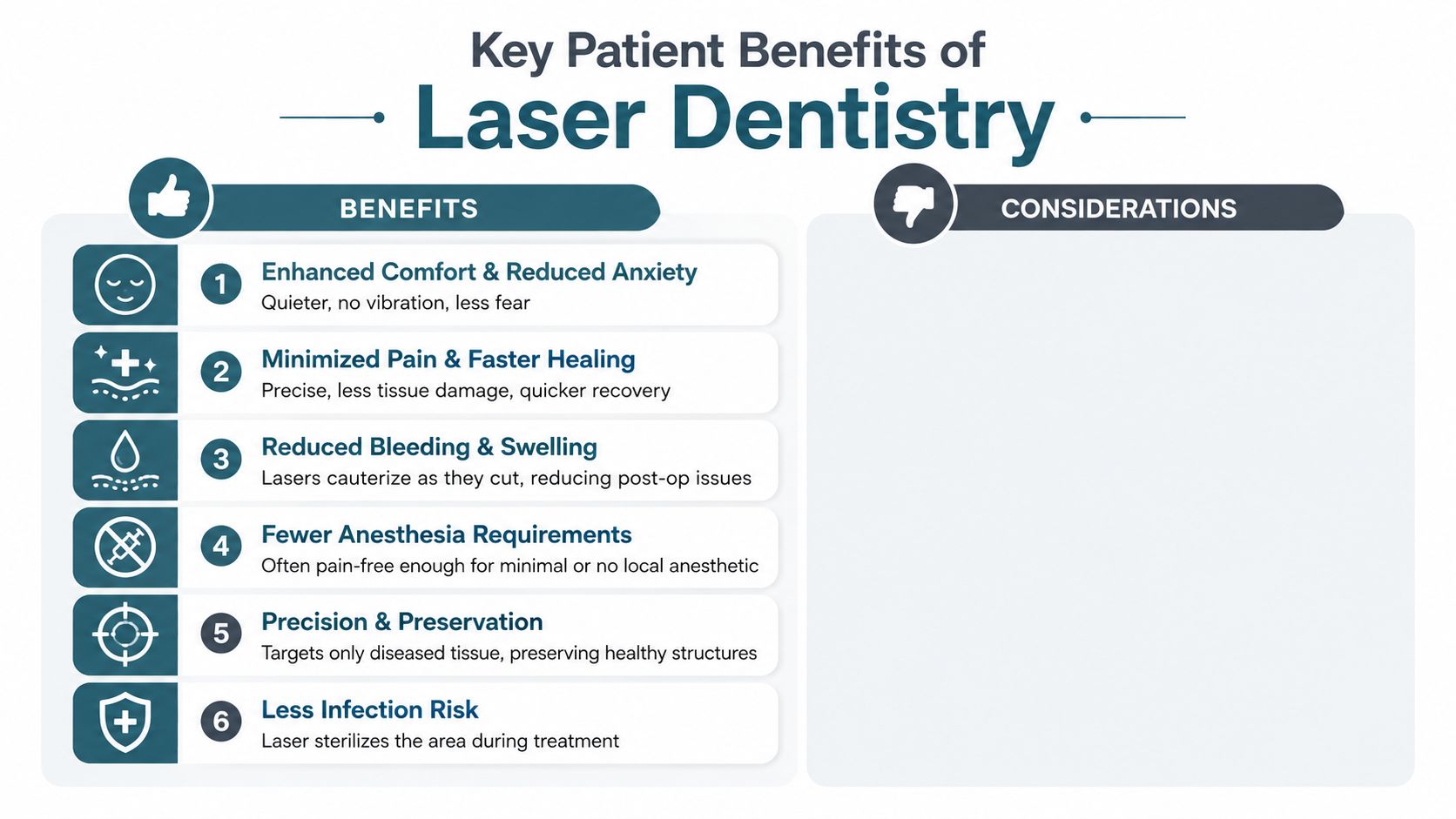
For many patients, the biggest benefit is simple. The appointment feels less intimidating. Laser procedures can reduce the need for drilling and, in some cases, anesthesia, and they may also reduce anxiety tied to the sound and sensation of traditional instruments as noted in this clinical summary.
That matters for patients who have delayed care because of fear. It also matters for parents bringing in children who are already nervous about the dental chair. Recent pediatric literature says lasers can make appointments less stressful by reducing injections, vibration, and odor, which may help children build a more positive attitude toward dental care as summarized here.
- Less noise and vibration: The experience can feel calmer than a drill-based procedure.
- Lower anxiety triggers: Fewer sensory stressors often make the visit easier to tolerate.
- Potentially less anesthesia: Some procedures may need little or no local anesthetic.
- Better acceptance of care: Patients who fear treatment are sometimes more willing to return.
Quiet treatment doesn't just help during the procedure, it can change how a family feels about future visits.
Unmatched Precision for Healthier Smiles
Lasers can selectively remove diseased tissue while minimizing damage to surrounding healthy tissue according to this review. That selective approach matters in the mouth, where a tiny difference in placement can affect comfort, appearance, or healing.
For patients considering restorative or cosmetic work, that precision can make treatment more conservative. Cleveland Clinic notes that lasers can precisely destroy diseased tissue while sparing healthy tissue, and the FDI-based overview it cites highlights selective caries ablation and improved adhesion with erbium lasers as described here. In plain language, the dentist can often focus on the problem area without disturbing nearby structure.
- Healthier tissue preservation: More of the tooth or gum tissue remains untouched.
- Cleaner treatment margins: Exact shaping is especially helpful for cosmetic gum work.
- Improved visibility and control: The operative field can stay easier to see.
- Better fit for detailed work: Procedures like crown lengthening and frenectomy benefit from careful targeting.
Faster Healing and Recovery
Laser dentistry also changes what happens after the appointment. Because the laser has a hemostatic effect that helps reduce bleeding and traumatizes less surrounding tissue, postoperative discomfort is often lower and healing can be faster as reported in this review.
That doesn't mean every patient has the exact same recovery. It does mean the tissue often gets a gentler experience than it would with more traditional cutting or drilling. For busy families in Amanda, Lancaster, Circleville, and Carroll, that can make a real difference in how quickly someone gets back to school, work, or normal eating.
- Less bleeding: A drier field can make treatment easier to complete.
- Less swelling: Reduced trauma often means less irritation afterward.
- Quicker return to routine: Many patients want a simpler recovery, not just a smoother appointment.
- Lower short-term discomfort: The treated area usually feels less beaten up.
For patients who also want a comfort option during treatment, nitrous oxide dentistry can be another useful discussion point at the consultation.
Common Procedures Using Dental Lasers
Laser dentistry isn't limited to one niche use. It spans both hard-tissue and soft-tissue procedures, including restorative removal, cavity preparation, bleaching, wound healing, and treating dentinal hypersensitivity as documented here. That versatility is one reason the technology shows up in both everyday and more specialized care.
Some of the most practical uses include:
- Cavity preparation: Lasers may help remove decay with less drilling, which can be useful for patients who dislike the sound and feel of traditional tools.
- Restorative removal: Old or damaged material can be addressed in a more controlled way when the case calls for it.
- Bleaching support: In some whitening protocols, lasers can be part of the process, especially when cosmetic dentistry is the goal.
- Wound healing support: Soft-tissue procedures sometimes benefit from laser use because the tissue response can be more manageable.
- Dentinal hypersensitivity treatment: Patients with sensitive teeth may be candidates for laser-based care depending on the source of the sensitivity.
- Gum reshaping and soft-tissue refinement: Procedures such as gingival contouring and hyperplastic tissue removal often fit the strengths of laser treatment.
- Biopsy or minor tissue removal: When a small sample or precise trimming is needed, the laser can help with control.
A few procedures deserve special attention in a local practice. Gingival contouring can improve the look of a smile by refining the gumline. Frenectomy can help when a lip or tongue tie affects function. Crown lengthening can expose more tooth structure when a restorative plan needs it. Those are the kinds of exact, margin-sensitive treatments where laser technology often makes sense.
For patients comparing cosmetic options, it can also help to compare teeth whitening treatment costs before deciding what kind of smile improvement fits their budget and goals.
Your Laser Dentistry Experience at Amanda Family Dental
A typical visit for laser dentistry starts with a conversation, not a handpiece. Dr. Alyssa Jenkins reviews the concern, looks at the tooth or gum area, and decides whether laser treatment is the right fit for the case. That judgment matters, because the best tool depends on the tissue involved, the exact goal, and how much precision the procedure needs.
When a laser is appropriate, the process is usually straightforward. The team explains what the patient will feel, reviews the treatment plan, and uses protective eyewear as needed. Because lasers can reduce injections, vibration, and noise for pediatric and anxious patients, the appointment often feels calmer from the start as noted in this pediatric review.
That calmer experience matters for families from Amanda and nearby towns. A child who flinches at the sound of a drill may sit more comfortably when the treatment is quieter and more controlled. An adult who has postponed gum care for years may finally feel ready to move forward once the process is explained in plain language and the tools feel less intimidating.
Practical rule: the right laser procedure should feel precise, explainable, and tailored to the problem, not trendy for the sake of novelty.
Patients who are also weighing diagnostic choices may ask about digital imaging before treatment. Digital x-ray advantages help show how modern assessment supports a more exact plan before any treatment begins. That combination of diagnosis and targeted care is what makes the experience feel more personal and less rushed.
Amanda Family Dental uses this approach for families who want a dentist in Amanda, OH with a comfort-first mindset and modern tools. The result is less guesswork, a more predictable process, and a treatment plan built around the patient, not just the procedure.
Frequently Asked Questions About Laser Dentistry
Is laser dentistry safe?
Yes, when it's used for the right procedure by a trained dental team, laser dentistry is a well-established clinical tool. The main safety advantage is precision, because the laser can target diseased tissue while minimizing damage to surrounding healthy tissue as summarized in this review.
Does laser dentistry cost more than traditional treatment?
The cost can vary by procedure, complexity, and the equipment involved. A helpful overview of erbium laser pricing is available in Understanding erbium laser treatment prices, and patients should expect the final fee to depend on the exact treatment plan, not the technology alone.
Will insurance cover it?
Coverage depends on the procedure and the plan. Laser treatment that's medically necessary may be treated differently from cosmetic use, so the smartest move is to ask the office to review the specific case before treatment is scheduled.
Who is a good candidate?
Patients with dental anxiety, children who struggle with noise or vibration, and people who need precise soft-tissue care are often good conversations for laser dentistry. It can also be useful in select restorative and cosmetic cases, especially when preserving healthy tissue matters.
What should patients ask at a consultation?
They should ask whether the laser is the best option for the tooth or gum problem, what kind of recovery to expect, and whether traditional care would work just as well. A good consultation gives a direct answer, not a sales pitch.
Amanda Family Dental helps patients in Amanda, Lancaster, Circleville, and Carroll get gentle, modern care that fits real life. If laser dentistry sounds like a better fit for a cleaning, gum procedure, cosmetic concern, or anxious visit, schedule a consultation with Amanda Family Dental and ask whether this approach makes sense for your smile.