

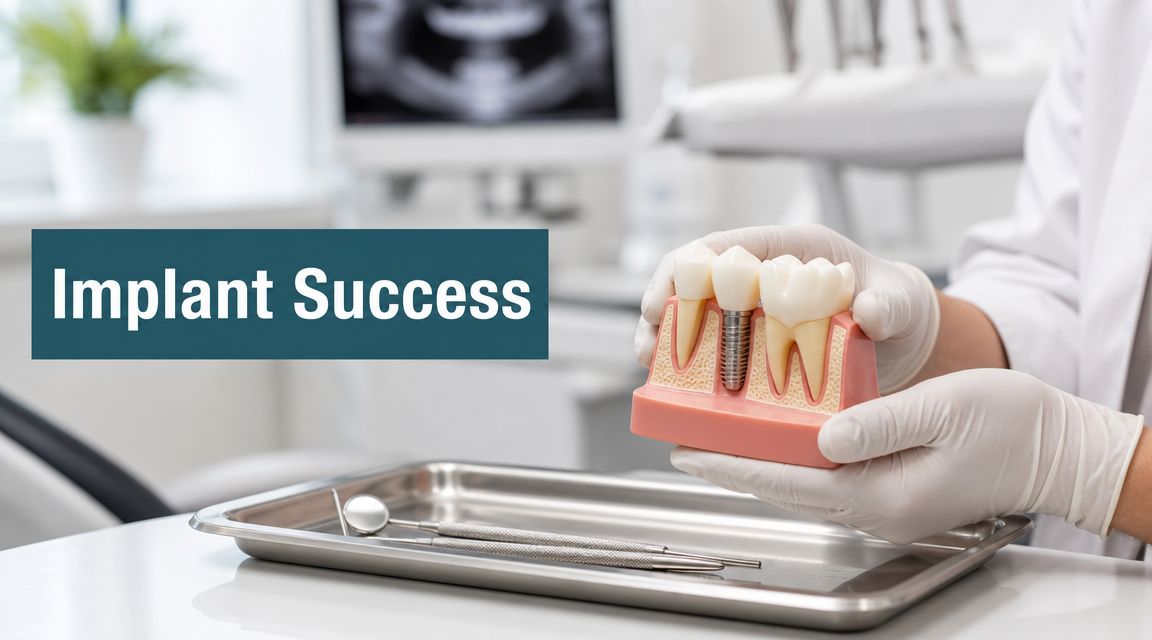
A missing tooth usually starts with a simple question. Is it worth fixing now, or can it wait a little longer? For many patients in Amanda, Lancaster, Circleville, and Carroll, that question turns into a bigger one after a few weeks or months. Chewing shifts to one side. Smiling starts to feel less natural. The space becomes a daily reminder.
Dental implants are often the treatment patients ask about when they want something that feels stable, looks natural, and doesn't rely on a removable appliance. The reason they get so much attention is simple. The long-term track record is strong. Across the clinical literature, dental implants achieve about 95% to 98% success within 5 to 10 years, and longer-term evidence reports a mean 20-year survival rate of 92% with one long-term single-implant cohort showing 95.6% cumulative survival after 38 to 40 years in function according to this summary of long-term implant evidence.
That said, the dental implant success rate isn't just about one headline number. It's about planning, bone support, healing, bite design, home care, and follow-up. Most important, it's a partnership. The dental team handles diagnosis, placement, and restoration. The patient handles the daily habits and follow-through that protect that investment for years.
Table of Contents
- Considering Dental Implants in the Amanda OH Area
- What the Statistics on Implant Success Really Mean
- Key Factors That Influence Your Implant Outcome
- Recognizing Signs of Implant Problems and When to Call Us
- Your Role in Ensuring a Successful Dental Implant
- The Amanda Family Dental Advantage for Your Implants
- Your Dental Implant Questions Answered
Considering Dental Implants in the Amanda OH Area
A common local scenario is easy to recognize. Someone loses a tooth years ago, gets used to chewing around it, and then reaches a point where the gap becomes harder to ignore. Sometimes it's a back tooth that makes meals inconvenient. Sometimes it's a front tooth that changes how a person talks, smiles, or shows up in photos. The concern is rarely cosmetic alone. It's function, confidence, and comfort all at once.
For patients searching for a dentist near me or dental implants near me in Amanda, OH, the primary question usually isn't whether implants are popular. It's whether they're predictable enough to trust. In restorative dentistry, implants are often considered the closest replacement to a natural tooth because they're designed to replace both the root and the visible crown.
Why implants appeal to so many adults
Older tooth replacement options still have a place, but they come with trade-offs. A bridge depends on neighboring teeth. A removable denture can shift, rub, or feel less secure. An implant is different because it stands on its own when the case is appropriate and the site is healthy enough for treatment.
Patients who want to review a local treatment overview can explore dental implants near Amanda Family Dental. For those curious about how dental practices organize patient education online, resources like dental clinic SEO playbooks are also useful for understanding why some questions show up again and again in implant searches.
Patients usually feel more confident once the process is explained in plain language. The treatment sounds more complicated than it feels when it's broken into steps.
What patients in Amanda and nearby communities want to know
Most patients in Amanda, Lancaster, Circleville, and Carroll ask versions of the same questions:
- Will it look natural
- Will it last
- Will healing be difficult
- What can be done to improve the odds of success
Those are the right questions. The answers depend on more than one statistic, and that's where a careful discussion matters. The strongest implant outcomes usually come from good case selection, realistic expectations, and steady follow-up after the procedure.
What the Statistics on Implant Success Really Mean
When patients search for the dental implant success rate, they often see one percentage and assume it tells the whole story. It doesn't. The most helpful way to understand implant data is to separate survival from success.

Survival and success are not the same thing
Survival means the implant is still physically in place. Success is a stricter standard. It asks whether the implant is functioning well, whether the surrounding bone and gum tissue remain healthy, and whether the patient is comfortable and satisfied with the result.
That distinction matters because an implant can remain present in the mouth and still fall short of ideal long-term health or comfort. Literature summarized in a clinical trial protocol reports that implant survival is about 95% at 5 years and 90% at 10 years, while stricter success rates range from 85.2% to 88.7% over follow-up periods up to 20 years according to the clinical trial protocol summary on implant outcomes.
How to read the numbers without misunderstanding them
A simple analogy helps. Think of a car. If it still starts and runs, it has “survived.” If it runs smoothly, handles well, has no warning lights, and stays dependable, that's closer to “success.” Dental implants work the same way. Patients want more than a fixture that remains in the bone. They want stable chewing, healthy tissue, and a restoration that feels like part of their normal life.
A better way to read implant data is to ask these questions:
| Question | Why it matters |
|---|---|
| How long was the follow-up | Short-term and long-term results can tell different stories |
| Was the result measuring survival or success | These are related, but they are not interchangeable |
| What kind of patient and site was included | Front teeth, molars, dense bone, and thinner bone don't behave the same way |
Practical rule: A strong dental implant success rate is reassuring, but the more useful question is whether the treatment is right for this specific mouth, bite, and healing pattern.
For new patients, this is often the turning point in the conversation. The goal isn't to sell a number. The goal is to understand what that number means for one person's tooth, one site, and one long-term plan.
Key Factors That Influence Your Implant Outcome
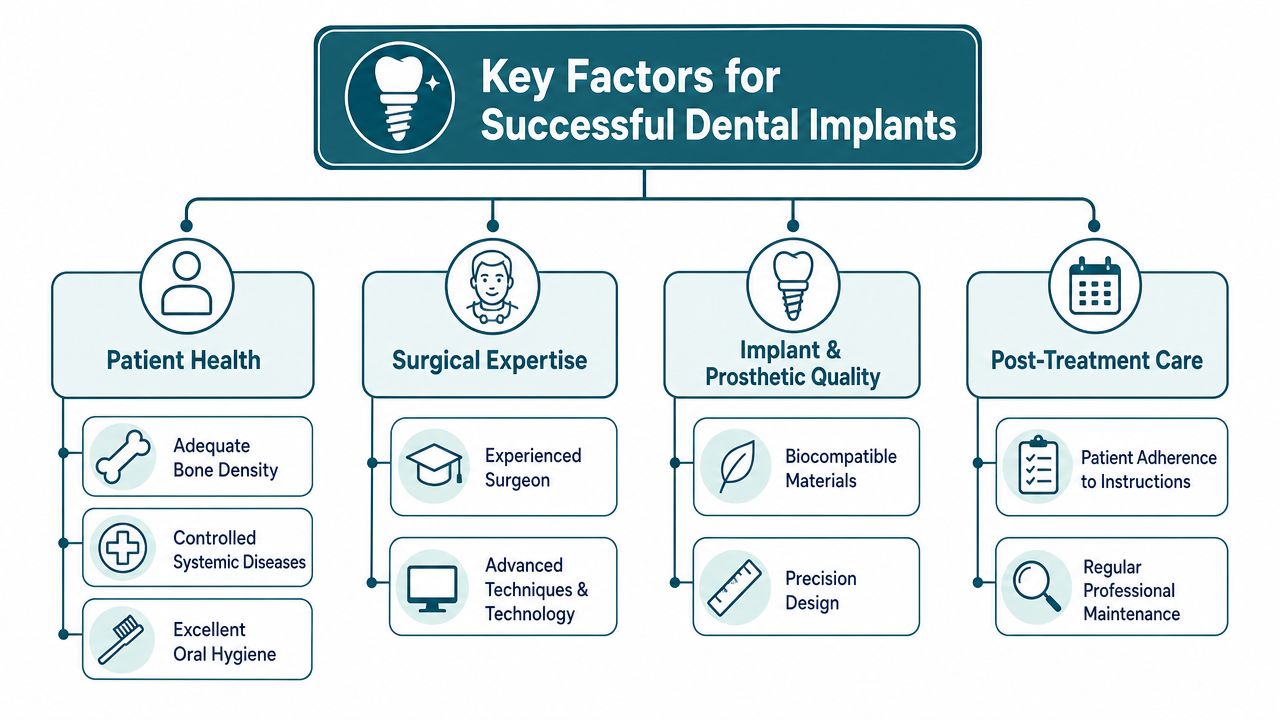
Good implant outcomes come from details. The broad success rates are strong, but individual cases don't all carry the same level of difficulty. Bone shape, tooth position, healing quality, gum health, and the way a patient bites all affect planning.
Anatomy changes risk from one site to another
A large-scale 2025 analysis of 158,824 dental implants placed in 53,874 patients found an overall implant survival rate of 97.79%, but risk varied by location. In that dataset, the maxillary molar region was 3.0% and the central incisor region was 3.37%, which shows that even with high overall survival, anatomy and case complexity still influence outcome according to the large cohort implant survival analysis.
That's why a front tooth case and a back molar case shouldn't be treated as interchangeable. The bone is different. The forces are different. The appearance demands are different.
A closer look at how the procedure is planned helps patients understand the process. This overview of the implant placement procedure shows how careful sequencing affects the final result.
To help patients visualize the process, this short video gives a useful overview.
What the patient controls and what the dental team controls
Some factors are largely clinical. Others depend heavily on patient behavior.
- Site quality: Bone volume and tissue condition determine whether the implant has the support it needs.
- Treatment planning: Digital imaging, bite analysis, and prosthetic planning reduce preventable mistakes.
- Healing support: Smoking, uncontrolled medical conditions, and poor oral hygiene can interfere with recovery.
- Maintenance: Even a well-placed implant can develop trouble if plaque control and recall care are neglected.
Not every challenge rules implants out. It usually means the case needs a more thoughtful sequence, or the patient needs to complete a step first, such as improving home care or addressing existing disease. That's why the strongest treatment plans don't rush to surgery. They prepare the site, the bite, and the patient.
Recognizing Signs of Implant Problems and When to Call Us
Most implants heal without major issues, but it helps when patients know what is normal and what deserves a call. That awareness can protect the implant early, when small problems are easier to manage.
What can be normal during healing
Some tenderness, mild swelling, and temporary sensitivity after a procedure can be part of normal recovery. The exact experience depends on the surgical site, the number of implants, and whether any additional procedures were part of treatment. Soft foods, careful cleaning, and close attention to instructions usually make the early phase smoother.
Patients sometimes worry because healing doesn't feel identical every day. That alone isn't always a warning sign. Recovery often improves gradually rather than all at once.
Signs that need a call sooner rather than later
These changes deserve prompt attention from the office:
- Pain that gets worse instead of better
- Swelling that persists or suddenly increases
- Any movement or looseness in the implant area
- Drainage, a bad taste, or signs of infection
- Visible implant threads when they weren't expected
- A bite that feels sharply off after the restoration is placed
If something feels wrong, it's better to call early than wait and hope it settles down.
Late problems can also happen. Bleeding around the implant, discomfort when chewing, or gum changes around the crown may point to inflammation or overload. Those issues don't always mean the implant is failing, but they do mean the site should be evaluated. Patients in Amanda, Lancaster, Circleville, and Carroll should treat an implant concern the same way they'd treat any other dental problem. Early contact usually leads to a simpler fix.
Your Role in Ensuring a Successful Dental Implant
The patient's role is often underestimated. A skilled dental team can place and restore an implant with precision, but daily habits and follow-through affect whether that result stays healthy. The strongest outcomes usually come from patients who treat the implant like a long-term partnership, not a one-time procedure.

Before the procedure
Preparation starts well before the day of surgery. Patients who attend the full consultation, complete recommended imaging, and ask questions usually feel calmer and make better decisions. If additional treatment is recommended before implant placement, delaying that step often creates more problems later.
Helpful patient actions before treatment include:
- Be open about health history: Medications, medical conditions, and habits affect healing.
- Address active dental disease: Gum problems or untreated infections can complicate implant care.
- Follow pre-op instructions closely: Small details matter when surgery is involved.
Some patients also benefit from tools that make communication and appointment follow-through easier. For example, articles about how AI appointment booking helps dentists show why fast scheduling and reminder systems can support better continuity of care.
After placement and for the long term
The work doesn't end after the implant is placed. In many ways, that's when the patient's role becomes most important. Daily brushing, cleaning around the implant, and keeping follow-up visits are what protect the tissue around it.
This guide on how to care for dental implants is a useful starting point for patients who want clear home-care basics.
A strong long-term routine usually includes:
- Protect the healing site early. Eat as instructed, avoid disturbing the area, and don't improvise care.
- Clean the implant consistently. Implants don't get cavities, but the surrounding tissue can still become inflamed.
- Keep recall visits. Professional monitoring catches subtle changes before they become bigger problems.
- Report changes promptly. Soreness, food trapping, or bleeding around the implant shouldn't be ignored.
An implant is designed to be durable, but durability still depends on maintenance.
Patients who take ownership of these steps usually make the most of the treatment. That's the part many statistics can't fully show.
The Amanda Family Dental Advantage for Your Implants
For patients searching for a dentist in Amanda, OH, or comparing options in Lancaster, Circleville, and Carroll, the quality of implant care often comes down to process. Good outcomes usually start with good diagnosis. That means a careful exam, digital imaging, review of the bite, and a treatment plan that fits the patient's actual goals rather than a generic template.

Planning and diagnosis matter before surgery starts
A new patient considering implants shouldn't need to guess what comes next. The visit should explain whether the site is ready, whether other restorative work matters first, and how long the sequence is likely to take. Digital X-rays help evaluate bone and surrounding structures. Clinical photos and exam findings help shape the restorative plan. Comfort matters too, because patients make better decisions when they don't feel rushed or confused.
Amanda Family Dental provides exams, digital X-rays, restorative dentistry, and dental implant treatment planning for patients who want local care close to home. That combination matters because implants aren't separate from the rest of the mouth. The gums, bite, neighboring teeth, and long-term maintenance all connect.
A local office should make follow-up easier not harder
Implant care doesn't happen on one day. It includes the consultation, any preparatory treatment, placement, restoration, maintenance, and occasional troubleshooting. For patients in surrounding communities, a local dental office can make that sequence easier to manage because follow-up is more practical.
That same idea shows up in how many practices think about patient communication online. A resource like the Bright Smiles Dental Group case study is useful because it highlights how much clarity and responsiveness matter when patients are choosing care. The same principle applies in the operatory. Clear instructions, realistic expectations, and availability after treatment often matter just as much as the procedure itself.
Patients looking for restorative dentistry in Amanda, OH, dental implants near me, or even an emergency dentist after a tooth problem usually want one thing above all. They want a plan that makes sense and a team that stays involved after the initial appointment.
Your Dental Implant Questions Answered
Are implants better than bridges or dentures
It depends on the case, but the trade-offs are clear. A bridge can be a good option in some situations, especially when the neighboring teeth already need crowns. A denture can replace multiple missing teeth and may work well for patients who want a removable option. An implant stands apart because it replaces a missing tooth without depending on adjacent teeth for support in the same way a traditional bridge does.
For many adults, the appeal comes down to feel and function. Patients often want something secure when they chew and speak. They also want a replacement that blends naturally with the smile and supports long-term comfort.
Do implants hurt and how long does the process take
Most patients are relieved to learn that the procedure is often more manageable than they expected. What matters most is careful planning, good communication, and following the instructions given for recovery. Discomfort is usually tied more to the healing phase than to the idea of the implant itself.
The total timeline varies because some mouths are ready right away and others need preparatory treatment first. Healing, restoration design, and bite adjustment all take time. That isn't a drawback. It's part of doing the work carefully.
Can a failed implant be replaced
Sometimes, yes, but that depends on why the problem happened and what the site looks like afterward. A loose implant, unhealthy tissue, or a failed healing pattern doesn't always end the conversation. It means the site needs evaluation, a diagnosis, and a revised plan.
Who is a good candidate
The best candidates are patients with a healthy enough foundation for treatment and a willingness to maintain the result. Good home care, regular checkups, and follow-through matter. Patients who want a quick fix without long-term maintenance usually aren't choosing implants for the right reasons.
The right implant case is not just about replacing a tooth. It's about building a result the patient can keep healthy.
For patients in Amanda, OH, Lancaster, OH, Circleville, OH, and Carroll, OH, the next step is a consultation that looks at the mouth as a whole. That visit can answer whether an implant is the right choice, what sequence makes sense, and what kind of result is realistic for that specific site.
Patients who are ready to replace a missing tooth or want a clear second look at their options can schedule a consultation with Amanda Family Dental. A personalized exam can determine whether an implant, bridge, denture, or another restorative treatment makes the most sense for comfort, function, and long-term oral health.