

A gap can start as a small inconvenience and turn into a daily workaround. Someone in Amanda chews lunch on one side. A neighbor in Lancaster covers a front space in photos. A parent in Circleville delays a visit because smoking, diabetes, or age feels like an automatic no. Plenty of adults in Carroll do the same. Wondering who is a candidate for dental implants is a practical question about readiness, not a promise to have surgery this week. Amanda Family Dental, led by Dr. Alyssa Jenkins, reviews that question in person for families across Amanda, Lancaster, Circleville, and Carroll, Ohio. The conversation covers finished jaw growth, bone and gums, overall health, daily cleaning, and whether a simpler replacement fits better right now.
Table of Contents
- Missing Teeth and Implant Candidacy Near Amanda
- What Makes a Strong Dental Implant Candidate
- Health Habits and Bone That Change the Decision
- Real Patient Situations and How Candidacy Shifts
- Choosing Implants Dentures or a Staged Plan
- What to Expect at Your Implant Consultation
- Schedule Implant Care with Amanda Family Dental
Missing Teeth and Implant Candidacy Near Amanda
A missing molar changes more than a menu. People start avoiding apples, steak, and anything that needs both sides of the mouth. A front gap changes speech just enough that phone calls feel awkward. Neighboring teeth can tip toward the empty space, and the smile gets planned around a hole. Those shifts are why a search for a dentist near me, or for dental implants near me, often begins with frustration rather than a treatment name.
The worry underneath is usually personal. Someone assumes they are too old. Someone else still smokes, or manages blood pressure or blood sugar, and expects a flat refusal. That assumption skips proper screening. Candidacy is risk-controlled readiness. It asks whether healing, cleaning, and follow-up can be made predictable, not whether a medical chart is perfect.
What the Local Question Is Really About
A consultation is not a commitment to an implant. It is a look at whether the site and the person can support one, or whether another path is kinder right now.
- Comfort and function: Chewing on one side strains the jaw and leaves food choices smaller than they should be.
- The rest of the smile: A gap can let nearby teeth drift and can make a person hide their mouth in conversation.
- Timing: Active infection, a tooth that still hurts, or a plan that cannot be finished should pause surgery, not force it.
People looking for a dentist in Amanda, OH, a dentist in Lancaster, OH, a dentist in Circleville, OH, or a dentist in Carroll, OH can bring those concerns to one local exam. Dr. Alyssa Jenkins and the team sort finished growth, bone, gums, health, and home care before anyone talks about a surgery date. If a tooth cannot be saved, tooth extraction and emergency dental services stay on the table as separate decisions. Readers finish the visit knowing what was checked and how to request care if today is only the first conversation.
A missing tooth raises a planning question. It does not sign anyone up for surgery.
What Makes a Strong Dental Implant Candidate
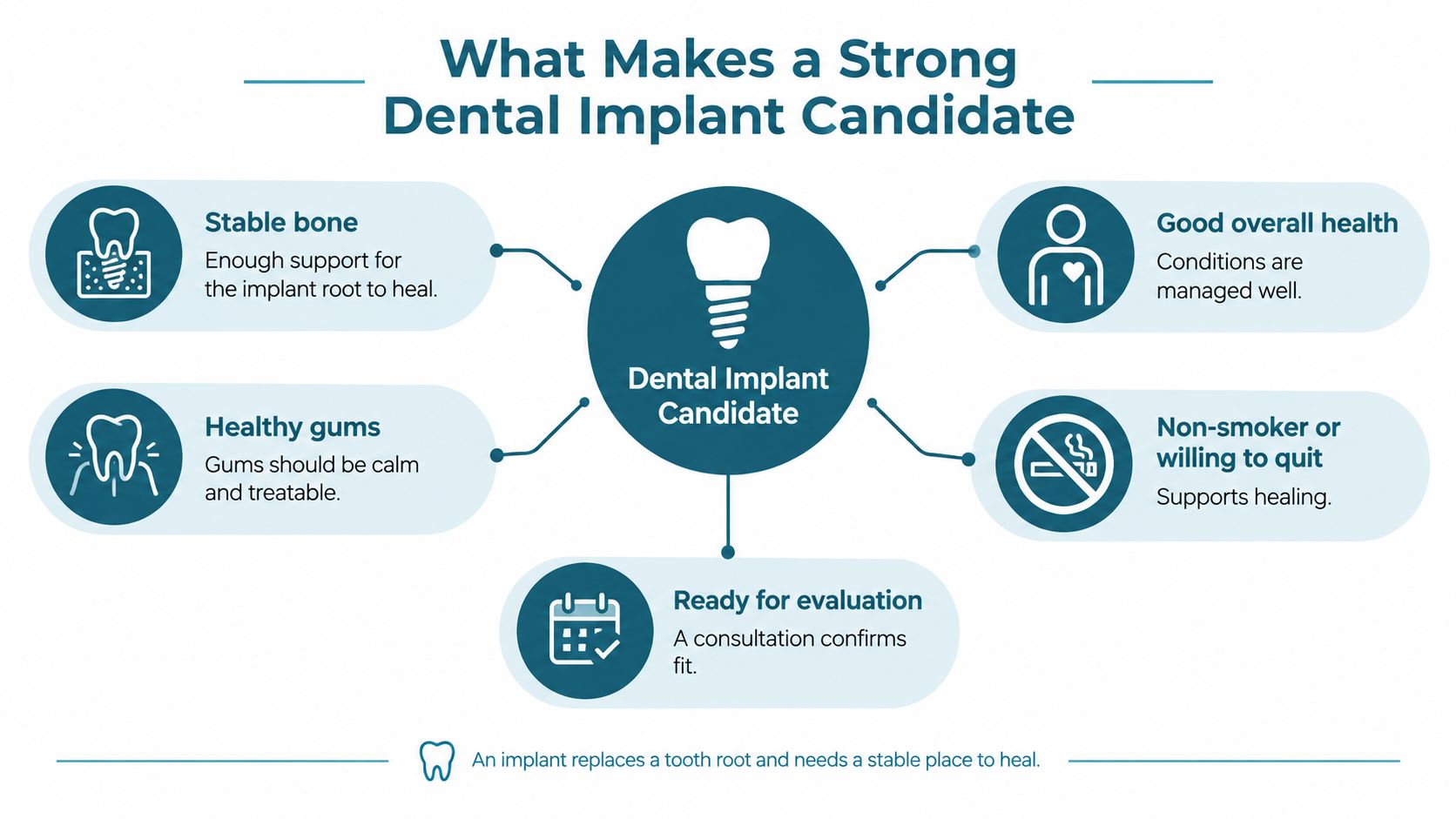
An implant replaces the tooth root, not only the visible crown. It needs a stable place to heal before the tooth that shows is attached. Think of a fence post. Solid ground and time to set matter more than how the fence looks on day one. That is the heart of candidacy. The record does not have to be perfect. The site and the person have to be ready for surgery and for the months of healing that follow.
The U.S. Food and Drug Administration describes a typical candidate as an adult or older patient with one or more missing teeth, adequate jawbone, healthy or treatable gums, and enough overall health to undergo oral surgery and heal. Overall health is a major factor in candidacy, healing time, and how long an implant may stay functional. Age by itself is not the test. Jaw growth should be finished. Daily brushing and flossing have to be realistic. Bone volume, gum health, medications, and medical conditions all belong in the same review.
What Readiness Looks Like in Plain Terms
Implants can restore chewing and appearance, stabilize neighboring teeth, and help limit jawbone shrinkage after tooth loss. Those gains depend on a calm surgical site. Active infection, untreated periodontal disease, inadequate hygiene, or an inability to return for follow-up can delay treatment until those issues are handled. That pause is protective. An implant does not make the gums immune to plaque.
Stable bone means enough support for the root-shaped post, or a site that can be built up later. Healthy gums means tissue that is already calm or can be treated first. Good overall health means conditions are managed well enough for predictable healing. A person who smokes is not erased from the list, but willingness to cut back matters because healing is slower when blood flow is poorer. Ready for evaluation means a clinician has looked, rather than a webpage deciding from a distance.
The implant is the post. The crown is the fence board. Neither holds if the ground is still soft.
Health Habits and Bone That Change the Decision
Smoking, diabetes, thin bone, and certain medicines do not write a yes or no by themselves. They change timing, the consent talk, and how closely the site needs to be watched. The practical goal is manageable risk, not the absence of every condition.
Smoking is one of the strongest habits a person can change. A meta-analysis found an implant-failure odds ratio of 2.402 for smokers versus nonsmokers, with the effect persisting across follow-up and with greater marginal bone loss, as reported in a review of systemic risk factors. That is a reason for cessation counseling and a frank healing discussion, not an automatic rejection. The same review found a higher failure risk in diabetic patients, with an odds ratio of 1.777, while also noting that well-controlled diabetes can still allow predictable treatment. Poor control is different. High blood sugar can impair immune function and bone healing, which raises concern for infection, delayed integration, and peri-implantitis.
Bone That Needs Help First
Thin jawbone does not always end the conversation. A staged graft or a sinus graft can create a usable ridge, though it adds healing time, surgical steps, and extra risk. A systematic review reported about 90% to 100% implant survival at 10 years in both grafted and nongrafted sites, and another review found survival in grafted bone from 97.3% to 100%, with a mean of 98.5%, according to research on grafted implant sites. Active gum disease, smoking, osteoporosis, and uncontrolled diabetes can raise the chance a graft fails, so those issues get handled before anyone celebrates the percentages.
Osteoporosis is a case-by-case topic, not a slogan. Readers who want a plain explanation of bone density, fracture risk, and common therapies can review osteoporosis causes and treatments before the dental visit, then bring medication names to the exam. Antiresorptive or bisphosphonate therapy, prior head-and-neck radiation, chemotherapy, nighttime grinding, and trouble keeping appointments belong in that same individualized review. Gum inflammation should be calmed first. A deep-cleaning visit such as scaling and root planing is often the step that makes a later implant discussion safer.
| Factor | How it changes risk | Typical planning response |
|---|---|---|
| Smoking | Higher failure odds and more bone loss around the implant | Cessation counseling and a slower, individualized timeline |
| Poorly controlled diabetes | Weaker immune response and slower bone healing | Medical coordination until control is steadier |
| Thin bone | The post may lack primary support | Graft or sinus lift, then a later placement visit |
| Active gum disease | Inflammation threatens the tissues around a future implant | Treat the gums and confirm they stay calm |
| Osteoporosis or bone medicines | Healing and medication effects need a medical check | Case-by-case consent, not a blanket refusal |
| Grinding or missed visits | Extra force and plaque raise long-term complications | A night guard plan and a realistic maintenance schedule |
Real Patient Situations and How Candidacy Shifts
Rules land differently once a real week, a real kitchen, and a real set of hands are in the picture. The profiles below are fictional, and they match questions families in Fairfield County ask out loud.

An Older Adult Whose Age Is Not the Issue
Helen is 78, lives near Amanda, and lost a lower tooth years ago. Her blood pressure is treated, and she gets to routine dental care with her daughter's help. Age alone does not settle this. The American Association of Oral and Maxillofacial Surgeons notes that, apart from growing children, people of almost any age may be candidates, including many patients with chronic conditions such as high blood pressure or diabetes, as long as healing capacity, oral health, and routine care are realistic.
The sharper question is functional resilience. A review of implant care in older adults points to frailty, reduced dexterity, caregiver dependence, kidney or cerebrovascular disease, medicines, and the ability to clean as factors that affect complications and whether a fixed tooth is practical. If Helen cannot thread floss behind a fixed crown, a simpler overdenture may protect comfort better than a restoration she cannot maintain. Families helping adults 75 and older should ask about cleaning, support at home, and whether a less extensive option is kinder. That is not a blanket refusal. It is a request for an individual exam.
A Smoker With a Missing Molar
Marcus works in Lancaster and lost a molar. He smokes and wants something that does not rock when he eats. He can still be evaluated. The visit should include cessation counseling and a direct talk about healing, gum inflammation, and graft success, rather than a door that closes on the first sentence. If he will not pause smoking and will not return for checks, the plan should wait.
Diabetes That Is Managed, and Diabetes That Is Not
A grandparent in Circleville whose blood sugar is steady, whose gums are calm, and who keeps dental visits can be planned with medical coordination. A relative whose sugars swing, or who still has an untreated gum infection, is in a different place. The infection and the control come first. Implants come after the mouth is quiet.
A short clinic conversation like the one below shows how those trade-offs get said out loud, without turning the visit into a lecture.
Choosing Implants Dentures or a Staged Plan
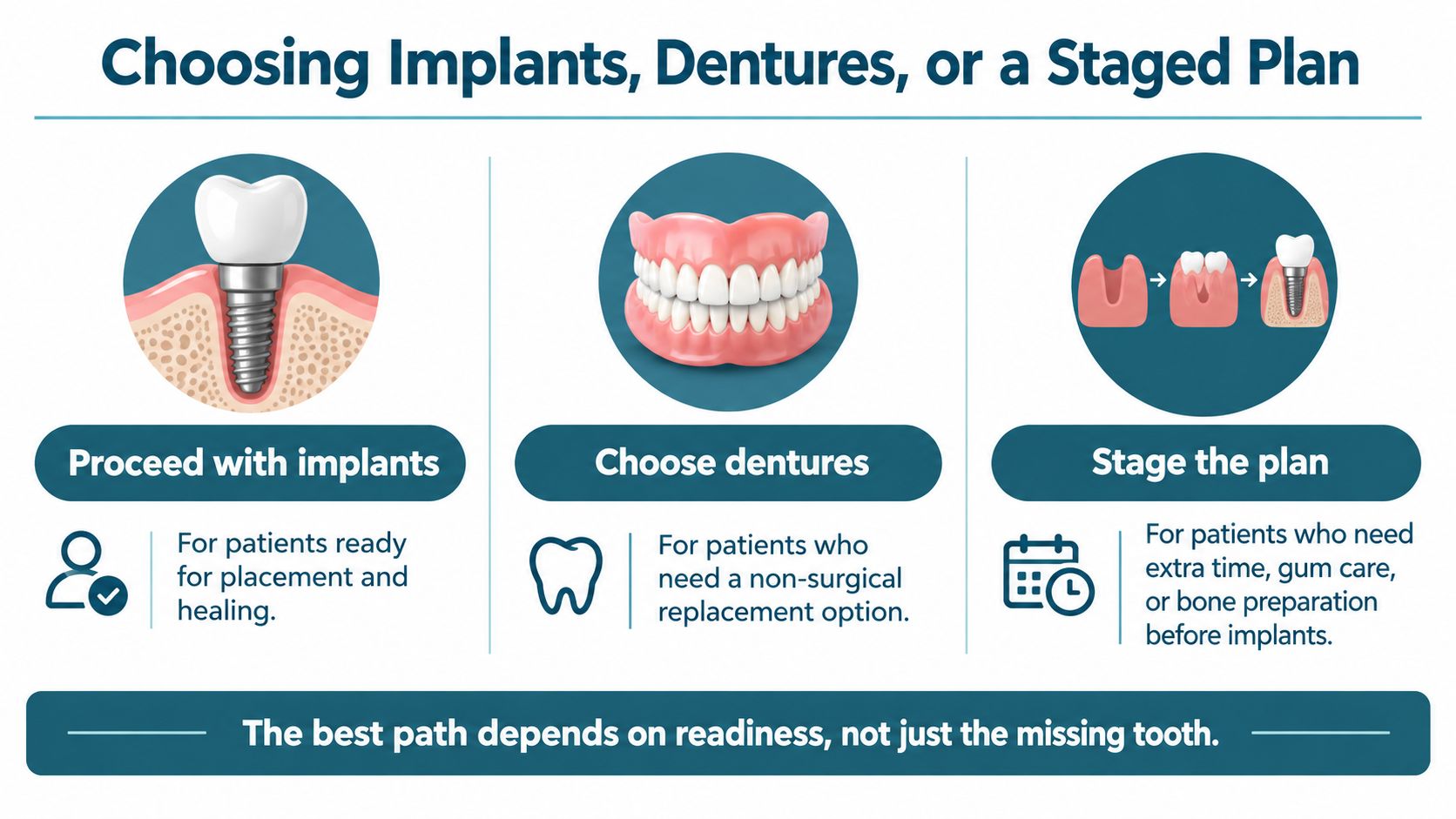
Three paths cover the majority of patients who walk in with a gap. The right one depends on readiness, money, and maintenance, not on how much someone wants a fixed tooth.
Proceed toward an implant when growth is finished, the bone can hold the post, the gums are calm, health is stable enough for surgery, and the person can clean and return. Stage the care when the site is not ready. That can mean periodontal treatment first, or bone augmentation, then placement after healing. Staging adds time and complexity, and it is still a complete plan rather than a failure. Choose a removable option when a fixed tooth is the wrong load. A denture or a simpler overdenture can restore chewing and speech when dexterity, medical risk, or the chance of finishing every step is the limit.
A full implant sequence can include placement, possible grafting, the crown or denture attachment, and follow-up. Recent US cost data put a median complete implant cost of about $4,000, with wide variation by market and provider, and public discussion still treats implants and related prosthetics as a significant out-of-pocket burden, as described in a comparison of implant costs across US markets. Financial readiness is part of candidacy. A plan someone cannot finish is not a small detail.
How the Choice Feels Day to Day
Benefits should serve the decision, not a sales script. A stable replacement can make chewing and speaking easier, ease the ache of an unstable gap, and bring back a smile a person does not hide. A denture can do part of that work with less surgery. A staged plan protects people who need gum care or bone preparation before any post is placed. Patients comparing those routes can review missing tooth solutions and then match the option to cleaning ability and budget.
Amanda Family Dental provides tooth extractions, dental implants, dentures, crowns, and other restorative dentistry for Amanda, Lancaster, Circleville, and Carroll. Visits include digital X-rays and a written plan. Payment options include a Power Plan Membership for patients who need predictable costs alongside cleaning and exams. Cosmetic dentistry, including teeth whitening when the gums are healthy, can wait until the missing tooth is settled. A cosmetic dentist near me search should still start with whether the foundation is sound.
The best path is the one a person can heal from, clean, and pay for through the last visit.
What to Expect at Your Implant Consultation
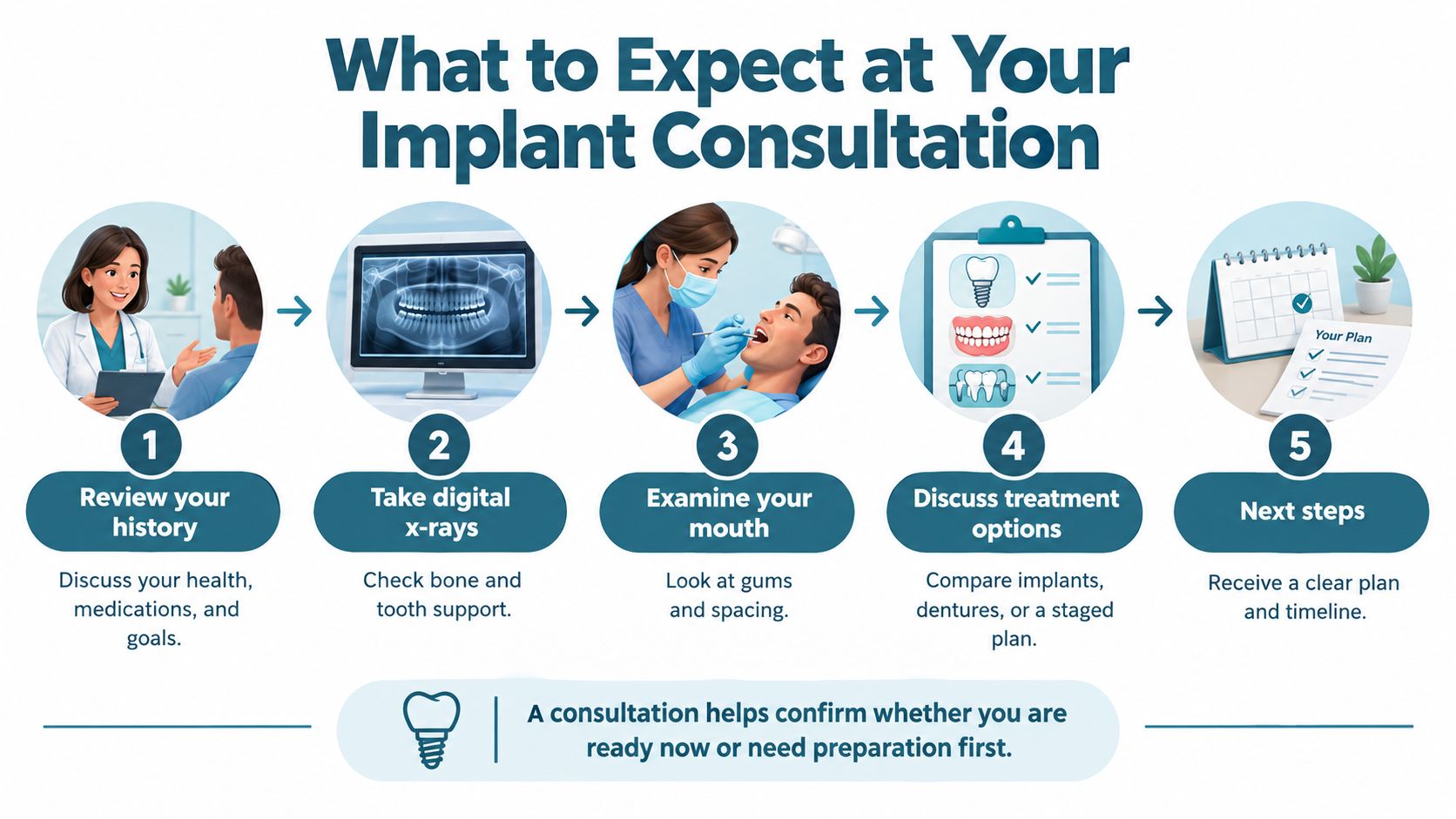
A new or returning patient from Amanda, Carroll, Circleville, or Lancaster should expect a conversation before any recommendation. The team asks about missing teeth, medical history, medicines, smoking, and diabetes control, plus what the person wants to eat and how they clean at home. That history explains healing risk. It is not a quiz with a passing score.
The Exam and the Images
Next comes a gentle look at the gums and the space where the tooth should sit. Digital images show bone support and nearby teeth. When the ridge is hard to judge on a standard film, three-dimensional imaging can show ridge size, anatomical structures, restorative space, and where a replacement tooth would sit, which matches the evaluation approach described in a clinical overview of dental implants. The advantages of digital X-rays include a clearer look with less hassle than older film, so the plan is based on the actual site.
The clinician checks for infection, whether gum disease should be stabilized first, and whether bone is adequate or would need grafting. Nighttime grinding and the ability to attend maintenance visits belong in that same pass. New patient exams stay unrushed so medications and goals are not skipped.
What You Leave With
The result is a personalized plan and a clear talk about healing, hygiene, follow-up, and alternatives. It is not an automatic surgery date. Anxious patients can expect a comfortable, transparent visit, with same-day care when the schedule allows, including urgent pain that needs an emergency dentist before any implant discussion. If the mouth needs dental x-rays only and a cleaning first, that is a complete outcome for the day.
- Review history: Health, medicines, smoking, diabetes, and goals.
- Examine the mouth: Gums, bite, and the empty space.
- Take images: Digital X-rays, and 3D views when the ridge needs them.
- Compare options: Implant, staged graft, denture, or a delay.
- Name next steps: A written plan, not a surprise appointment.
Schedule Implant Care with Amanda Family Dental
A gap, a loose denture, or a tooth that cannot be saved is reason enough to be seen. That is true for readers in Amanda, Lancaster, Circleville, and Carroll who feel like obvious candidates, and for readers who are unsure because of age, smoking, diabetes, or limited bone. Uncertainty is a reason to book, not a reason to wait another year while the neighboring teeth drift.
The visit reviews health, gums, images, and goals, then explains whether an implant, a staged plan, or another restorative option fits. Nobody has to decide in the parking lot. Convenient scheduling and a welcoming, family-focused setting led by Dr. Alyssa Jenkins make the first call the easy part. Patients can schedule an appointment, request an implant consultation, or contact the office and talk with the team about timing, cleaning, and cost before any procedure is set.
Bring a list of medicines, a note about smoking or blood sugar, and the question that has been sitting in the back of your mind. The answer should match your mouth, your health, and the care you can keep up at home.
Amanda Family Dental offers implant consultations, staged restorative plans, dentures, and everyday family dental care for patients in Amanda and nearby Ohio communities who are sorting out a missing tooth. The team looks at health, gums, images, and long-term cleaning so the recommendation matches real readiness. Schedule a visit or request a consultation with Amanda Family Dental and get a clear next step for your smile.