

A veneer that once made every smile feel effortless can start to feel like one more thing to manage. A chipped edge, a dark line near the gum, new sensitivity, or a veneer that feels loose may leave someone searching for a dentist near me and wondering whether the answer is a simple repair or full dental veneer replacement.
Amanda Family Dental helps patients from Amanda, OH, Lancaster, OH, Circleville, OH, and Carroll, OH understand that decision without rushing. A careful evaluation considers the veneer, the tooth underneath, the gums, and the bite before recommending cosmetic dentistry, restorative treatment, or another option.
Table of Contents
- A Local Patient's Starting Point
- What Veneers Are and Why Replacement Becomes a Topic
- Signs Your Veneers May Need Replacement
- Replacement Options Worth Considering
- How the Replacement Procedure Actually Works
- Cost, Longevity, and the Maintenance Mindset
- What to Expect at Amanda Family Dental
- Taking the Next Step in Amanda, OH
A Local Patient's Starting Point
A patient from Amanda may notice the change gradually. A veneer that looked bright for years can begin to appear dull in family photos. A small chip may catch against the lip, or one front tooth may feel slightly different when biting into an apple. Someone traveling from Lancaster might avoid hard foods, smile less openly, or keep checking the same edge in the mirror.
Those concerns can feel minor at first, but they often affect daily confidence. The question isn't only whether a veneer looks imperfect. Patients also want to know whether the tooth is healthy, whether the veneer can be repaired, and whether removing it will cause more damage.
The first appointment is an investigation
Amanda Family Dental approaches an aging veneer with fresh eyes. The dentist reviews the restoration's history, listens to what has changed, and examines how the veneer meets the tooth and gumline. A patient who says, “It just feels off,” may be describing a bite change, a marginal gap, gum recession, or a problem beneath the restoration rather than a simple cosmetic concern.
A useful evaluation may include:
- A close clinical exam: The dentist checks the veneer, enamel, margins, gums, and neighboring teeth.
- Updated imaging: Dental X-rays can help reveal decay or changes that aren't visible from the front.
- Bite assessment: Contact points and grinding patterns can show why a veneer chipped or loosened.
- Cosmetic planning: Shade, shape, symmetry, and the patient's preferred outcome all matter.
Practical rule: A veneer that looks worn doesn't automatically need replacing, and a veneer that looks acceptable may still need evaluation if it feels loose or causes sensitivity.
The right plan may be a polish, a composite repair, a new veneer, or a different restoration. For patients in Amanda and surrounding communities, the benefit of a local family dentist is continuity. The team can address the immediate concern while also considering cleaning and exams, gum health, tooth protection, and longer-term restorative needs.
What Veneers Are and Why Replacement Becomes a Topic
A patient may arrive at Amanda Family Dental with a veneer that still looks attractive but no longer feels right. The restoration may be intact while the tooth beneath it, the gumline, or the bite has changed. That is why replacement starts with understanding what a veneer covers and what it cannot protect.
A dental veneer is a thin, custom shell bonded to the front of a tooth. Porcelain and composite are common materials. Like a fitted cover on one surface, a veneer can change the tooth's apparent color, shape, size, and position. It does not replace the whole tooth or make the covered tooth immune to decay, wear, or pressure.
The preparation and bonding process determine how the restoration functions. Patients can review how dental veneers work for an explanation of preparation, impressions, and bonding. Material choice also affects appearance, strength, translucency, and how much tooth structure may need preparation. The comparison of zirconia vs lithium disilicate offers technical context, but the appropriate material depends on the individual tooth, smile goals, and bite.
Why a replacement becomes necessary
Replacement may enter the discussion when:
- Bonding weakens: The veneer can loosen or separate.
- The gumline changes: Recession may expose a margin that was once hidden.
- Decay develops: A veneer cannot stop decay at an exposed edge or beneath a compromised margin.
- Bite forces change: Clenching, grinding, tooth movement, or a new restoration can increase pressure.
- The material ages: Color, texture, or edge integrity may no longer blend with the smile.
Veneers are long-term restorations, not lifetime guarantees. The American Dental Association describes veneers as lasting about 10 years, while the Cleveland Clinic gives a typical range of 10 to 15 years. A systematic review reported a 10-year cumulative survival rate of 95.5% for porcelain laminate veneers.
Survival means the restoration remains in service, not that every patient will reach the same outcome. In the chair, the decision may be a repair, a like-for-like replacement, or a crown if the remaining tooth needs greater protection. Enamel, hygiene, bonding, bite forces, and underlying tooth health all shape that choice.
Signs Your Veneers May Need Replacement
A veneer can look nearly normal while developing a problem at its edge. Conversely, a small surface imperfection may be repairable without removing the entire restoration. The visible symptom is only the starting point, so patients shouldn't diagnose the cause from appearance alone.
What patients commonly notice
Chipping or cracking often follows an injury, biting a hard object, or repeated clenching. A rough edge may be smoothed or repaired in selected cases, while a crack that extends through the veneer may call for replacement.
A loose or separated margin can feel like movement, a catch with the tongue, or a change in the way floss passes. A veneer that has fallen off should be kept safely and brought to the appointment if possible. The dentist can then assess whether rebonding is sensible or whether the restoration and bonding surface are too compromised.
Persistent staining or a dark line near the gum may reflect surface discoloration, exposed bonding, gum recession, decay, or a margin that no longer seals well. Whitening won't correct every cause, particularly when the discoloration comes from the tooth-restoration boundary.
Sensitivity or bite discomfort deserves more attention than a purely cosmetic complaint. Cold sensitivity, pain when chewing, or pressure on one tooth can indicate decay, a crack, exposed dentin, bite interference, or pulpal irritation.
The patient-facing guide on what to do if a veneer falls off reinforces an important practical point: prompt evaluation protects both the restoration and the tooth while the dentist determines the next step.
A simple self-check before booking
Patients can note whether the change affects one veneer or several, whether it began suddenly or gradually, and whether discomfort occurs with cold, chewing, or pressure. That information helps the dentist separate an isolated chip from a broader issue such as grinding, gum changes, or bite wear.
A sudden break after an injury, facial swelling, severe pain, or signs of infection should be treated as urgent. In that situation, an emergency dentist can determine whether the tooth needs immediate protection before cosmetic replacement is planned.
Replacement Options Worth Considering
A patient arrives expecting a new veneer, but the examination may point elsewhere. The tooth might still support a like-for-like replacement, or decay, a crack, worn enamel, or bite stress may make a crown, repair, or broader plan safer. The decision is less like replacing a phone case and more like checking the structure underneath before choosing its new covering.
Four paths a dentist may discuss
A new porcelain veneer fits a tooth with sufficient remaining enamel, limited decay, healthy surrounding tissue, and a cosmetic concern a veneer can address. Porcelain creates a durable, natural-looking surface, while reliable bonding still depends on enamel, bite control, and a sound preparation.
A full crown may be the better choice when decay is extensive, a large filling or crack weakens the tooth, or little structure remains after earlier preparation. A crown covers more of the tooth and can provide added protection. The trade-off is greater tooth preparation than a veneer usually requires.
Direct composite repair can suit a small chip, rough edge, or localized wear when the veneer and tooth remain stable. It may preserve the existing restoration with less intervention. However, repair can serve as a temporary bridge when the veneer, its fit, or the underlying tooth is deteriorating.
A broader smile or restorative plan deserves discussion when several veneers are aging together or when grinding, acid erosion, tooth wear, or bite changes affect multiple teeth. Replacing one veneer while leaving the cause untouched is like repainting one section of a wall with an active leak behind it. The same failure pattern may return.
A replacement plan should protect the tooth underneath, not just recreate the appearance of the old veneer.
| Option | Best For | Typical Lifespan | Key Trade-off |
|---|---|---|---|
| New porcelain veneer | Strong tooth, healthy margins, cosmetic change | Long-term service, with published studies showing high survival over time (review) | Conservative coverage, but depends on enamel and bonding |
| Full crown | Weakened tooth, extensive decay, cracks, or major structural loss | Depends on tooth health, bite, and maintenance | More coverage and preparation |
| Composite repair | Small chip or edge defect with stable veneer | Usually shorter-term than a sound ceramic restoration | Less invasive, but may need future refinement |
| Comprehensive restoration | Multiple failing restorations or generalized wear | Varies by material and underlying cause | Addresses the pattern, but involves broader planning |
The examination, imaging, and bite analysis help clarify which option fits. A dentist in Amanda may recommend a new veneer for one tooth, a crown for another, or repairs that preserve stable areas rather than treating every tooth alike. That chairside assessment matters because a familiar-looking replacement is not always the safest long-term choice.
Patients who also need missing-tooth care may hear about dental implants near me, bridges, or other restorative treatments. Those options replace missing teeth. They do not serve the same purpose as replacing a veneer that remains bonded to a natural tooth.
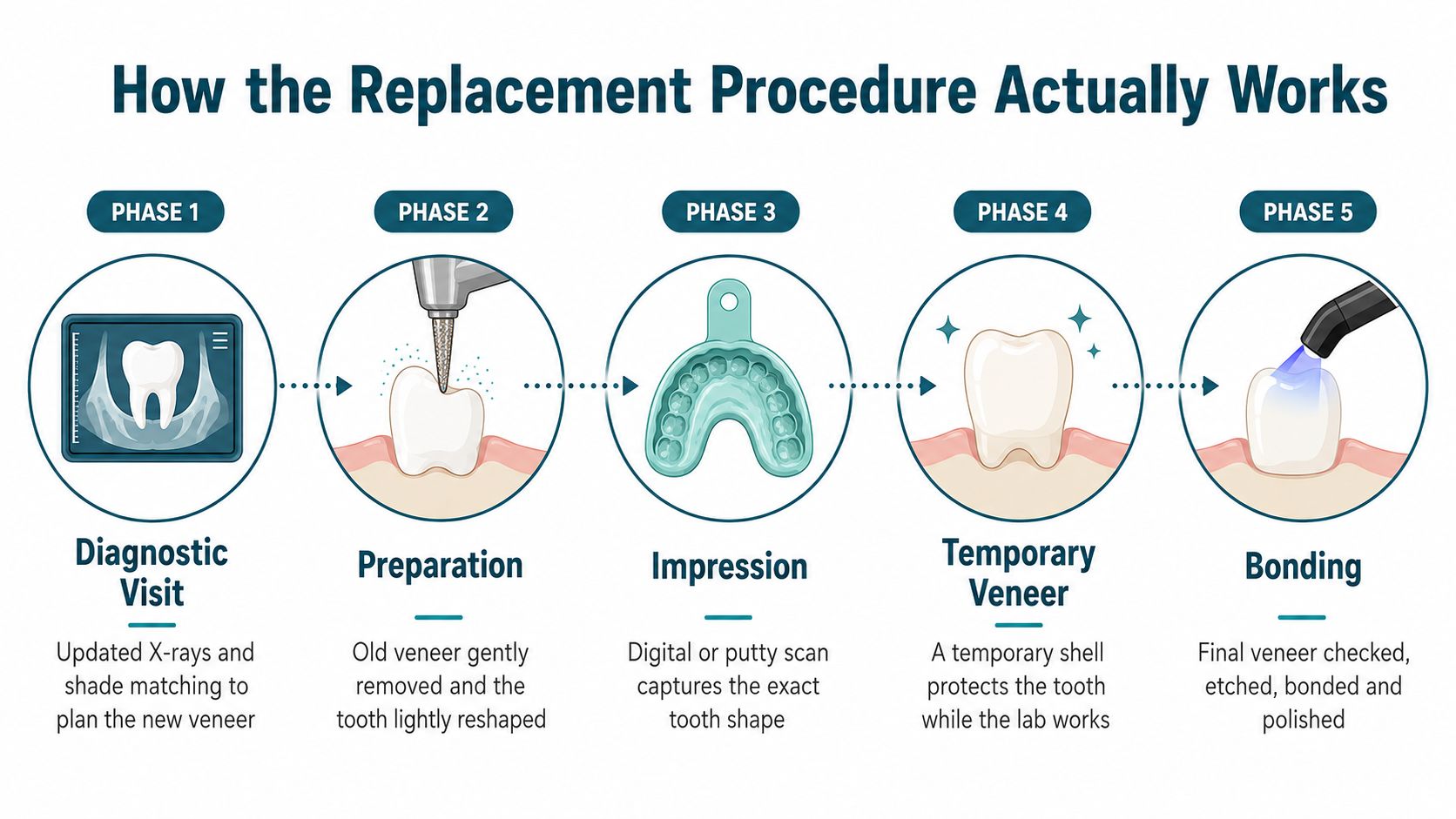
How the Replacement Procedure Actually Works
A planned dental veneer replacement usually feels more manageable when each appointment has a clear purpose. The exact sequence depends on the number of veneers, the condition of the teeth, and whether the dentist discovers decay or structural damage.
The diagnostic visit
The first visit may include updated dental X-rays, photographs, shade review, and bite analysis. The dentist examines the veneer and the underlying enamel, then discusses whether a new veneer, a crown, a repair, or a broader plan offers the safest result.
This appointment is also where patients can explain practical concerns. A patient may care most about a dark margin, a change in speech, an upcoming event, or fear that removal will further weaken the tooth. Those details help shape the treatment sequence.
Removal and preparation
At the removal appointment, the dentist carefully sections or lifts the old veneer rather than treating it like a removable cover. Once the restoration is off, the tooth can be checked for decay, cracks, cement remnants, enamel availability, and changes at the gumline.
The dentist then prepares the surface as conservatively as the situation allows. Digital scans or putty impressions capture the tooth's shape, and the lab uses that information to fabricate the permanent restoration. A temporary veneer protects the prepared tooth during this stage.
Try-in and bonding
At the bonding visit, the dentist verifies the shade, contour, contacts, and fit before final placement. The veneer is tried in, adjusted if needed, and then the tooth is prepared for adhesion with etching and adhesive application.
The dentist seats the veneer with bonding cement and uses a curing light to set the material. Excess cement is removed, the margins are polished, and the bite is checked so the new restoration doesn't take unnecessary pressure during chewing.
Most replacements take two to three appointments spread across two to three weeks, although the schedule can change if decay, gum treatment, a crown conversion, or laboratory revisions are needed.
A visual walkthrough can help patients understand the sequence before the first visit.
Cost, Longevity, and the Maintenance Mindset
A patient may arrive expecting a simple price for one replacement veneer. The estimate can change once the dentist examines the tooth, because replacement is not identical for every case. A straightforward veneer may involve an examination, preparation, laboratory fabrication, and bonding. Decay, gum disease, bite problems, or a decision to convert the tooth to a crown can add different steps and costs.
Published guidance places porcelain veneer costs in a broad range of about $500 to $2,500 per tooth, according to Lexington Dental. The same practice-oriented estimate describes replacement as commonly costing 80% to 100% of the original cost, since laboratory work and chair time may be similar. Fees in Amanda or Lancaster depend on the tooth, material, preparation, number of restorations, and whether a crown or another option better protects the tooth.
Patients can review how much veneers cost before requesting an estimate. An online range provides context, but the examination determines which treatment the tooth can support.
Longevity is a planning factor
As noted earlier, patient guidance describes veneer service in the range of about 10 to 15 years. Clinical reviews also report 96% survival at 10 years and 91% at 20 years in one long-term prospective study, while emphasizing that keeping preparation within enamel supports stronger bonding (peer-reviewed review).
A separate long-term review reported feldspathic porcelain veneers at 96% survival at five years, 93% at 10 years, and 91% at 12 years (systematic review). These findings describe groups of patients, not a guarantee for one tooth. They support a maintenance mindset: replacement planning should account for oral health, bite forces, habits, and the condition of the underlying tooth.
Regular hygiene care, attention to grinding, and avoiding habits that overload front teeth can help protect the restoration. A rough edge, looseness, or changing bite deserves prompt review, since a small concern may be easier to address before the tooth needs broader treatment. The chairside decision may be a repair, another veneer, or a crown, depending on how much healthy structure remains.
Amanda Family Dental can discuss phased treatment, written estimates, and available payment approaches. That conversation helps patients weigh oral health and priorities alongside the fee.
| Material | Average Cost Per Tooth (Amanda/Lancaster) | Expected Lifespan | Annualized Cost |
|---|---|---|---|
| Porcelain | Requires an individualized estimate | About 10 to 15 years in patient guidance | Depends on the final fee and actual service life |
| Composite | Requires an individualized estimate | Generally shorter-lived than porcelain | Depends on the final fee and repair needs |
| Crown conversion | Requires an individualized estimate | Depends strongly on tooth structure and maintenance | Depends on the final fee and service life |
What to Expect at Amanda Family Dental
A veneer evaluation at Amanda Family Dental starts with a conversation rather than an assumption that every older veneer should be replaced. A patient arriving from Amanda may explain what feels different, when the change began, and whether the original veneers were placed locally or elsewhere. Someone traveling from Lancaster, Circleville, or Carroll can bring prior records if they have them, but missing records shouldn't prevent an evaluation.
The clinical portion may include photographs, dental X-rays, a review of the existing veneers, a gum assessment, and a bite check. The dentist looks for details that patients may not see at home, including marginal integrity, hidden decay, enamel availability, uneven contact, and signs of clenching.
Turning findings into choices
After the exam, the dentist explains the findings in plain language. Models, photographs, or an on-screen view can make the difference between a small repair and a larger restorative procedure easier to understand.
A treatment discussion may compare:
- A repair: Appropriate when the defect is limited and the veneer remains stable.
- A veneer replacement: Reasonable when the tooth is healthy enough for another bonded shell.
- A crown: Considered when the underlying structure needs broader protection.
- A staged plan: Useful when several teeth need attention but treatment should occur over time.
Shade selection and gum health form part of the cosmetic planning. The dentist also reviews the expected appointments, temporary restoration needs, aftercare, and written estimate. That transparency matters for patients comparing a cosmetic dentist near me with a general dental office, because a pleasing result still depends on healthy teeth and gums.
Amanda Family Dental offers care that can include preventive cleanings and exams, pediatric dentistry, fillings, crowns, root canals, dentures, dental implants, veneers, whitening, and Invisalign. For patients with dental anxiety, comfort-focused care and sleep dentistry discussions can be part of the conversation, especially when an old restoration must be removed and replaced.
Taking the Next Step in Amanda, OH
A veneer concern doesn't require a perfect explanation before a patient books. The most useful first step is a dental veneer replacement evaluation with a dentist who can examine the restoration and the tooth beneath it.
Before the appointment, patients can gather:
- Past dental information: Bring old records, material details, or the name of the original dentist if available.
- Current photos: Images showing the smile from the front and side can document changes over time.
- A short symptom list: Note sensitivity, roughness, movement, staining, pain, or bite changes.
- A treatment timeline: Explain whether the goal is prompt repair, gradual improvement, or completion before a specific event.
- Insurance and payment details: Ask what financing or payment plan options may apply.
Patients shouldn't wait for a veneer to break completely if a margin is changing or chewing feels uncomfortable. Early assessment may reveal a repairable issue, while a delayed visit can allow decay, gum problems, or bite stress to complicate the plan. A tooth extraction, dental implant, or emergency dental service may be relevant only when the underlying tooth has a separate serious problem, so examination comes before assumptions.
Amanda Family Dental welcomes patients seeking a dentist in Amanda, OH, as well as families traveling from Lancaster, Circleville, and Carroll. The consultation should feel like a conversation about health, comfort, appearance, and realistic choices, not a commitment to treatment before the facts are clear.
A patient can call the office to schedule an evaluation, ask about new patient exams and digital X-rays, and request a written treatment estimate. The team can also discuss cosmetic dentistry, restorative care, dental implants, teeth whitening, and emergency dental services when those needs connect to the broader smile plan.
Amanda Family Dental provides personalized evaluations for aging, chipped, loose, or uncomfortable veneers, with treatment options that may include repair, dental veneer replacement, or a crown when the tooth needs broader protection. Patients in Amanda, Lancaster, Circleville, and Carroll can visit Amanda Family Dental to request a consultation and take the next step toward a healthy, confident smile.