

The most popular advice about how to detox from fluoride is also the least reliable. Supplements, juice cleanses, special diets, and “binders” can't pull stored fluoride from bone and teeth, and they shouldn't replace medical care after a potentially dangerous ingestion.
For families comparing a dentist near me in Amanda, Lancaster, Circleville, or Carroll, Ohio, the practical question is different: which fluoride exposures are occurring, and what can be changed safely? Amanda Family Dental offers fluoride-free options for patients who want a prevention plan that reflects their preferences, while still protecting against cavities through examinations, cleanings, diagnostics, and individualized care.
Table of Contents
- Why Fluoride Detox Claims Miss the Mark
- How Fluoride Moves Through Your Body
- Where Fluoride Exposure Actually Comes From
- Practical Steps to Reduce Fluoride Exposure
- What to Expect at a Fluoride-Free Dental Practice
- Warning Signs and When to Seek Professional Help
- Schedule Your Fluoride-Free Consultation in Ohio
Why Fluoride Detox Claims Miss the Mark
A cleanse may sound appealing because the word “detox” suggests a quick reset. Human biology doesn't work that way with fluoride. Fluoride leaves plasma through the kidneys, while some of what the body absorbs moves into calcified tissues. There isn't a supplement or food that creates a special fluoride-removal pathway in the way marketing claims often imply.
The National Academies explains that fluoride is rapidly absorbed from the gut, then cleared from plasma mainly through urinary excretion and uptake into bone. Its plasma half-life is about 3 to 10 hours, while skeletal fluoride can remain much longer because bone turns over slowly (National Academies overview of fluoride absorption and excretion). That distinction matters. A person may have much less fluoride circulating in the blood later the same day, but that doesn't mean every fluoride atom has left the body.
Practical rule: Reducing ongoing exposure is the realistic strategy. A cleanse isn't a substitute for identifying sources, reviewing dental products, or getting urgent help after a large ingestion.
Why the “flush it out” idea is misleading
The body's main removal system is the kidneys. PubMed-indexed dental research reports that about 99% of the body burden is associated with calcified tissues, and most of that stored fluoride isn't exchangeable (PubMed review of fluoride distribution in the body). A drink, powder, or restrictive meal plan can't reliably reverse that storage pattern.
Families may still choose to reduce fluoride because of personal concerns, a child's exposure history, or a desire for fluoride-free dental products. That choice deserves respectful, clinically informed guidance. A fluoride-free toothpaste option for children is discussed by Amanda Family Dental, where parents can consider product choices alongside brushing habits and professional prevention.
Exposure reduction protects oral health too
Fluoride has a recognized cavity-prevention role. The CDC states that fluoride reduces dental caries, slows or reverses existing lesions, and is safe and effective when used as directed (CDC guidance on fluoride and cavity prevention). That doesn't force every family into one decision, but it does mean that removing fluoride should come with a replacement prevention plan.
That plan may include careful brushing, appropriate toothpaste selection, dietary counseling, sealants, regular cleaning and exams, and early treatment of weakened enamel. The right approach depends on age, cavity history, enamel condition, swallowing habits, and the family's goals.
How Fluoride Moves Through Your Body
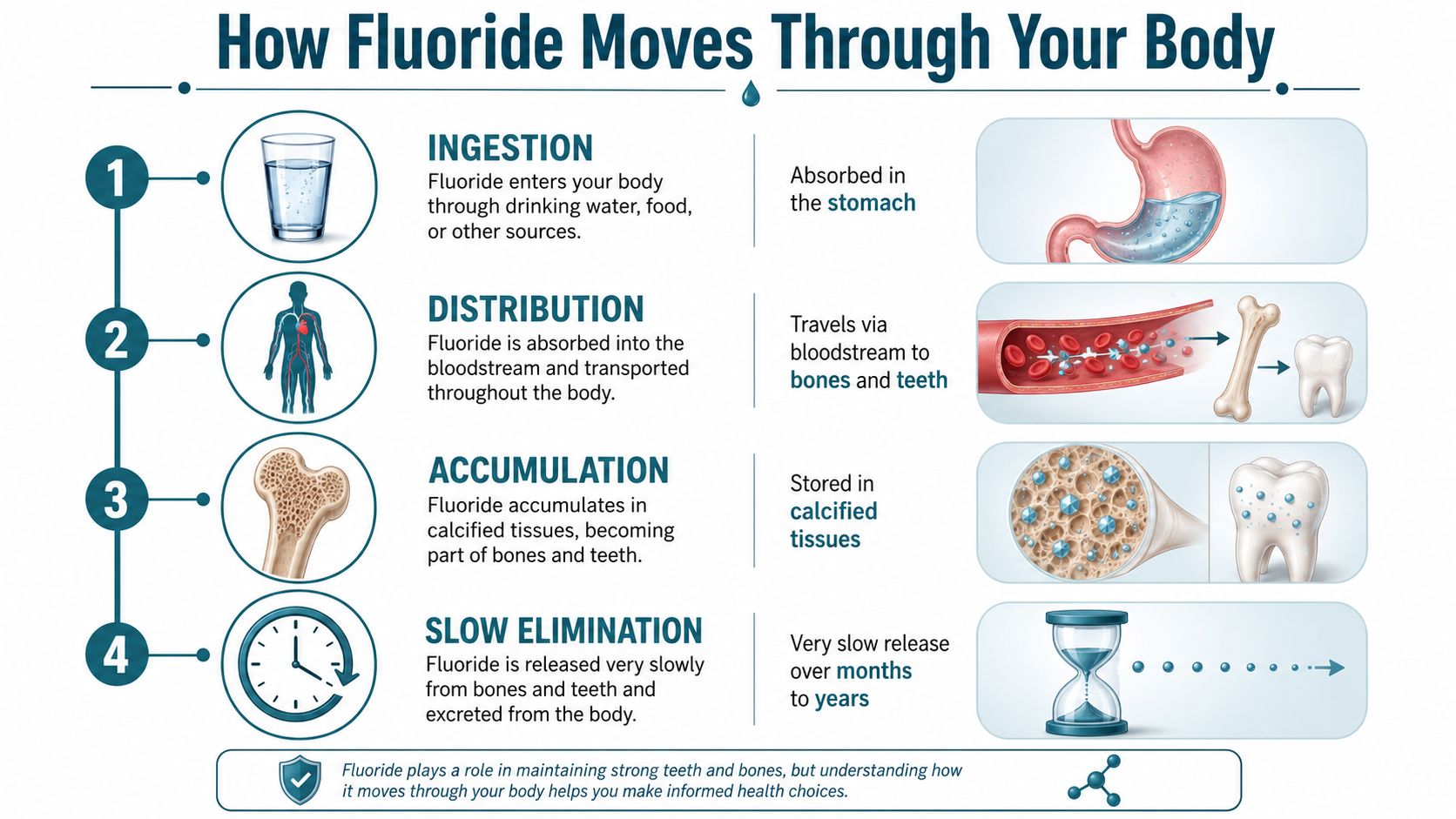
Fluoride's path through the body is best understood as a timeline. After someone swallows it, the digestive tract absorbs it quickly. The National Academies describes an initial half-life near 30 minutes, followed by a plasma half-life of about 3 to 10 hours as fluoride circulates, distributes, and begins leaving the bloodstream (National Academies explanation of fluoride pharmacokinetics).
The body removes fluoride primarily through the kidneys. Medical references describe renal excretion as the main removal route, with reported elimination half-life estimates of 2.4 to 4.3 hours and average renal fluoride clearance around 50 mL per minute (AccessMedicine clinical reference on fluoride handling). These measurements describe fluoride in circulation and urine. They do not mean that fluoride associated with mineralized tissues has disappeared.
Blood clearance and tissue storage are different clocks
Fluoride clearance works like a bathtub draining while a nearby sponge slowly releases absorbed water. Urinary excretion represents the drain, or the reduction of fluoride in plasma. Bone and teeth are more like the sponge, retaining some fluoride and releasing it gradually.
Older dental literature observations found that after fluoride was removed from community water, the half-life for fluoride loss was about 120 weeks in adults and 70 weeks in children (AccessMedicine discussion of fluoride release from tissues). This distinction explains why detox claims can sound plausible while missing important context. Circulating fluoride may decline relatively quickly, whereas fluoride associated with the skeleton changes more slowly.
What this means for families
No special schedule tells the body when to “cleanse” fluoride. With healthy kidney function, ordinary renal excretion handles much of the fluoride in circulation. Long-term tissue storage changes through normal bone remodeling and changing exposure patterns.
A clinician may consider kidney health, age, total intake, and the reason for concern. Families can reduce unwanted exposure without panicking about the slower tissue timeline. They also should not expect a product marketed as a detoxifier to erase established storage. A fluoride-free dental practice can instead help review exposures and build a prevention plan that fits the family's choices.
Where Fluoride Exposure Actually Comes From
Water is only one part of the exposure picture. Fluoride may also come from food, fluoridated salt, toothpaste, mouthwash, and professional dental products. The practical question is how much is swallowed, how often it happens, and whether several sources overlap in the same household.
EFSA's updated assessment identifies drinking water, food, fluoridated salt, and toothpaste as possible sources, while noting that population data about dental products remain limited. It also reported that European water concentrations were below 0.3 mg/L in 86% of samples and below 0.7 mg/L in more than 97% of samples. Those findings do not establish the fluoride level in a particular Ohio home. Local municipal information or private-well testing is more useful for that decision.
Common fluoride exposure sources
| Source | Typical Fluoride Level | Exposure Frequency |
|---|---|---|
| Drinking water | Varies by municipal supply, well, and filtration | Often daily |
| Food and beverages | Varies with ingredients, preparation water, and origin | Daily or occasional |
| Fluoridated salt | Depends on whether the product is fluoridated | Based on eating habits |
| Toothpaste | Depends on the product formula and whether it's swallowed | Usually during brushing |
| Mouthwash | Depends on the product formula | Occasional or daily |
| Professional dental products | Depends on the treatment selected | During dental appointments |
There is no single “typical” number that fits every product or family. A child who routinely swallows toothpaste has a different exposure pattern from an adult who spits well but drinks fluoridated water. Daily fluoride mouthwash creates another pattern, while a treatment applied only during an appointment is occasional.
Source-by-source questions
Parents can sort through the possibilities with three questions:
- What gets swallowed? Toothpaste and mouthwash matter more as ingested sources than products used briefly and fully expelled.
- What happens every day? A repeated habit may deserve more attention than an occasional product.
- What does the water report say? Municipal and private-well supplies can differ, and filtration may change the fluoride level in the water used for drinking and cooking.
This review keeps attention on the sources that affect a family's routine. It also prevents one product from becoming the automatic explanation before the full exposure pattern is understood. A fluoride-free dental practice can help families examine those choices while continuing to monitor brushing, cleaning, examinations, and cavity risk.
Practical Steps to Reduce Fluoride Exposure
Families who want lower fluoride exposure can begin with ordinary household decisions, not an expensive cleanse. The safest plan preserves brushing, cleaning, examinations, and cavity monitoring while changing the sources that matter most for that individual.
Start with the most likely swallowed sources
Review toothpaste habits. Children should be supervised so toothpaste is brushed and spat rather than swallowed. Families considering fluoride-free toothpaste can also discuss hydroxyapatite products and prevention planning through hydroxyapatite toothpaste benefits.
Check mouthwash use. Mouthwash isn't automatically necessary for every person. A parent can read the active ingredients and ask a dental professional whether the product adds value for that child or adult.
Investigate the water supply. Municipal water information, private well testing, and household filtration can clarify whether water is a meaningful source. Reverse osmosis and activated alumina are commonly discussed filtration approaches, but filter performance depends on the specific product and its maintenance.
For readers comparing filtration systems, a detailed guide to the best filter for fluoride in water can help explain which technologies are designed to address fluoride and what consumers should verify before purchase. The filter should be selected for the actual household source, not based on a broad “detox” label.
Keep nutrition sensible
A mineral-rich diet supports general health, but no food has been proven to extract stored fluoride from bone. Families can focus on varied meals, adequate hydration, and normal nutrition rather than restrictive regimens that promise rapid cleansing.
Dental prevention still matters after a toothpaste or water change. Regular cleaning and exams, dental X-rays when clinically indicated, sealants, and early treatment can help identify risk before a small enamel problem becomes a painful cavity. Fluoride-free care doesn't mean ignoring oral hygiene or accepting preventable tooth decay.
The CDC identifies dental fluorosis as an enamel appearance change caused by consuming too much fluoride while teeth are developing, so children's swallowing habits deserve special attention (CDC information about dental fluorosis). A family can ask about alternatives, including hydroxyapatite varnish, sealants, and recall visits, while making decisions based on the child's actual cavity risk.
What to Expect at a Fluoride-Free Dental Practice
A fluoride-free dental visit should still feel like a complete dental visit. A parent may arrive with questions about toothpaste, water, enamel spots, or previous treatments. The team can review those concerns, examine the teeth and gums, and explain which preventive choices fit the patient's age and risk profile.

A visit built around questions and choices
A new patient exam may include a health history, oral examination, cleaning recommendations, and digital X-rays when the clinician needs diagnostic images. The purpose isn't to pressure a family into a product. It's to identify active disease, previous fillings, enamel development, gum health, and habits that affect future risk.
Patients preparing for a consultation may find these doctor visit preparation tips useful. A written list can include questions about hydroxyapatite, sealants, brushing technique, water testing, recall timing, and what signs would require a change in the plan.
Prevention without fluoride treatments
A fluoride-free plan may combine several tools rather than relying on one substitute. Depending on the patient, the dentist may discuss:
- Hydroxyapatite products: These are fluoride-free options used to support enamel care.
- Sealants: These protective coatings may help shield vulnerable chewing surfaces.
- Dietary guidance: Meal and beverage patterns can be reviewed for cavity-related risks.
- Closer monitoring: Some patients need regular follow-up so early changes are found promptly.
Amanda Family Dental provides fluoride-free dentistry as an option within broader preventive and restorative care. The same practice can also address fillings, crowns, root canals, tooth extraction, dentures, and dental implants when disease or damage requires treatment.
A fluoride-free plan doesn't guarantee that cavities won't occur. It does create a clear agreement about the products used, the risks being monitored, and the steps the family will take if enamel begins to weaken.
Warning Signs and When to Seek Professional Help
Searching for fluoride information does not automatically mean there is an emergency. Many parents are reviewing toothpaste, drinking water, or a child's developing teeth. Two separate concerns often appear in the same search: dental fluorosis and acute fluoride toxicity.
Dental fluorosis occurs when a child consumes excess fluoride while teeth are forming. The CDC describes white flecks, spots, or lines as possible enamel changes and characterizes fluorosis mainly as a cosmetic condition (CDC explanation of dental fluorosis). These marks are different from sudden poisoning. A dentist can compare them with early decay, enamel defects, or surface staining and explain whether any treatment or monitoring is appropriate.
When the situation is urgent
A single large ingestion requires a different response. Acute fluoride toxicity can cause nausea, vomiting, abdominal pain, diarrhea, weakness, and hypocalcemia. A clinical review discusses symptoms that may occur with ingested doses around 3 to 5 mg/kg, while 5 to 10 mg/kg is often cited as a typical toxic dose range (clinical review of acute fluoride poisoning).
If someone may have swallowed a large quantity of toothpaste, fluoride gel, tablets, or another fluoride-containing product, contact poison control or emergency medical services promptly. Treatment is managed by medical professionals and may include soluble calcium, correction of calcium and potassium disturbances, acid-base management, and cardiac monitoring when indicated. Activated charcoal does not work well for fluoride because it does not adsorb effectively to charcoal (acute fluoride poisoning management resources).
A simple decision framework
- White marks on developing teeth: Arrange a dental evaluation.
- Concern about routine exposure: List the sources and request a preventive consultation.
- Recent large ingestion or symptoms: Seek emergency medical guidance immediately.
Parents should not try to treat acute symptoms with a home detox drink or wait for a routine cleaning. Routine exposure questions belong in a dental consultation, while suspected poisoning belongs with poison control or emergency care.
Schedule Your Fluoride-Free Consultation in Ohio
Families can make informed fluoride choices without abandoning cavity prevention. The evidence supports a source-specific approach: reduce unnecessary intake, avoid unsupported detox products, and use professional monitoring to protect enamel and comfort.
Amanda Family Dental serves families seeking a dentist in Amanda, OH, as well as patients traveling from Lancaster, Circleville, and Carroll, Ohio. A consultation can address fluoride-free toothpaste, hydroxyapatite options, sealants, cleanings and exams, dental X-rays, emergency dental services, tooth extraction, restorative dentistry, cosmetic dentistry, and dental implants near me or a cosmetic dentist near me search when broader care is needed. Readers evaluating how practices communicate and grow can also review guidance on how to partner with Transactional LLC, while keeping the focus on clear patient communication.
Amanda Family Dental offers fluoride-free preventive options, new patient exams, digital X-rays, cleanings, and personalized treatment plans for families in Amanda, Lancaster, Circleville, and Carroll, Ohio. Visit Amanda Family Dental to request a consultation and discuss a safe, practical plan for reducing fluoride exposure while protecting the smile.