

Choosing toothpaste for a child can feel oddly stressful. A parent stands in the store aisle, compares labels, sees words like “natural,” “safe if swallowed,” and “cavity protection,” and then wonders which claim matters. For many families in Amanda, Lancaster, Circleville, and Carroll, Ohio, the primary question isn't whether a product sounds good. It's whether it fits the child in front of them.
Parents usually aren't looking for a trend. They're trying to make a careful decision. Some want to limit what their toddler swallows. Some are worried about cavities because an older sibling had them early. Some want straight answers from a local dental office that understands both the science and the day-to-day reality of getting a young child to brush.
That's where clear guidance matters. Fluoride-free toothpaste for kids can make sense in certain situations, but it doesn't do the same job as fluoride toothpaste. The difference is important, and it's one of the reasons families looking for a dentist in Amanda, OH often want a conversation that goes beyond product marketing and focuses on risk, routine, and what works at home.
Table of Contents
- Navigating Your Child's Oral Health in Amanda Ohio
- What Is Fluoride-Free Toothpaste for Kids
- The Pros and Cons for Your Child's Dental Health
- How to Choose a Kids Toothpaste Ingredients to Look For
- Safe Brushing Techniques and Toothpaste Amounts
- A Partnership for Lifelong Health at Amanda Family Dental
- Schedule a Consultation with Your Local Amanda Dentist
Navigating Your Child's Oral Health in Amanda Ohio
A common scene plays out long before a child ever sits in a dental chair. A parent is in the oral care aisle, holding two boxes. One says fluoride free. The other promises cavity protection. Both look like they're made for children. The harder part is knowing what those labels mean for a toddler who still swallows toothpaste, or for a preschooler who has already had a few white spots on the teeth.
Families across Amanda, Lancaster, Circleville, and Carroll often come in with that exact concern. They've read online opinions that pull in opposite directions. One article says fluoride is essential. Another says to avoid it completely. Parents are left trying to sort through fear, marketing, and half-explained advice while also managing bedtime routines, picky eaters, and busy schedules.
Amanda Family Dental approaches that conversation with the same mindset used for all dental care. The question isn't what the internet is arguing about. The question is what fits a child's age, brushing habits, cavity risk, and home routine. Parents who want more guidance on daily prevention can also review these children's dental health tips.
Local families usually need clarity, not extremes
Some households prefer simpler ingredient lists in many parts of family life. That may include personal care products, foods, and even nursery planning. For parents taking that broader approach, resources on creating a non-toxic nursery can be part of the same thoughtful decision-making process.
The safest-feeling option isn't always the most protective option. The best choice depends on what problem a parent is trying to solve.
That distinction matters. If the main concern is swallowing toothpaste, a fluoride-free option may be reasonable for a young child in a narrow stage of development. If the concern is preventing decay in a child who is already at higher risk, the answer often changes.
Good advice starts with the child, not the label
A child's toothpaste is only one part of the picture. Diet, brushing supervision, snack frequency, regular cleanings and exams, and professional recommendations all affect whether a child stays cavity free.
Parents searching for a dentist near me, a dentist in Lancaster, OH, or a dentist in Circleville, OH often want a practice that can make these choices simpler. That's the main goal here. Not to shame one choice or glorify another, but to help families understand what each option does and does not do.
What Is Fluoride-Free Toothpaste for Kids
Fluoride-free toothpaste for kids is best understood as a learning-stage product. It helps children get used to brushing, the feel of a toothbrush, and the routine of cleaning their teeth. It can also help remove plaque when a parent brushes thoroughly for them.
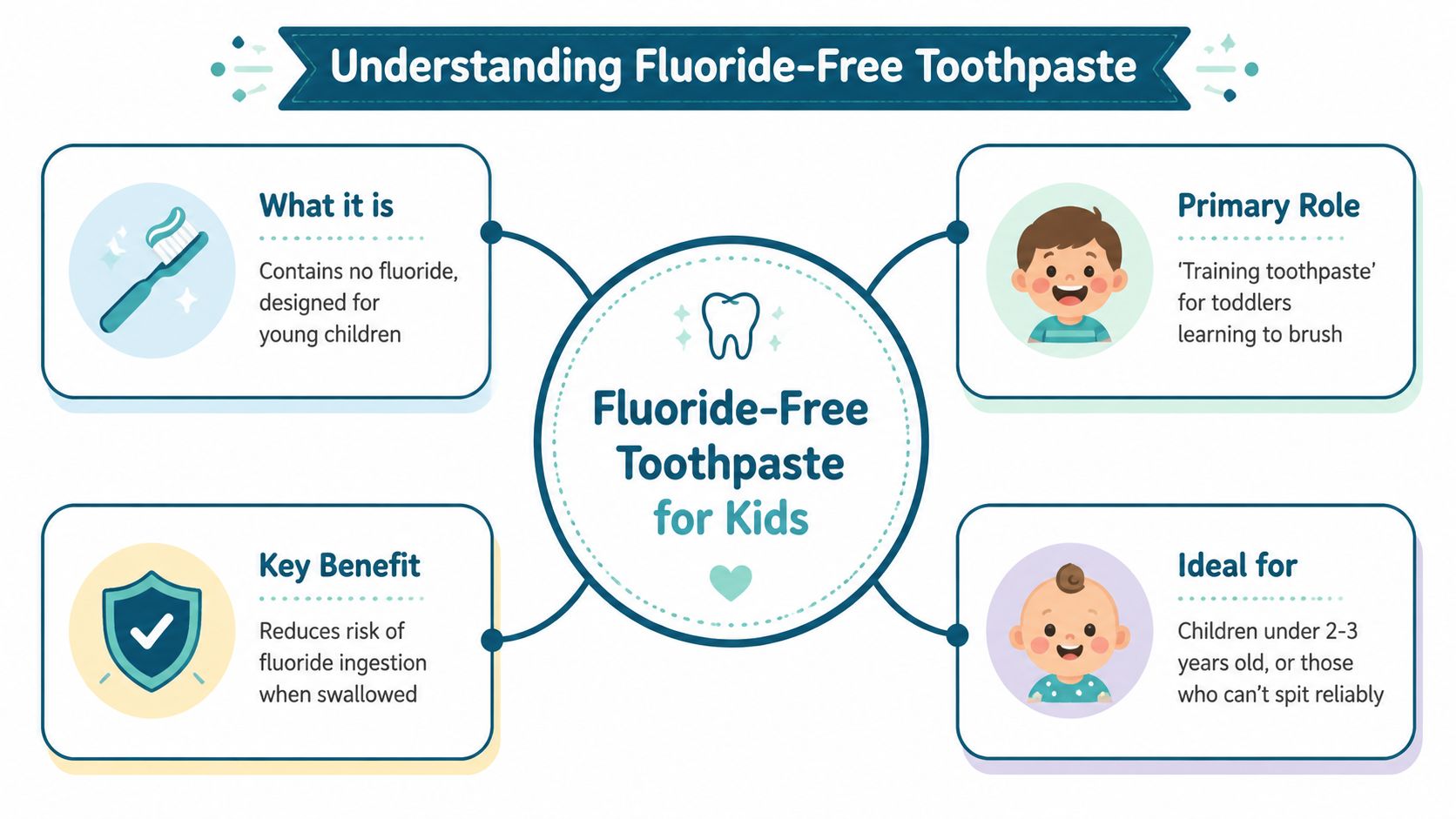
That's why many dentists think of it the same way they think about training wheels on a bike. It supports the learning phase. It is not the final goal. Its main role is habit building and mechanical cleaning, especially for children who can't spit reliably yet.
A tool for learning, not a full substitute
Clinical guidance described in this pediatric oral health discussion from University of Utah Health explains that fluoride-free toothpaste for young children is primarily a training and plaque-removal aid, not a cavity-preventive agent. Its value depends on the child's cavity risk and on the mechanical action of brushing.
That point often gets lost in packaging language. A fluoride-free paste can help a brush move smoothly over the teeth. It may improve cooperation because the flavor is mild. It may reduce worry for parents whose toddler still swallows. But it doesn't provide the same enamel-strengthening and decay-prevention role that fluoride toothpaste is meant to provide.
Practical rule: If a parent chooses fluoride-free toothpaste, the quality of brushing becomes even more important.
Who it may fit best
For some toddlers at low to moderate cavity risk, fluoride-free toothpaste can be a reasonable short-term choice when the parent is brushing carefully and consistently. That usually means the child has no history of cavities, doesn't snack on sugary foods often, and isn't showing early signs of enamel trouble.
A simple way to think about it is this:
| Child situation | How fluoride-free toothpaste may fit |
|---|---|
| Very young child still swallowing | May help with routine building |
| Child resists strong flavors | May improve cooperation |
| Parent wants a transitional option | Can work as a temporary training paste |
| Child already showing higher decay risk | Usually not enough on its own |
Children's toothpaste decisions shouldn't be based on age alone. They should be based on behavior and risk. A child who still swallows but has frequent snacking habits may need a different plan than a child of the same age with lower decay risk.
That's why this topic shouldn't be reduced to “good” versus “bad.” Fluoride-free toothpaste has a place. It just needs to be used for the job it does.
The Pros and Cons for Your Child's Dental Health
The main advantage of fluoride-free toothpaste is easy to understand. It reduces concern about fluoride ingestion in children who swallow toothpaste. For parents of toddlers, that can feel like a practical compromise while brushing habits are still developing.
The main drawback is just as important. It does not offer the same cavity protection as fluoride toothpaste. That trade-off needs to be stated plainly, because many toothpaste labels blur the line between “gentle” and “protective.”
Where fluoride-free toothpaste helps
Fluoride-free products can be useful when the goal is routine, not chemical cavity prevention. They may help with:
- Swallowing concerns when a toddler isn't able to spit yet
- Brushing practice during the early learning phase
- Plaque removal support when a parent is doing the brushing well
- Flavor acceptance for children who reject stronger products
Those benefits are real, but they are limited. They revolve around safety comfort and habit building. They do not change the basic biology of cavity prevention.
Where it falls short
The best available evidence still supports fluoride toothpaste for reducing decay. A systematic review summarized in PubMed Central concluded that trials of fluoride toothpaste in children provided clear evidence that it helps prevent dental caries. The same review notes that toothpaste with at least 1,000 ppm fluoride is more effective at reducing tooth decay than fluoride-free toothpaste, and some consumer-facing pediatric guidance states that fluoride has been shown to decrease cavity formation in children by at least 40%.
Parents don't need to memorize the chemistry to understand the practical point. Fluoride helps teeth resist the daily acid attacks that come from bacteria feeding on sugars and starches. That makes it a very different tool from a toothpaste that helps a brush glide and freshens the mouth.
Parents are right to ask hard questions about ingredients. The answer should still match what prevents disease most reliably.
A balanced view usually looks like this:
| Question | Fluoride-free toothpaste | Fluoride toothpaste |
|---|---|---|
| Helps with training and brushing routine | Yes | Yes |
| Reduces worry about swallowing | Yes | With proper small amounts and supervision |
| Provides stronger cavity prevention | No | Yes |
| Best used as a long-term default for high-risk kids | No | More often, yes |
For a child with early cavities, dry mouth, frequent snacking, or other higher-risk factors, fluoride-free toothpaste usually asks too much of brushing alone. For a low-risk toddler in a short transitional stage, it may still be a reasonable tool. The key is understanding that these are different products with different jobs.
How to Choose a Kids Toothpaste Ingredients to Look For
Once a parent decides whether a fluoride-free product fits their child's stage, the next step is reading the ingredient label carefully. Not all fluoride-free toothpastes are equal. Some are thoughtfully made for children. Others focus more on branding than function.
What to look for on the label
A good children's toothpaste should clean gently and make brushing easier to repeat every day. For fluoride-free options, several ingredients deserve a closer look.
- Xylitol can be a smart sweetener choice. It is a non-cariogenic polyol and can inhibit mutans streptococci, the bacteria most associated with cavities.
- Low-abrasivity cleaning agents such as hydrated silica can help remove plaque without being too harsh on developing enamel.
- Child-friendly flavors often improve cooperation, especially for toddlers who resist mint.
- Simple formulations may be easier for parents who want to avoid unnecessary additives.
Guidance summarized by this pediatric dentistry ingredient review notes that xylitol is beneficial in fluoride-free kids' toothpastes, low-abrasivity agents like hydrated silica help protect developing enamel, and strong detergents such as high levels of SLS can irritate a child's mouth.
What deserves extra caution
Some children's products sound appealing but create avoidable problems. A parent should pause before choosing a toothpaste with:
- Strong detergents, especially if a child's mouth seems sensitive or brushing leads to complaints of stinging
- Whitening or charcoal claims, which often don't belong in a young child's routine
- Sugary or syrup-like sweeteners, which work against the goal of reducing cavity risk
- Rough abrasives, especially for children with visible enamel wear or sensitivity
For families who want to compare different product categories more broadly, these fluoride-free options for dental care can help frame the discussion. Product choice still needs to be individualized, but a label check goes a long way.
A toothpaste that tastes good but irritates the mouth or scrubs too aggressively isn't a good children's toothpaste.
One practical note matters here. “Natural” doesn't automatically mean better for teeth. A child's toothpaste should be judged by how gently it cleans, whether it supports a consistent routine, and whether it matches the child's decay risk. Parents often do better when they ignore front-label buzzwords and focus on the ingredient panel instead.
Safe Brushing Techniques and Toothpaste Amounts
Parents often spend a lot of time choosing toothpaste and not enough time on the amount used. That's understandable, but the amount matters. So does who is doing the brushing.
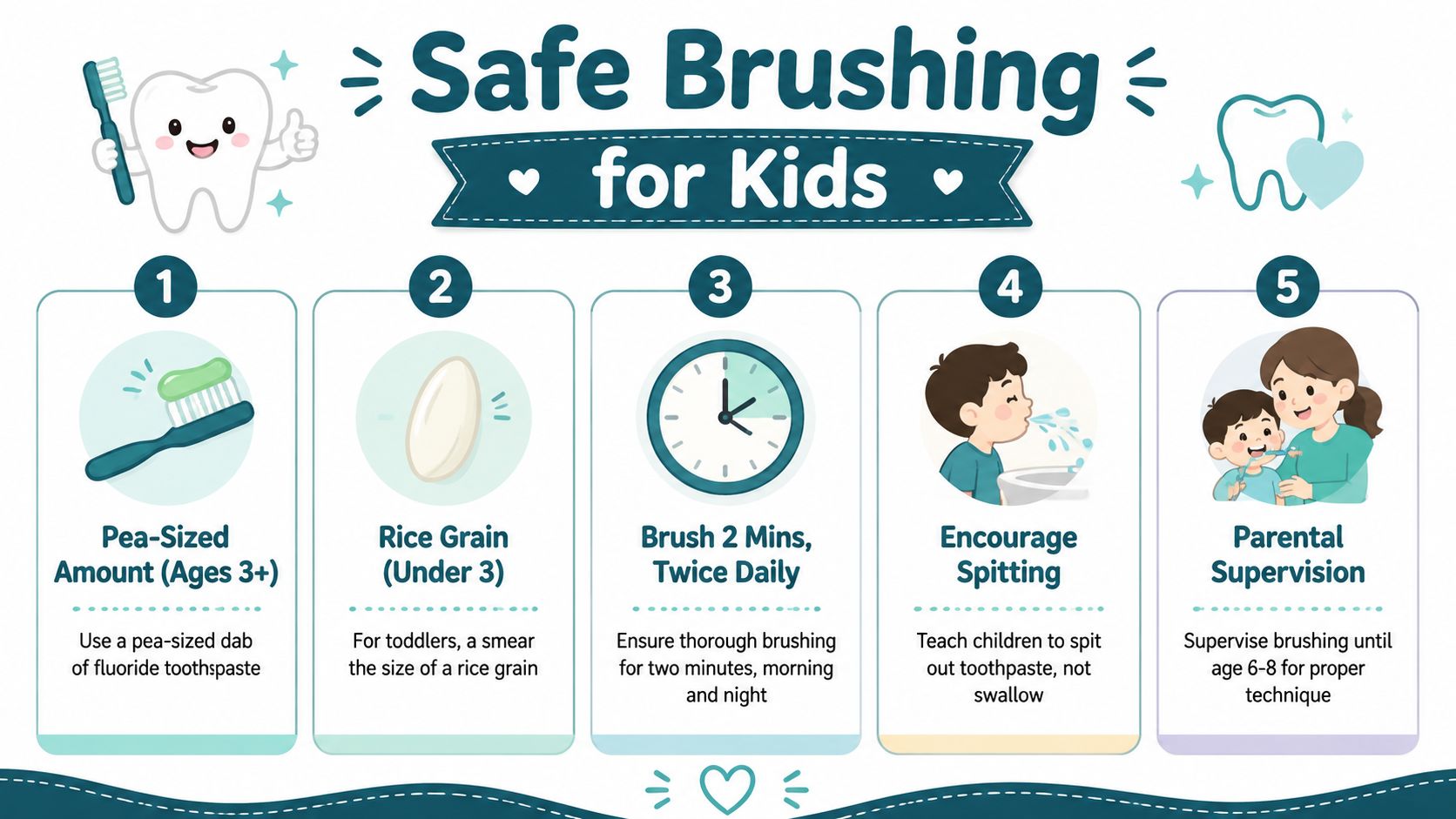
A visual can make that easier to remember.
The amount matters more than most parents think
The American Academy of Pediatrics recommends a smear or grain-of-rice–sized amount of fluoride toothpaste from the first tooth until age 3, then a pea-sized amount after age 3, according to the AAP guidance summarized on HealthyChildren.org. That same source notes that more than 38% of children aged 3 to 6 years used more toothpaste than recommended in CDC analysis, which shows why parental guidance matters.
That advice surprises many parents because toothpaste ads and product photos often show a brush covered end to end. Children don't need that much. In fact, using too much creates the exact worry many parents are trying to avoid.
A short reference video can also help parents picture the routine at home.
Technique is what makes any toothpaste useful
No toothpaste can make up for rushed brushing. For young children, parents should brush or closely supervise for a full 2 minutes, covering the front, back, and chewing surfaces.
A simple home routine usually works best:
- Use a soft-bristled brush that fits the child's mouth comfortably.
- Place only the recommended amount of toothpaste on the bristles.
- Angle the brush gently along the gumline and tooth surfaces.
- Help the child spit, but don't panic if a very small amount is swallowed.
- Keep the routine consistent morning and night.
Families who want to fine-tune the order of oral hygiene steps can also review guidance on mouthwash before or after brushing, especially as children get older and their routines become more independent.
For some children, home brushing still needs backup. Professional fluoride varnish may be appropriate for higher-risk kids. For families who prefer a fluoride-free route, one available option at Amanda Family Dental is hydroxyapatite varnish, along with fluoride-free toothpaste containing hydroxyapatite. That doesn't make every child a candidate for the same approach, but it gives parents another preventive option to discuss during a visit.
A Partnership for Lifelong Health at Amanda Family Dental
A toothpaste decision is never the whole story. A child can use the right product and still struggle if brushing is inconsistent, snacks are frequent, or early enamel changes go unnoticed. That's why long-term oral health works best when home care and professional care support each other.
Home care works better with professional guidance
Regular cleanings and exams help catch small issues before they become painful ones. New patient exams and digital X-rays can reveal patterns that parents can't see at home, including developing decay between teeth or areas where plaque tends to build. For some children, that leads to a simple preventive plan. For others, it may mean closer follow-up, fluoride recommendations, or restorative care if decay has already started.
This is one reason families searching for a dentist in Carroll, OH, an emergency dentist, or a local office for new patient exams often want a full-service practice instead of one-off advice. Children's needs change quickly, and prevention decisions need to change with them.
A broader plan for growing smiles
A strong plan for kids usually includes more than toothpaste choice alone:
- Routine preventive visits to monitor development and spot early concerns
- Personalized risk assessment based on diet, brushing habits, and cavity history
- Comfort-focused care so children build trust with dental visits early
- Access to restorative treatment if a cavity, chipped tooth, or infection needs prompt attention
Healthy habits outside the bathroom matter too. Family patterns around snacks, drinks, sleep, and activity affect oral health more than many people realize. Parents who are thinking broadly about overall wellness may also find useful ideas in this Playz article on reducing childhood obesity, since daily routines around food and movement often overlap with cavity prevention habits.
A child's smile is usually shaped by many small daily choices, not one perfect product.
That's the mindset behind pediatric care in a community practice. Whether a family comes from Amanda, Lancaster, Circleville, or Carroll, the goal is the same. Keep children comfortable, protect healthy teeth, and give parents advice that fits real life.
Schedule a Consultation with Your Local Amanda Dentist
The best toothpaste for one child may not be the best toothpaste for another. A toddler who still swallows, a preschooler with early enamel changes, and a grade-school child with frequent snacking habits may each need a different recommendation. That's why a personalized dental visit is more useful than guessing in the store aisle.
Parents looking for a dentist near me, a dentist in Amanda, OH, or family-focused dental care in the surrounding area often want a clear answer to one simple question. What should this child use right now? That answer depends on brushing skill, cavity risk, diet, and what the teeth look like during an exam.
Amanda Family Dental serves families in Amanda, Lancaster, Circleville, and Carroll, Ohio with preventive care, pediatric evaluations, digital X-rays, and treatment planning that matches the child's needs. If a parent is weighing fluoride-free toothpaste for kids, wondering about cavity risk, or trying to make brushing easier at home, a consultation can make the decision much simpler.
A local visit can also help if a child needs more than prevention alone, including restorative dentistry, tooth extraction, or urgent care from an emergency dentist. Early guidance often prevents more stressful treatment later.
If questions about fluoride-free toothpaste for kids are coming up at home, the next step is a personalized conversation with Amanda Family Dental. Parents in Amanda, Lancaster, Circleville, and Carroll can schedule an appointment to discuss home care, cavity prevention, and age-appropriate treatment options for their child's smile.