

A lot of people first notice gum recession in ordinary moments. Cold water suddenly stings near one tooth. A front tooth starts to look a little longer in the mirror. Brushing feels fine, but the gumline doesn't look the way it used to. That kind of change can be unsettling, especially when it's hard to tell whether it's cosmetic, painful, or a sign of something more serious.
The good news is that gum recession treatment is real, practical, and often more manageable than patients expect. Some cases can be stabilized with non-surgical care. Others need grafting or another procedure to protect the tooth and improve the gumline. What matters most is getting a clear diagnosis early, before sensitivity, decay around the root, or further tissue loss become harder to manage.
For families looking for a dentist near me in Amanda, OH, or nearby communities like Lancaster, Circleville, and Carroll, Ohio, local care matters. It helps to have a dental office close to home where questions can be answered clearly, treatment choices are explained without pressure, and comfort is part of the plan from the first visit through recovery.
Table of Contents
- Your Trusted Local Dentist for Gum Health
- What Is Gum Recession and What Causes It
- How We Diagnose Gum Recession in Our Amanda Office
- Effective Non-Surgical Gum Recession Treatments
- Advanced Surgical Solutions for Lasting Results
- Your Comfort-Focused Journey at Amanda Family Dental
- Frequently Asked Questions About Gum Recession Care
Your Trusted Local Dentist for Gum Health
A patient in Amanda might think the problem is just sensitivity. A patient in Lancaster might assume the teeth have always looked that way. Someone in Circleville or Carroll may put it off because there's no major toothache yet. Gum recession often starts subtly, which is one reason people wait longer than they should.
What makes this frustrating is that the issue can affect comfort, appearance, and long-term dental health all at once. The exposed root can feel tender. The tooth can seem longer or uneven. Plaque can become harder to control around the gumline. If recession is tied to gum disease or bite stress, the underlying problem keeps moving forward even when symptoms come and go.
That's why local, thorough evaluation matters. A patient searching for a dentist in Amanda, OH or a dentist in Lancaster, OH usually wants more than a quick answer. Those seeking care typically want to know what's causing the change, whether it can be stopped, and what treatment is worth doing.
A common situation close to home
One of the most common patterns looks like this: a patient notices a notch near the gumline, starts avoiding cold drinks on one side, and wonders whether whitening toothpaste or a harder brushing routine is making things worse. Another patient sees recession around a tooth that already has an old filling or crown and worries the tooth may be failing.
Practical rule: If a tooth suddenly looks longer, feels newly sensitive, or collects plaque along the gumline more easily, it's worth having the gums checked before the problem gets deeper.
For patients in Amanda, Lancaster, Circleville, and Carroll, Ohio, the goal isn't to make treatment sound dramatic. The goal is to make it understandable. Some recession needs maintenance and habit changes. Some calls for restorative care. Some needs a surgical approach for dependable root coverage. Good care starts by matching the treatment to the underlying cause, not just to the visible symptom.
What Is Gum Recession and What Causes It
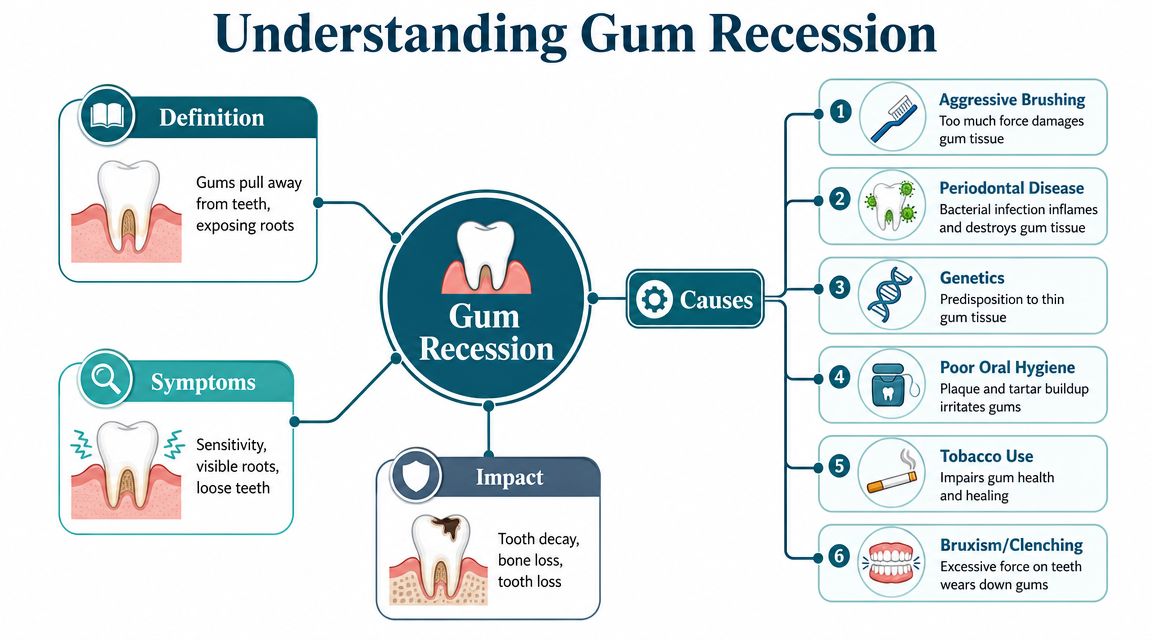
Gum recession means the gum tissue has moved away from its normal position on the tooth, exposing more of the tooth structure and sometimes the root. A simple way to think about it is shoreline erosion. The waterline shifts, and parts that used to stay covered are now exposed.
When the root is exposed, patients often notice sensitivity first. Others notice the shape of the smile changing, small grooves near the gumline, or an area that traps food more easily. Gum recession can involve one tooth or several. It can be mild and stable, or it can progress if the cause isn't addressed.
How recession changes the tooth and gumline
The root surface isn't the same as the enamel-covered part of the tooth. It's more vulnerable to wear and discomfort, and it can be harder to keep clean once the gumline has changed. Cleveland Clinic notes that approximately 88% of people over age 65 have gum recession on one or more teeth, which shows how common it becomes with age and why early attention matters for long-term oral health (Cleveland Clinic overview of gum recession).
For some people, the first clue isn't cold sensitivity. It's heat sensitivity, especially around exposed areas near the gumline. A practical outside resource on that symptom is this guide to heat sensitivity in teeth, which helps explain why temperature changes can feel sharper when the root surface is involved.
Common causes patients can recognize
Recession doesn't happen for one single reason. Several patterns show up repeatedly in day-to-day dental care:
- Periodontal disease: Infection and inflammation can damage the tissues that support the teeth and allow the gumline to pull back.
- Brushing too aggressively: A hard scrubbing technique can wear away gum tissue over time, especially near the canines and premolars.
- Thin gum tissue or genetics: Some patients start with a thinner gum profile that's easier to irritate or lose.
- Clenching and grinding: Excess force can contribute to stress around the teeth and gumline.
- Plaque and tartar buildup: If oral hygiene slips, inflamed tissue is more likely to recede.
- Restorative or alignment issues: Overhanging restorations or tooth position can create areas that are harder to clean and more prone to tissue loss.
Recession usually isn't just about appearance. It often reflects inflammation, friction, bite pressure, anatomy, or a mix of those factors.
Patients looking for preventive guidance can also review these tips for maintaining healthy gums. Daily habits matter, but home care works best when it's paired with an exam that identifies the actual driver behind the recession.
How We Diagnose Gum Recession in Our Amanda Office
A gumline problem can look simple from the mirror and still have several causes underneath it. That's why a real diagnosis matters. Treatment decisions change depending on whether recession comes from inflammation, bite pressure, brushing trauma, thin tissue, old dental work, or bone loss around the tooth.
What happens at the exam
A careful exam usually starts with what can be seen and measured directly. The gumline is checked tooth by tooth. The depth and pattern of recession matter. So does the thickness of the tissue, the position of the teeth, the presence of plaque buildup, and whether the exposed area is causing sensitivity or root wear.
Digital imaging also plays an important role. Bone support can't be judged by appearance alone, and low-radiation imaging helps show what's happening around the roots and beneath the gumline. Patients who want to understand that part of the process can learn more about digital X-ray advantages, including why this technology helps with diagnosis and treatment planning.
Why a full periodontal evaluation matters
Gum recession is often part of a broader gum health issue. The National Institute of Dental and Craniofacial Research reports that 42.2% of adults age 30 or older in the United States had total periodontitis, including 7.8% with severe periodontitis (NIDCR periodontal disease data for adults). That's why an exam for recession shouldn't stop at the visible edge of the gumline.
A thorough periodontal evaluation checks whether the supporting tissue is healthy, whether pockets are present, and whether the tooth is losing attachment. If the root cause is missed, treatment may improve the appearance temporarily while the disease process continues underneath.
The right diagnosis doesn't just answer, “Can this be covered?” It answers, “Why did this happen, and what has to change so it doesn't keep happening?”
That approach is especially important for patients in Amanda, OH, and surrounding communities who want practical answers without unnecessary treatment. Sometimes the next step is conservative. Sometimes it's restorative. Sometimes it's referral for surgical correction. The value is in knowing which path fits the condition in front of the patient.
Effective Non-Surgical Gum Recession Treatments
A lot of patients come in hoping the gumline can be moved back into place without surgery. In mild cases, conservative treatment can make a real difference. The goal is usually to calm the tissue, reduce sensitivity, and stop the recession from progressing so eating, brushing, and daily care feel comfortable again.
When conservative care is the right first step
The right non-surgical plan depends on what is driving the recession. If inflammation is active, the first priority is getting the area clean enough to heal. If brushing trauma is the problem, technique matters more than adding another product. If the root is exposed and sensitive, protecting that surface may bring faster relief than anything else.
Common non-surgical options include:
- Scaling and root planing: A deep cleaning that removes plaque and tartar below the gumline and smooths the root surface so irritated tissue can settle down.
- Topical antibiotics or antimicrobial rinses: Used in selected cases to lower bacterial activity in inflamed areas.
- Brushing technique changes: A soft toothbrush and a gentler approach can reduce repeated wear at the gumline.
- Bonding for exposed roots: Tooth-colored bonding can cover a sensitive or worn root surface and improve the look of a small recessed area.
- Orthodontic correction in selected cases: If tooth position is contributing to recession, moving the tooth into a healthier position may help protect the gum tissue over time.
As noted earlier, mild cases may respond well to measures such as bonding, orthodontic correction, or antibacterial therapy. Patients should still hear the trade-off clearly. These treatments are often very good at controlling the cause of recession, but they do not usually rebuild lost tissue.
What these treatments can and can't do
This is often the most important part of the conversation. Non-surgical care can reduce bleeding, tenderness, and temperature sensitivity. It can make brushing more comfortable and lower the risk of further damage. It can also give us a healthier starting point if a surgical procedure is needed later.
What it usually cannot do is fully cover an exposed root once gum tissue has been lost.
That does not make conservative care a temporary fix. In many mild cases, it is the appropriate treatment. If the area is stable, comfortable, and easy to keep clean, monitoring may be better than rushing into a procedure the patient does not need.
A short visual overview can help make those options easier to picture:
In our Amanda office, non-surgical treatment is usually the most comfortable place to start. We walk patients through what they may feel during a deep cleaning, how to manage sensitivity at home, what foods may bother exposed roots for a few days, and how soon we should recheck healing. That patient experience matters. Clear expectations reduce anxiety, and they help people follow through with the home care that often determines whether recession stays stable.
The best conservative plan is usually straightforward. Remove the irritation. Protect the root. Give the tissue a chance to calm down. Then reassess whether the result is healthy, comfortable, and acceptable to the patient.
Advanced Surgical Solutions for Lasting Results
When recession is more advanced, when roots remain exposed after conservative care, or when patients want the most dependable long-term root coverage, surgery becomes the more realistic option. At this point, the conversation should become more precise. Newer and less invasive techniques sound appealing, but patients deserve honest guidance about what tends to work most predictably and what trade-offs come with each approach.
Which surgical options tend to be most reliable
The current clinical literature supports a clear standard for predictable root coverage. A peer-reviewed clinical review identifies coronally advanced flap or tunneling procedures combined with a connective tissue graft as the most predictable options for single and multiple gingival recession defects (clinical review on recession treatment predictability).
That matters because patients often hear about many alternatives at once. Pinhole techniques, collagen matrices, acellular dermal matrices, platelet-based materials, and other newer approaches all have roles in selected cases. But when the main goal is long-lasting, evidence-supported root coverage, connective tissue grafting paired with a flap or tunneling approach remains the benchmark.
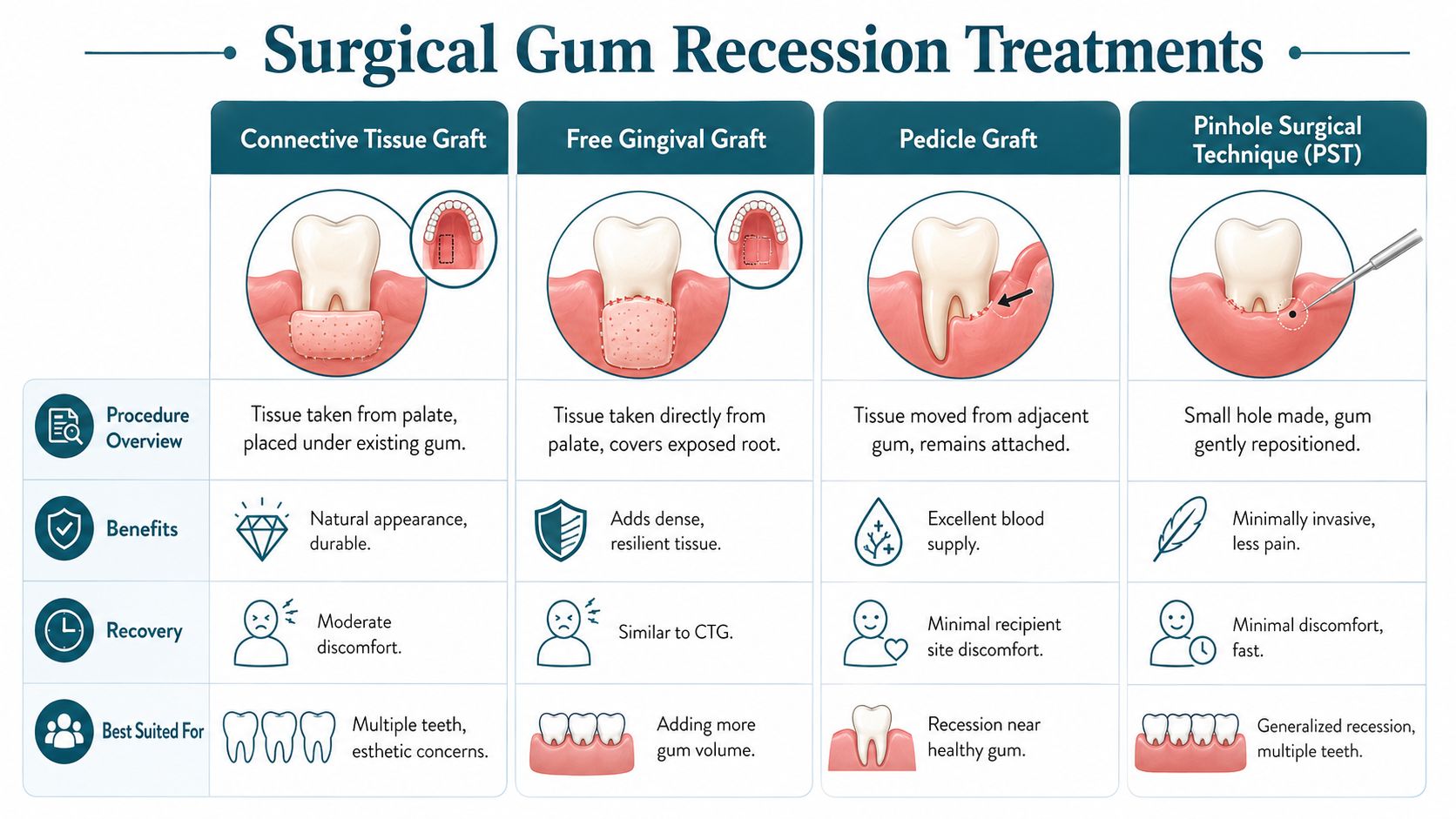
Three common ways to think about the options are:
- Good for tissue thickening: Free gingival grafts can add sturdy tissue where the main need is increasing gum width or durability.
- Better for selected adjacent tissue cases: Pedicle grafts use nearby gum tissue and can work well when the anatomy is favorable.
- Best-supported for predictable root coverage: Connective tissue grafting with a coronally advanced flap or tunneling procedure generally offers the most reliable blend of esthetics and long-term coverage.
Newer doesn't automatically mean more dependable. In recession surgery, the least invasive option isn't always the option with the strongest long-term support.
Comparing the trade-offs
Patients usually care about four things. Will it cover the root. How uncomfortable will it be. Will tissue need to be taken from the palate. How likely is the result to hold up.
Here is a practical comparison:
| Comparing Gum Recession Surgical Treatments | Best For | Invasiveness | Recovery Time |
|---|---|---|---|
| Connective tissue graft with flap or tunneling | Predictable root coverage and esthetic concerns | Moderate | Moderate |
| Free gingival graft | Building thicker, more resilient gum tissue | Moderate | Moderate |
| Pedicle graft | Isolated recession with healthy neighboring tissue | Moderate | Moderate |
| Pinhole Surgical Technique | Patients prioritizing minimal incisions in selected cases | Lower | Often lighter early recovery |
The table helps, but candidacy still depends on anatomy. Thin tissue, tooth position, bone support, depth of recession, and patient goals all affect the recommendation.
What works versus what sounds attractive
Many treatment conversations become confusing due to the availability of less invasive alternatives. These may reduce donor-site discomfort because they can avoid taking tissue from the palate. That can be a meaningful benefit. But the trade-off is that these methods are often chosen for patients who want to avoid tissue harvesting or who aren't ideal candidates for standard grafting, not because they consistently outperform conventional graft-based surgery.
Patients considering implants, crowns, or other restorative work should also know that healthy gum architecture matters. If recession is active or the supporting tissue is unstable, cosmetic and restorative results are harder to maintain over time.
A balanced recommendation usually sounds like this:
- If the priority is maximum predictability, connective tissue grafting usually leads the discussion.
- If the priority is avoiding a donor site, biomaterials or alternative methods may be considered with a clear discussion of limitations.
- If the main issue is tissue width rather than cosmetic root coverage, a different graft design may make more sense.
That kind of clarity helps patients make decisions without feeling pushed toward a trendy procedure or an overly aggressive one.
Your Comfort-Focused Journey at Amanda Family Dental
Most patients don't worry only about the gum recession itself. They worry about the process. They want to know whether the exam will hurt, whether treatment will be rushed, whether options will be explained in plain language, and what recovery will feel like once they get home.
From first conversation to treatment day
That journey usually starts with a front-desk experience that feels organized and calm, not hurried. For many people, that matters more than they expect. A comfortable start lowers tension before anyone looks at the teeth.

During consultation, the most helpful approach is collaborative. The dentist reviews what's visible, explains whether the case looks mild or more advanced, and talks through the practical choices. Some patients need non-surgical care and habit changes first. Some need restorative protection for exposed root surfaces. Some are better served by referral or planning for graft-based treatment.
For anxious patients, comfort options can change the entire experience. A useful local resource for learning about that side of care is sleep dentistry information, especially for people who tend to delay treatment because of fear, past difficult visits, or trouble sitting comfortably through dental procedures.
A good treatment plan should feel understandable. Patients shouldn't have to guess why a recommendation was made or what recovery will ask of them.
Recovery with clear guidance and support
Recovery tends to go better when instructions are specific and realistic. Patients usually do best when they know which foods to avoid, how to clean around the area, what level of tenderness is expected, and when they should call the office with a concern.
A comfort-focused visit also means respecting preferences. Some patients value choices reflecting their personal health philosophies, such as mercury-free materials or fluoride-free options when those choices fit the procedure being discussed. Others care most about efficient scheduling, same-day help when available, or spacing treatment in phases that work for family and work life.
For families in Amanda, OH, and nearby areas including Lancaster, Circleville, and Carroll, Ohio, that practical support often makes the deciding difference. Gum care doesn't feel overwhelming when each step is explained, the pace is manageable, and the patient knows exactly what comes next.
Frequently Asked Questions About Gum Recession Care
Is gum recession treatment painful
Most patients tolerate evaluation and early treatment well, especially when the area is handled gently and the plan matches the severity of the problem. Deep cleaning can cause temporary tenderness. Surgical treatment involves a recovery period, but discomfort is usually easier to manage when patients know what to expect and follow post-operative instructions closely.
Can gum recession be reversed
Recession itself isn't typically reversed on its own. Cleveland Clinic states that it can't be reversed, but treatment can keep it from worsening, and grafting is the most predictable and long-lasting corrective option. In practical terms, some treatments control the problem, while surgical treatment may be needed to cover exposed roots more fully.
Will insurance help with treatment
Coverage depends on the diagnosis, the procedure, and the details of the patient's plan. Some gum-related care is viewed as medically necessary periodontal treatment, while other parts may be handled differently if the main goal is cosmetic improvement. For patients trying to understand public coverage questions, this Family Caregiving Kit article on Medicaid dental offers a useful starting point for broader insurance research.
Can brushing harder fix the problem
No. A stronger brushing technique can make recession worse. A soft brush, a gentler hand, and a professional review of brushing habits are usually much safer than trying to scrub the area clean.
When should someone schedule an exam
A visit makes sense if a tooth looks longer, feels sensitive near the gumline, shows a notch near the root, bleeds easily, or has a gumline that seems uneven. Those changes don't always mean surgery is needed, but they do mean the gums should be examined before the condition advances.
If gum sensitivity, exposed roots, or changes in the way your smile looks have been worrying you, the next step is a clear diagnosis and a treatment plan that fits your comfort level. Patients in Amanda, Lancaster, Circleville, and Carroll can contact Amanda Family Dental to schedule an appointment, request a consultation, and get practical guidance on gum recession treatment close to home.