

A missing tooth rarely stays a small problem. Meals get awkward. Smiling in family photos can feel forced. Some people start chewing on one side, avoiding certain foods, or covering their mouth when they laugh. By the time they ask are dental implants worth it, they usually aren't asking about a product. They're asking whether the result will justify the time, surgery, and financial commitment.
That's a fair question for patients searching for a dentist in Amanda, OH, or nearby care in Lancaster, Circleville, and Carroll, Ohio. The right answer depends on more than appearance alone. It depends on how implants work, who's a good candidate, what trade-offs come with bridges or dentures, and what the long-term investment really looks like.
Table of Contents
- Why Patients Near Amanda OH Ask About Dental Implants
- What Exactly Are Dental Implants and How Do They Work
- A Realistic Comparison Implants vs Bridges and Dentures
- Are You a Good Candidate for Dental Implants
- The Dental Implant Process and Recovery Timeline
- Understanding the Cost and Financing Your Implants
- Take the Next Step at Amanda Family Dental
Why Patients Near Amanda OH Ask About Dental Implants
A common situation looks like this. Someone loses a back tooth and thinks they can live with it. Months later, chewing feels less natural, the gap becomes more noticeable than expected, and the question changes from “Can this wait?” to “What's the most solid fix?”
That's why people searching for dental implants near me, a dentist near me, or a dentist in Lancaster, OH are often looking for more than a cosmetic upgrade. They want a replacement that feels stable, looks natural, and doesn't create more trouble later. For many patients in Amanda, Circleville, Carroll, and nearby communities, a key concern is whether implants are worth the commitment compared with doing nothing or choosing a quicker alternative.

Why this question comes up so often
Missing teeth affect daily life in practical ways:
- Chewing changes: Harder or chewy foods often become less comfortable.
- Speech can feel off: Even one missing tooth can change how certain sounds come out.
- Confidence drops: People notice gaps more in conversations and photos than they expected.
- Other teeth may take extra pressure: Patients often start favoring one side without realizing it.
Implants also aren't a fringe treatment anymore. Implant use among U.S. adults with missing teeth increased by an average adjusted 14% per year from 1999 to 2016, and projections suggested that by 2026, up to 23% of adults needing tooth replacement could have implants, according to a U.S. population analysis of dental implant prevalence.
Many patients ask whether implants are worth it because they want one decision that solves the problem well, not a series of short-term fixes.
Some readers like comparing perspectives before scheduling a visit. A useful outside overview comes from Grand Parkway Smiles on implants. For readers who want the treatment details closer to home, this overview of dental implants near Amanda walks through the basics.
What Exactly Are Dental Implants and How Do They Work
A dental implant replaces the tooth's unseen portion. The root. That's what makes it different from a restoration that rests on top of the gums or depends on neighboring teeth for support.
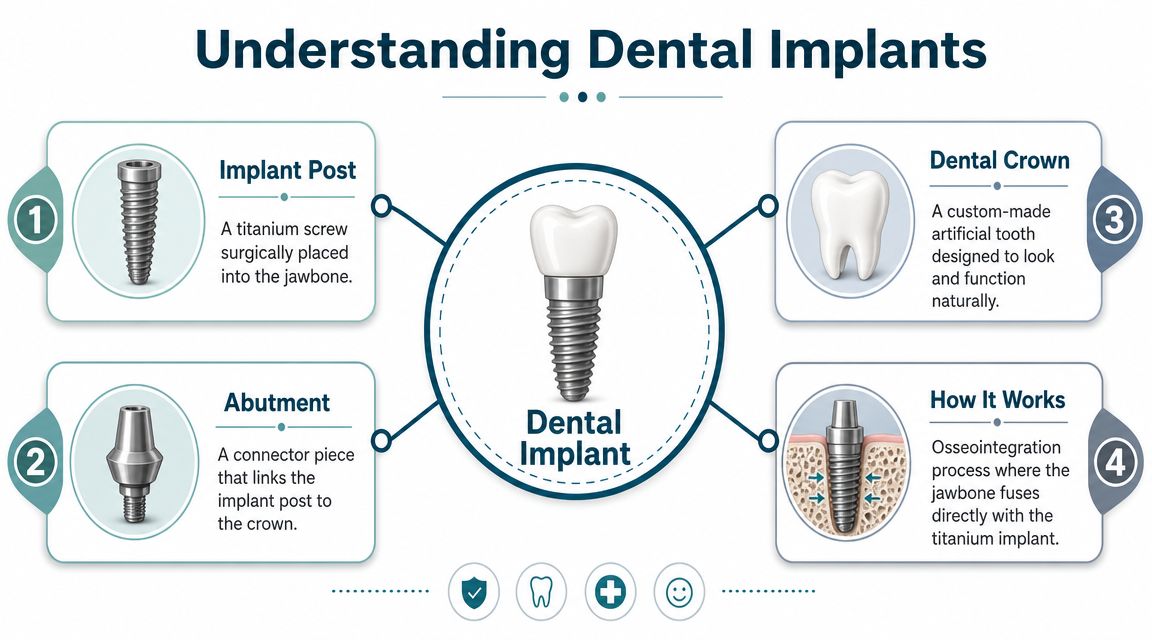
The basic design is straightforward. There's an implant body placed in the jawbone, a connector called an abutment, and the visible restoration, often a crown. Together, those parts create a replacement that functions more like a natural tooth than a removable appliance does.
The three parts in plain language
Imagine mounting something securely to a wall.
- Implant post: This is the part placed into the jawbone. It acts like the artificial root.
- Abutment: This small connector joins the implant to the final tooth.
- Crown: This is the visible part shaped and shaded to look like a natural tooth.
That structure matters because the support comes from inside the bone, not from a clasp, adhesive, or neighboring teeth.
Why implants behave differently
The FDA explains that a dental implant is surgically inserted into the jawbone to replace the tooth root, and the restoration is then supported by the implant body and abutment. The same FDA guidance notes that this design helps preserve adjacent teeth and can help prevent jawbone shrinkage from disuse, which is a major biological advantage over removable dentures and conventional bridges. That explanation appears in the FDA's overview of what dental implants are and what they do.
Practical rule: If the goal is to replace both the missing tooth and the missing root support, implants are the option designed to do both.
That jawbone connection is a big reason implants can feel more secure. When a tooth is missing, the body no longer gets the same signal to maintain bone in that area. An implant gives the replacement tooth a foundation inside the jaw, which is why patients often describe it as feeling closer to a natural tooth than other options.
For someone comparing restorative choices in Amanda, OH or surrounding communities, that difference isn't academic. It affects comfort, function, and how the mouth changes over time.
A Realistic Comparison Implants vs Bridges and Dentures
The most helpful way to judge value is side by side. Not every patient needs an implant. Some are better served by a bridge or denture because of budget, anatomy, health factors, or timeline. But the comparison needs to be honest.
Clinical summaries report implant success rates around 95% to 98% in the first five years, with long-term survival often above 90% at 20 years, and with proper care they may last a lifetime, according to this clinical summary on dental implant success and survival. That durability is why implants are often discussed as a long-term investment rather than a one-time purchase.
Dental Implants vs Bridges vs Dentures A Comparison
| Feature | Dental Implants | Fixed Bridges | Removable Dentures |
|---|---|---|---|
| Support | Anchored in the jawbone | Supported by neighboring teeth | Rest on the gums |
| Feel in daily use | Usually closest to a natural tooth | Stable, but depends on adjacent teeth | Can feel bulkier or less secure |
| Impact on nearby teeth | Preserves adjacent teeth | Usually requires shaping neighboring teeth | Doesn't rely on adjacent teeth in the same way |
| Jawbone support | Helps preserve jawbone | Doesn't replace the root | Doesn't replace the root |
| Cleaning and care | Ongoing home care and professional maintenance | Home care plus cleaning around the bridge area | Daily removal and cleaning |
| Repairs and adjustments | Possible over time, especially if complications arise | May need replacement or repair later | Often needs adjustments as the mouth changes |
| Long-term value | Often strongest when health and hygiene support success | Can be a practical middle-ground option | Often lowest upfront barrier, but trade-offs are real |
What usually matters most in real life
A bridge can be a very reasonable option when a patient wants a fixed replacement and isn't a good implant candidate. It can restore appearance and function well. The downside is that it usually depends on the teeth next to the gap, and those teeth may need to be prepared to hold the bridge.
Dentures still have an important place in restorative dentistry. They can replace multiple missing teeth and may be the right solution for patients who want a non-surgical option. But patients should go into that choice with clear expectations about stability, fit, and the day-to-day routine.
For many people, implants become the most appealing option because they stand on their own. They don't rely on neighboring teeth, and they're built around the missing root, not just the visible gap.
A second opinion can also help when the choices feel close. Some readers appreciate this review of missing-tooth options from Clayton Dental Studio, which lays out alternatives in a patient-friendly way.
The best replacement isn't the one with the lowest starting cost. It's the one that fits the patient's mouth, health, habits, and long-term goals.
Are You a Good Candidate for Dental Implants
A lot of people rule themselves out too early. They assume they're too old, that one medical condition makes implants impossible, or that they waited too long after losing the tooth. Sometimes that's true. Often it isn't.
The better question is whether the mouth and the patient's health support predictable healing and long-term maintenance. That answer comes from an exam, digital imaging, and a review of medical history. Still, there are useful signs patients can look at before scheduling.
A practical self-check
A patient may be a better implant candidate if several of these are true:
- The gums are generally healthy: Active gum problems may need treatment first.
- There's enough bone support: Some patients have enough bone right away. Others may need additional planning.
- Daily oral hygiene is realistic: Implants need consistent care, not occasional care.
- Smoking is limited or addressed: Tobacco use can complicate healing and long-term stability.
- Medical conditions are managed: Conditions like diabetes matter most when they're uncontrolled, not merely because they exist.
None of this means a patient needs a perfect dental history. It means the plan has to fit the actual patient, not an idealized one.
Questions older adults often ask
Age alone is not a primary barrier. Evidence indicates that implant success in older adults depends more on factors such as systemic health, controlled diabetes, bone quality, and oral hygiene than on chronological age, as noted in this discussion of implant candidacy in older adults.
That matters for people looking for a dentist in Circleville, OH, a dentist in Carroll, OH, or an implant consultation closer to Amanda. Many seniors are strong candidates. Some younger patients are not. The decision should be based on health and habits, not the birth year on a form.
A few good questions to ask at a consultation are:
- Is the bone in the missing-tooth area strong enough for support?
- Are the gums healthy enough to move forward now?
- Do any medications or health conditions change the plan?
- Would a bridge or denture make more sense in this specific case?
- What maintenance would this restoration require year after year?
If a patient can keep natural teeth healthy with steady home care and regular visits, that's usually a good sign for implant maintenance too.
The Dental Implant Process and Recovery Timeline
For patients who feel nervous about surgery, the process usually becomes much less intimidating once it's broken into steps. Implant treatment isn't one long appointment. It's a sequence with planning, healing, and follow-up built in.
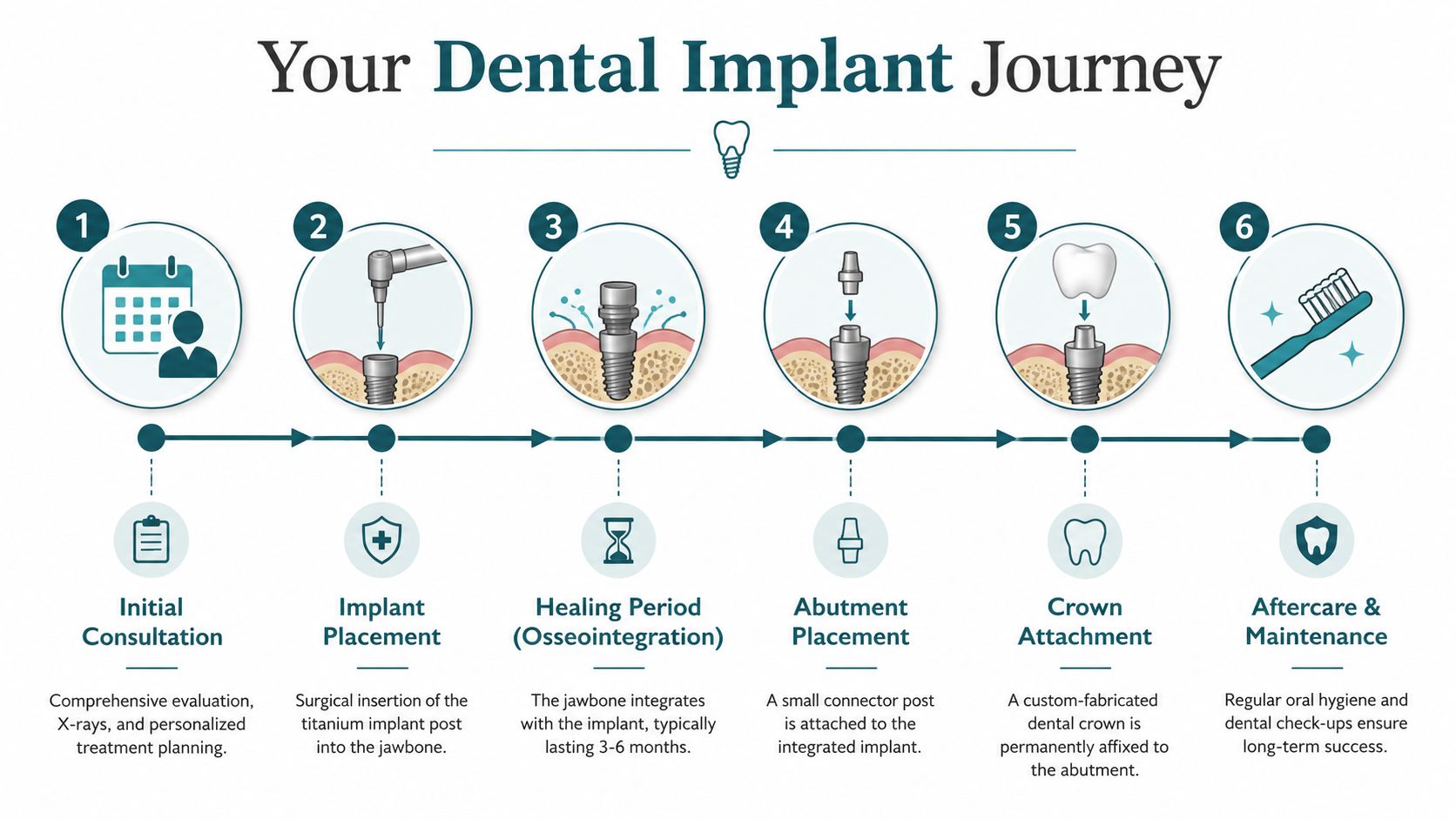
This visual gives a simple overview of the treatment path.
What the process usually includes
Most implant cases follow a pattern like this:
Consultation and records
The visit usually includes an exam, digital X-rays, and treatment planning. At this stage, bone levels, gum health, bite, and goals are reviewed.Implant placement
The implant post is placed in the jawbone. The exact approach depends on the case, but the goal is stable placement with conditions that support healing.Healing period
The jawbone needs time to integrate with the implant. During this phase, the implant becomes the foundation for the final tooth.
A more detailed overview of the steps is available in this page on the implant placement procedure.
For patients who like a visual explanation before their visit, this short video helps make the process easier to picture.
What recovery tends to feel like
Recovery is usually easier when patients know what part is short-term and what part takes patience.
- First day: Tenderness, minor swelling, and a need for softer foods are common.
- First week: The surgical site generally becomes easier to manage, though patients still need to follow home-care instructions carefully.
- Longer healing phase: The mouth may feel normal well before the internal healing is complete. That doesn't mean the final stage should be rushed.
After healing, the abutment and final crown are placed when appropriate. The visible finish is often the part patients focus on, but the long-term result depends heavily on the planning and healing stages that come before it.
For patients also dealing with damaged teeth, loose restorations, or a tooth that can't be saved, implant treatment may be part of a broader restorative plan that can also involve tooth extraction or other restorative dentistry steps.
Understanding the Cost and Financing Your Implants
Cost is often the reason patients pause, even when they believe implants are the right clinical choice. That hesitation makes sense. Implant treatment is a significant investment, and the most honest answer isn't just about the initial bill. It's about what the patient is buying over time.
Reviews discussing implant value note that the total cost should include long-term maintenance, because complications such as peri-implantitis can require professional care and possible repairs. That broader view appears in this discussion of lifetime dental implant value and maintenance.
What affects the investment
The total treatment plan can vary based on factors such as:
- How many teeth are missing: A single implant case differs from a larger restoration plan.
- Condition of the site: Some areas are ready sooner than others.
- Type of final restoration: A crown, bridge, or implant-supported denture changes the scope.
- Maintenance expectations: Long-term hygiene visits and possible repairs are part of the full cost picture.
That's why broad internet estimates often frustrate patients. Two people can both “need an implant” and still have very different treatment needs.
How patients make treatment manageable
What helps most is a written treatment plan with clear sequencing. Some patients move forward in phases. Others use insurance where applicable, health savings tools if available to them, or financing arrangements that spread treatment over time. For a general consumer-friendly perspective, some readers find The Smile Spot's dental implant costs useful as a starting framework for thinking about affordability.
Amanda Family Dental provides a page on how much dental implants cost, and the practice also offers payment flexibility, including a Power Plan Membership, for patients who want to review options before committing.
Patients searching for a dentist in Amanda, OH or dental implants near me should expect a consultation to answer three financial questions clearly. What treatment is needed. What can wait. What the ongoing maintenance responsibility will be after placement.
Take the Next Step at Amanda Family Dental
So, are dental implants worth it?
For the right candidate, they often are. They replace the missing root support, restore function in a way that feels stable, and can offer strong long-term value when the patient is healthy enough for treatment and committed to maintenance. For other patients, a bridge or denture may be the smarter path. The key is choosing based on the actual condition of the mouth, not guesswork.
Patients in Amanda, Lancaster, Circleville, and Carroll, Ohio usually don't need more internet opinions. They need a clear evaluation. That means looking at the missing tooth area, reviewing health history, taking digital X-rays, and discussing what result matters most. Some want the closest thing to a natural tooth. Others want the simplest way to chew comfortably again. Others need a practical restorative plan after an emergency dentist visit or a necessary extraction.
A good consultation should leave the patient with answers, not pressure. It should clarify candidacy, timeline, alternatives, and maintenance expectations. It should also explain when implants make sense and when they don't.
If a missing tooth is affecting eating, confidence, or comfort, the next step is a professional exam with a treatment plan built around the patient's actual needs.
If you're looking for a practical, local answer about implants, bridges, dentures, or broader restorative dental care, Amanda Family Dental offers consultations for patients in Amanda, Lancaster, Circleville, and Carroll, Ohio. A visit can include a new patient exam, digital X-rays, and a personalized discussion of treatment options so you can decide with confidence.