

A missing tooth changes small daily habits first. People in Amanda, Lancaster, Circleville, and Carroll, Ohio often notice it when chewing shifts to one side, when a denture feels less secure, or when smiling in photos starts to feel uncomfortable. That's usually when the search begins for a dentist near me or dental implants near me, along with a lot of understandable questions about surgery, healing, comfort, and cost.
Dental implants can sound complex at first, but the process is easier to understand when it's broken into clear stages. In the United States, implant treatment has become much more common. By 2015 to 2016, about 5.7% of U.S. adults had at least one dental implant, up from 0.7% in 1999, and about 500,000 new implants are placed each year according to this U.S. implant summary. For many patients, that growing use is reassuring. It means implants are no longer viewed as an unusual option. They're a mainstream restorative treatment for replacing missing teeth.
This guide walks through the implant placement procedure in plain language, with a focus on what patients can expect close to home in Amanda, OH and nearby communities.
Table of Contents
- Your Search for a Permanent Smile Solution in Ohio
- What Exactly Is a Dental Implant
- The Implant Placement Procedure Step by Step
- Are You a Good Candidate for Dental Implants
- The Life-Changing Benefits of Dental Implants
- Implant Timeline Costs and Aftercare in Ohio
- Your Dental Implant Questions Answered
Your Search for a Permanent Smile Solution in Ohio
Many people don't start by searching for “implant placement procedure.” They start by searching for help.
A patient in Lancaster may have had a tooth removed months ago and be tired of the gap. Someone in Circleville may be frustrated with a partial denture that moves during meals. A patient in Carroll may have a front tooth concern and want something that looks and feels more natural. In Amanda, those same concerns often come down to one practical question: what's the most stable way to replace a missing tooth?
That's where implants enter the conversation. Instead of sitting on top of the gums like a removable option, an implant is placed into the jawbone and supports a replacement tooth in a way that more closely resembles a natural root and crown. For patients who want a long-term solution, that difference matters.
Missing teeth don't just affect appearance. They can change chewing habits, speech, bite balance, and confidence in ordinary social moments.
Choosing implant treatment is also a trust decision. People aren't only choosing a procedure. They're choosing the office that will evaluate the bone, explain the steps clearly, monitor healing, and answer questions when something feels unfamiliar. That's why local care matters so much when someone is comparing options in Amanda, OH and surrounding communities.
Patients who want to review treatment options in more detail can learn more about dental implants near Amanda, OH. For many families across Amanda, Lancaster, Circleville, and Carroll, implant care becomes less intimidating once the process is explained in a steady, step-by-step way.
What Exactly Is a Dental Implant
A dental implant replaces a missing tooth in a way that rebuilds both the support below the gums and the tooth you see above them. For many patients in Amanda, OH, that is the point when implants start to make sense. The goal is not only to fill a space. It is to restore a part of the mouth that was doing real work every day.
A clear way to picture the parts
An implant is best understood as a three-part tooth replacement.
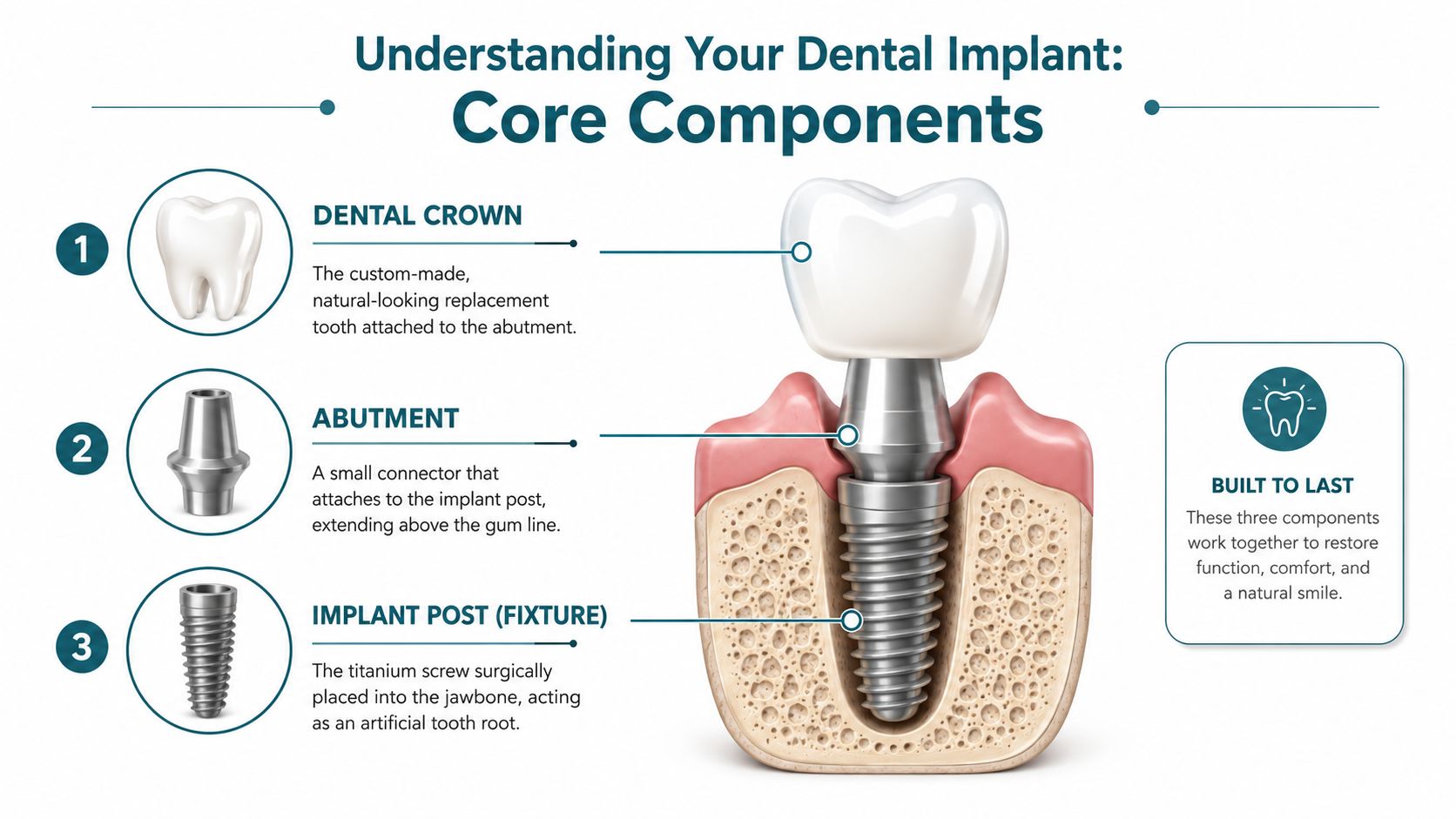
| Part | What it does | Where it sits |
|---|---|---|
| Implant post | Serves as the replacement root | In the jawbone |
| Abutment | Connects the post to the new tooth | At the gum line |
| Crown | Acts as the visible chewing surface | Above the gums |
A natural tooth has two main jobs. The root anchors it in bone, and the top portion helps you bite and chew. An implant rebuilds that same arrangement in separate pieces. The post, often made of titanium, is placed in the bone. The abutment joins the parts together. The crown is custom-shaped and shaded so it fits with the teeth around it.
That structure matters.
Why the root portion makes such a difference
If only the visible part of a missing tooth were replaced, the area would still be missing the support that used to come from the root. Over time, the jawbone in that spot gets less pressure from chewing, and that can contribute to bone changes. Nearby teeth can also begin to shift, and the bite may feel less even.
An implant addresses that deeper problem because it is anchored in the jaw rather than resting only on top of the gums. Patients often tell us this is the part that feels easiest to understand once it is explained chairside at a local office. It is a replacement built from the foundation up.
That is also why implants are often compared with other tooth replacement options. A bridge fills the space. A removable denture replaces teeth above the gums. An implant replaces the missing root support first, then the visible tooth.
In daily life, patients usually notice the difference in simple ways:
- Chewing can feel steadier because the replacement tooth is anchored in place.
- Speech may feel clearer if a gap or loose appliance had been affecting certain sounds.
- The smile looks more natural because the crown is made to match nearby teeth.
- Home care stays familiar since brushing and cleaning around the area is similar to caring for a natural tooth.
For someone in Amanda who has been missing a tooth for months or even years, that can make the idea of treatment feel less mysterious. It is not a gadget or a one-piece substitute. It is a carefully planned replacement that restores support, function, and appearance in a way that is specific to that patient's mouth.
The Implant Placement Procedure Step by Step
The implant placement procedure is a sequence, not a single event. That's one reason it tends to feel more manageable once patients understand where each appointment fits.
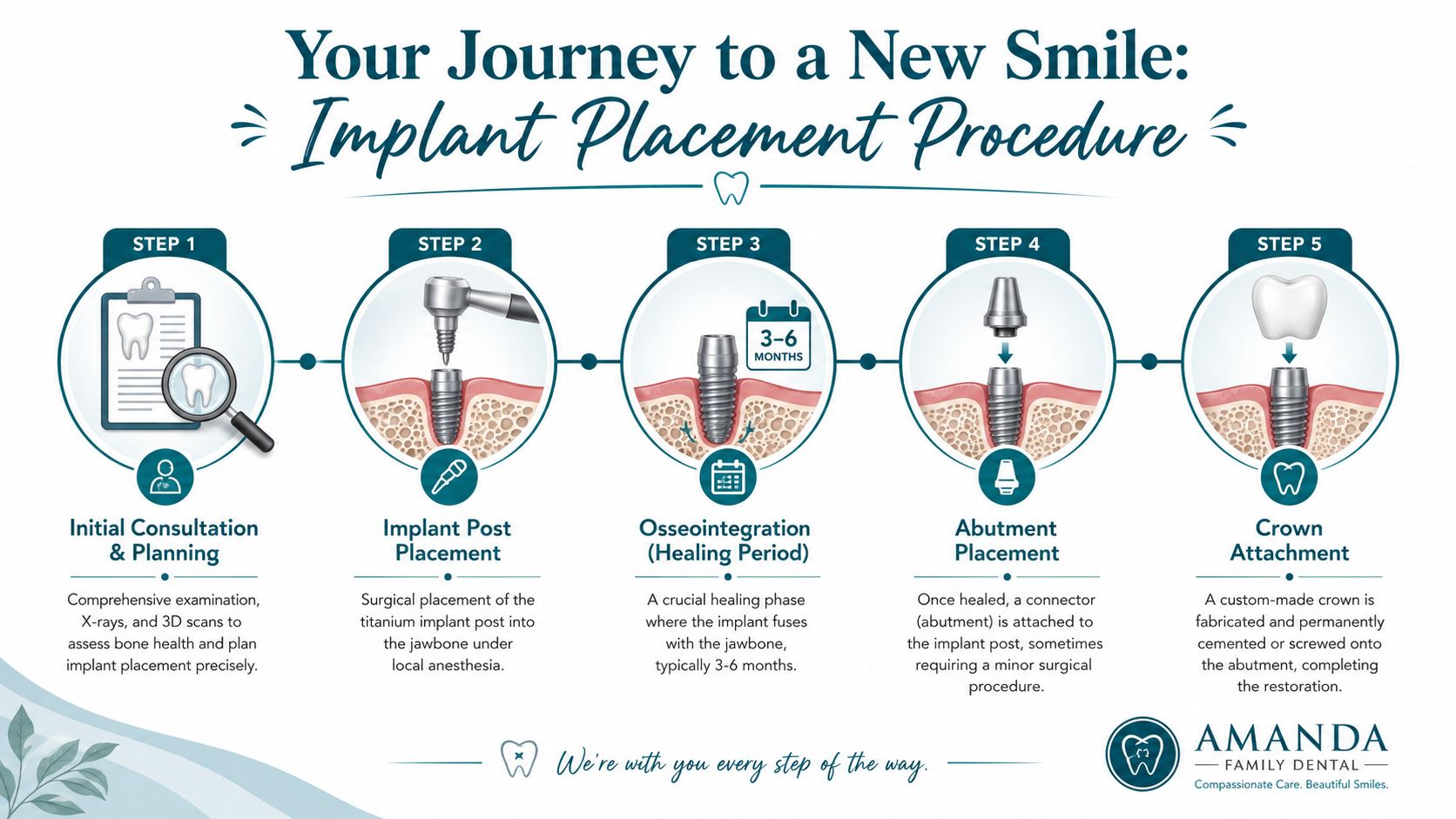
A patient usually starts with records and planning, then has the implant placed, then goes through a healing period before the final restoration is attached. Mayo Clinic notes that the process commonly includes a full exam, X-rays, and 3D imaging before surgery, followed by a gum incision, drilling to prepare the site, implant placement, healing, and later connection of the abutment and final tooth in its implant surgery overview.
Consultation and digital planning
The first visit is about deciding whether implant treatment fits the patient's mouth, health history, and goals. This stage often includes a clinical exam, digital X-rays, and sometimes 3D imaging to evaluate bone and identify important anatomy.
That imaging matters. It helps the dentist study bone width and height, and it helps map structures that shouldn't be disturbed during placement. If the area needs additional preparation, such as healing after a tooth extraction or bone support before placement, that becomes part of the plan rather than an unwelcome surprise.
To make the sequence easier to visualize, this overview helps:
Practical rule: The more detailed the planning, the more predictable the placement tends to be.
Surgery day and implant placement
On the day of surgery, the focus is comfort and precision. Local anesthesia is commonly used so the area is numb during the procedure. After the tissue is opened, the site in the jawbone is prepared carefully, and the implant post is inserted into the planned position.
For a single implant, the surgical portion is often shorter than many patients expect. What usually surprises people is that the actual treatment timeline is longer than the procedure itself because biology needs time to do its work.
This video gives a helpful visual reference for what that journey looks like:
Some cases are straightforward, especially when the bone is healthy and the site is well defined. Others require more planning because the tooth has been missing for a long time, the space is near a sinus or nerve, or the bite places heavier demands on the restoration. In more complex anatomy, current review coverage notes that digital guidance methods such as dynamic navigation may improve accuracy compared with freehand placement in selected cases, according to this review of navigation in implant surgery.
Healing and the final tooth
After placement, the jawbone needs time to bond with the implant surface. That bond is called osseointegration. During this period, the implant becomes the stable foundation that will later support the visible tooth.
Healing doesn't always look dramatic from the outside. Patients often feel like the surgery is “done,” while the most important part is still happening under the gums. Once the site is ready, the dentist attaches the abutment and then the custom crown.
A short checklist helps many patients keep the sequence straight:
- Exam and images to confirm bone and plan the position
- Implant placement under local anesthesia
- Healing time while bone integrates with the implant
- Connector placement if needed
- Final crown to complete the restored tooth
That staged approach is why implant care can feel methodical rather than rushed. Each step supports the next.
Are You a Good Candidate for Dental Implants
Many adults rule themselves out too early. A missing tooth, an old extraction, or concern about age doesn't automatically mean implants aren't possible.
Candidacy usually comes down to a few basics. The mouth needs to be healthy enough for treatment, the area needs adequate bone support or a plan to build support, and the patient needs to be willing to follow through with healing and home care. That's why a complete exam matters more than guesswork.
What dentists usually look for
Dentists often consider these questions during an implant evaluation:
- Is the area healthy enough for placement with no active issue that should be treated first?
- Is there enough jawbone for stable support, or would a grafting procedure help prepare the site?
- Is the bite manageable so the future implant won't be overloaded?
- Is the patient ready for a staged process that may involve several visits over time?
Some patients need a tooth extraction before the implant phase begins. Others have worn a bridge or denture for years and are exploring a more fixed solution. Both situations can still lead to implant treatment, but the path may look different.
What can complicate treatment without ruling it out
Bone loss is one of the most common concerns. If a tooth has been missing for a while, the site may need added support before or during implant care. Gum health also matters because healthy tissues help protect the implant long term.
Another point that causes confusion is angle. Patients sometimes worry that an implant must be perfectly upright to succeed. Research discussed in a study on implant angulation and bone stress found that perpendicular placement can reduce stress, but angled placement may still be used intentionally in selected cases when restorative planning allows for a functional result. That's why the right question isn't “Will a tilted implant fail?” It's “Why is this angle being used in this case?”
A thorough new patient exam in Amanda, OH gives the clearest answer. The best treatment plan is the one built around the person's actual anatomy, bite, and goals, not around assumptions from an internet search.
The Life-Changing Benefits of Dental Implants
A patient in Amanda might tell us, “I just want to eat on that side again without thinking about it.” That goal says a lot. A key benefit of a dental implant is not only how it looks in the mirror. It is how little you have to think about the missing tooth once treatment is complete.
Daily life often gets easier in small, meaningful ways. Biting into a sandwich feels more natural. Smiling in a conversation feels less guarded. Talking can feel steadier because the replacement tooth is fixed in place instead of shifting like some removable options.
What changes in daily life
For adults in Amanda and nearby communities such as Lancaster, Circleville, and Carroll, the benefits are often practical first and emotional second. Both matter.
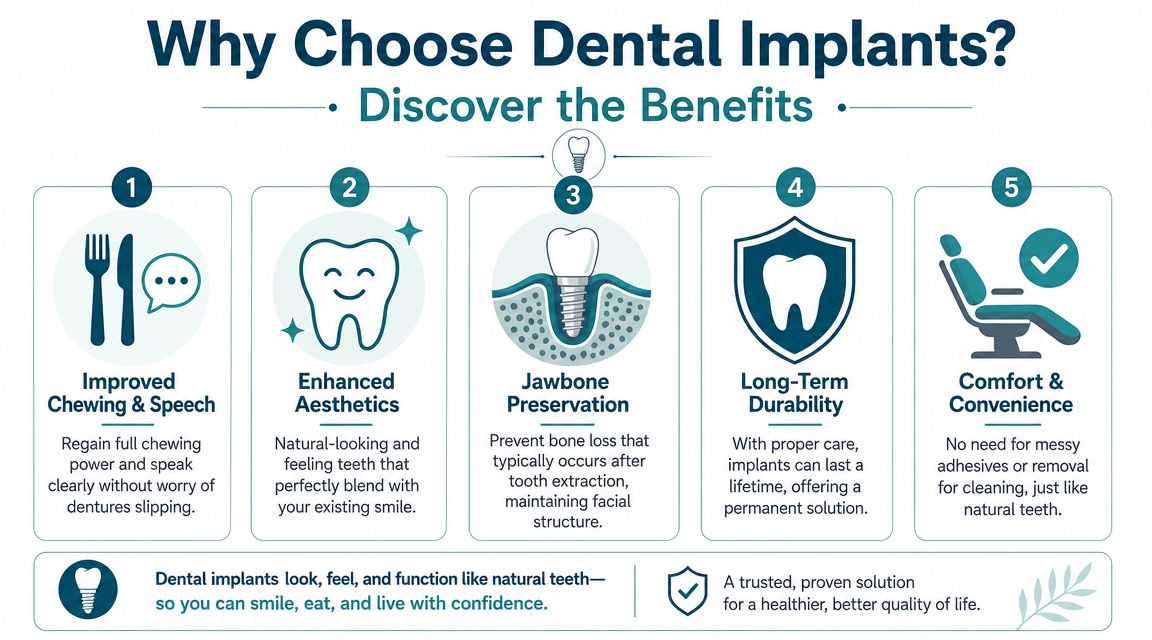
- Stronger chewing ability: Because the implant is anchored in the jaw, many patients feel more stable biting and chewing than they do with a removable replacement.
- A smile that blends in: The final crown is designed to match the nearby teeth in shape and color, so the result usually feels like part of your own smile.
- More confidence while speaking: A secure tooth replacement can help speech feel more comfortable, especially for patients who have been compensating around a gap or a loose appliance.
- Better support for neighboring teeth: Filling an open space can help maintain spacing and support a more balanced bite over time.
- Less daily hassle: There is no adhesive, soaking cup, or routine of taking the tooth in and out.
An implant works like a replacement root under the gums, with a custom tooth built on top. That structure is a big reason many patients describe the result as feeling closer to a natural tooth than other options.
A well-planned implant helps restore routines. Eating, smiling, laughing, and talking start to feel normal again.
Why implants are considered so dependable
Dental implants have a strong long-term reputation in restorative dentistry. As noted earlier in the article, the FDA references research reporting high long-term success for implants when they are properly planned, placed, and maintained.
That matters to patients because they are not only replacing a tooth for appearance. They are choosing a solution they hope will stay comfortable and useful for years. At a community-focused practice in Amanda, OH, that conversation is personal. We look at how you chew, what you want your smile to feel like, and what kind of care fits your budget and schedule, then build a plan around that.
If you are also weighing the financial side, our guide to dental implant costs and what affects the price can help you understand the decision more clearly.
Implant Timeline Costs and Aftercare in Ohio
The three questions most patients ask are straightforward. How long will this take? What affects the cost? What does recovery involve?
The answer to the first question depends on healing, not just scheduling. A major part of the implant placement procedure is the period of osseointegration, which typically lasts 2 to 6 months according to Delta Dental's step-by-step implant overview. That's the period when bone grows tightly around the implant and creates the support needed before the final crown is attached.
How long the process usually takes
Some patients move through treatment with only a few key appointments separated by healing time. Others need extra steps, such as an extraction or grafting, before implant placement can happen.
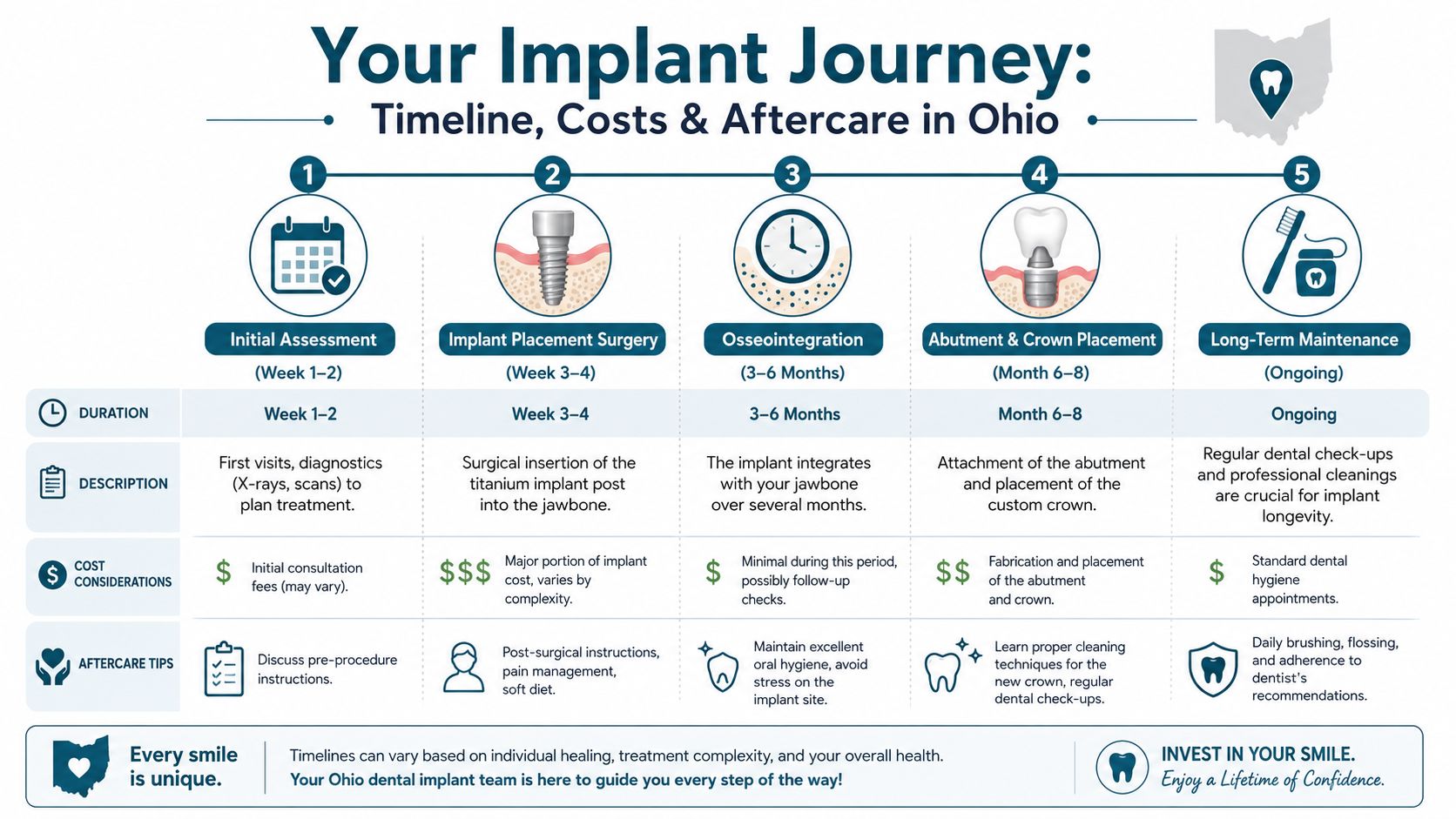
A simple way to think about the timeline is in phases:
| Phase | What happens |
|---|---|
| Planning | Exam, imaging, and treatment design |
| Placement | The implant post is surgically inserted |
| Healing | Bone integrates with the implant |
| Restoration | The abutment and crown are attached |
| Maintenance | Ongoing checkups and home care |
Patients often feel better once they understand that “waiting” during implant treatment isn't lost time. It's healing time.
What affects cost
Implant cost varies by case. The number of teeth being replaced, the need for preparatory treatment, the type of final restoration, and the complexity of the bite all influence the total. A single implant case won't look the same as a broader restorative plan involving multiple teeth or implant-supported dentures.
For patients comparing options, this page on how much dental implants cost gives useful context about what may be included in treatment planning. In practical terms, transparency matters more than a one-size-fits-all quote. The key is understanding what steps are necessary for that specific mouth.
How to care for an implant during healing and long term
Recovery instructions depend on the procedure performed, but the basics are familiar. Patients are usually told to protect the area, keep it clean, and avoid putting unnecessary pressure on the implant while it heals.
A simple aftercare routine often includes:
- Gentle cleaning: Keep the area clean exactly as instructed so healing tissue isn't disturbed.
- Food choices that protect the site: Soft foods are often easier early on while the area settles.
- Follow-up visits: These let the dentist confirm that healing is progressing properly.
- Daily home care long term: Brushing and cleaning around the implant remain essential after the final crown is placed.
Healing is only the first finish line. Long-term success depends on the habits that follow.
Your Dental Implant Questions Answered
Even after a patient understands the steps, a few concerns usually remain. They're often less about the science and more about comfort, alternatives, and whether the result will really last.
Is the implant placement procedure painful
During surgery, local anesthesia is typically used to numb the area. Patients usually feel pressure and movement more than pain. After the procedure, some soreness is normal, but the process is often found to be more comfortable than expected.
It also helps to arrive prepared with questions written down. Patients who like to organize concerns for medical visits often find that a short list reduces anxiety and makes the consultation more productive.
What are the alternatives to a dental implant
The main alternatives are usually a bridge or a removable denture or partial denture. Each option can restore appearance and function, but they work differently. An implant replaces support within the jaw, while other choices rely on nearby teeth or a removable base.
The best choice depends on the number of missing teeth, the condition of the surrounding teeth, the bite, and the patient's priorities. Some people want the most fixed option available. Others prefer a different restorative path.
How long do dental implants last
They're designed for long-term function, but longevity depends on planning, placement, healing, bite forces, and home care. Cleaning matters. Follow-up care matters. So does discussing the design of the case in detail, especially if the implant position or angle is unusual.
Patients who want practical maintenance guidance can review how to care for dental implants. A well-maintained implant is meant to be part of normal daily life, not something fragile that requires constant worry.
Patients looking for a dentist in Amanda, OH, or nearby care in Lancaster, Circleville, or Carroll, can schedule a consultation with Amanda Family Dental to discuss missing teeth, implant options, digital X-rays, and a personalized treatment plan built around comfort, function, and long-term oral health.