

Root canal treatment cost without insurance usually falls between $700 and $1,800 per tooth, and more complex molar cases can reach $2,100+. The biggest factor is which tooth needs treatment, because front teeth are simpler to treat and molars usually take more time and precision.
A lot of patients start this search the same way. A tooth starts throbbing at dinner, pressure builds overnight, and by morning the pain is hard to ignore. The next question usually isn't just whether a root canal is needed. It's whether the cost will be manageable without dental insurance.
That concern is understandable, especially for families in Amanda, Lancaster, Circleville, and Carroll, Ohio who want clear answers before making a decision. Root canal fees can look confusing online because some pages give one average number, while others leave out important costs like the final crown. A useful guide should make the price easier to understand, not harder.
Table of Contents
- Facing Tooth Pain and Cost Concerns in Amanda OH
- Your Guide to Root Canal Costs in Ohio
- Key Factors That Change Your Final Price
- Planning for Additional Treatment Costs Like Dental Crowns
- Affordable Payment and Financing Options Near Amanda
- Root Canal vs Extraction A Long-Term Cost Comparison
- Frequently Asked Questions About Root Canal Treatment
Facing Tooth Pain and Cost Concerns in Amanda OH
A common situation looks like this. Someone in Amanda wakes up with a deep toothache, tries to get through work, then notices the pain gets sharper when chewing or drinking something hot. By the time that person searches for an emergency dentist or a dentist near me, the fear isn't only about the tooth. It's also about what the visit might cost without insurance.
That mix of pain and uncertainty can make people wait longer than they should. Some hope the tooth will settle down on its own. Others worry that calling a dental office will commit them to a bill they haven't planned for.
Nationally, the average root canal is often cited at about $1,165 without insurance, although estimates in major markets can range from roughly $500 to $1,800 depending on tooth location and procedure complexity, according to Guardian's dental procedure cost guide. That wide spread explains why a single average doesn't help much when a patient is trying to budget for a real tooth problem.
Why patients often feel caught off guard
Many people assume a root canal has one standard price, similar to a routine exam. It doesn't. A front tooth, a premolar, and a molar can involve very different levels of difficulty.
Patients also get confused because the pain feels urgent, while the pricing language feels technical. Terms like canals, restoration, specialist treatment, and crown placement don't always mean much in the middle of a dental emergency.
A good treatment estimate should answer two questions clearly. What needs to be done now, and what may still be needed to protect the tooth afterward.
What helps most in the first conversation
For patients in Amanda, Lancaster, Circleville, and Carroll, Ohio, the most useful next step is a focused exam with digital X-rays and a clear explanation of whether the tooth can be saved. Practical preparation can also reduce stress before the visit. This guide on how to prepare for a root canal can help patients know what to expect before treatment starts.
When a tooth hurts badly, clarity matters. So does having a local dental team that explains treatment in plain language and doesn't treat cost questions like an afterthought.
Your Guide to Root Canal Costs in Ohio
Understanding root canal treatment cost without insurance starts with one simple idea. There is no single Ohio price that fits every tooth.
A root canal works a lot like home repair. Fixing a small problem on an easy-to-reach window usually costs less than repairing a damaged section of the roof. In dentistry, the tooth's location and internal shape play a similar role in the final fee.
Why one number never tells the whole story
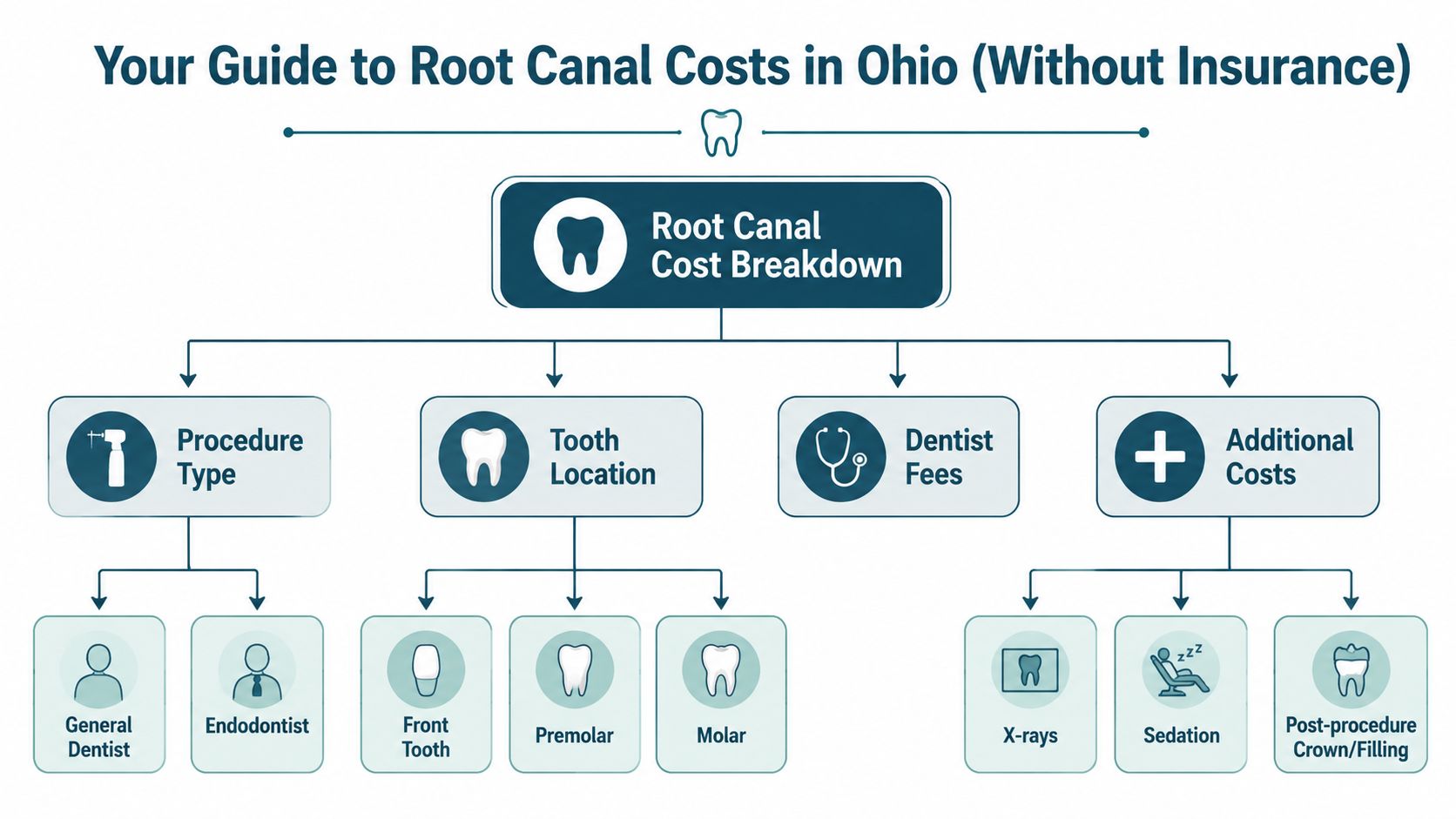
Without insurance, root canal prices in the U.S. typically range from $700 to $1,800 per tooth, while treatment from an endodontist may run $1,300 to $2,000 according to GoodRx's root canal cost overview. Those numbers are useful as a starting point, but they still do not answer the question most patients in Amanda have. What is this likely to cost for my tooth, in my situation, and what else might be part of the plan?
The main reason pricing varies is anatomy. Front teeth are often more straightforward to treat. Back teeth, especially molars, usually have more canals and can take more time to clean and seal properly.
That difference matters.
A short visual can make that easier to follow.
Typical self-pay ranges by tooth type
Colgate's cost benchmark places typical self-pay root canal fees at about $620 to $1,500 for an anterior tooth, $700 to $1,700 for a premolar, and $900 to $2,100+ for a molar in its root canal cost guide.
| Tooth type | Typical self-pay range |
|---|---|
| Anterior tooth | $620 to $1,500 |
| Premolar | $700 to $1,700 |
| Molar | $900 to $2,100+ |
These ranges show why two patients can receive very different answers for the same procedure.
- Front tooth cases often cost less because access is easier and there are usually fewer canals to treat.
- Premolars fall in the middle. They are more involved than front teeth, but they are often less complex than molars.
- Molars usually cost the most because they sit farther back and commonly contain multiple canals that require more treatment time.
Practical rule: A painful molar usually falls toward the higher end of the self-pay range.
For families in Amanda, OH, and nearby communities like Lancaster, Circleville, and Carroll, this kind of local, tooth-by-tooth explanation is far more useful than a broad national average. At Amanda Family Dental, the goal is to give patients a clear estimate they will use, then walk through realistic payment options so cost feels manageable instead of confusing.
Key Factors That Change Your Final Price
The final fee usually changes for the same reason two car repairs can carry different estimates. The repair may have the same name, but the amount of work under the hood is not always the same.
With a root canal, the tooth type gives you a starting point, as noted earlier. The final number often depends on how difficult it is to treat that specific tooth safely and thoroughly. That is why two patients with painful back teeth can hear different estimates, even if both need a molar root canal.
Why one case costs more than another
A straightforward case usually takes less chair time and less technical effort. A tooth that is harder to numb, harder to reach, or harder to clean inside can take more time and planning.
Dentists also look at whether the tooth has been heavily restored before. A large filling, deep decay, a cracked area, or prior dental work can change how the tooth is accessed and protected during treatment. In plain terms, the more fragile or complicated the setup, the more careful the procedure needs to be.
Some teeth can be treated comfortably in a general dental office. Others are better handled by an endodontist, a dentist with advanced training in root canal therapy. That referral can affect the fee, but it may also be the right choice for a tooth with unusual anatomy or a more difficult infection.
What usually affects the estimate
Here are the details that commonly move the price up or down for patients in Amanda and nearby communities:
- How complex the inside of the tooth is. Narrow, curved, or difficult-to-find canals can add treatment time.
- How advanced the problem has become. Swelling, infection, or a tooth that has been hurting for a long time may require more involved care.
- Whether the tooth has older dental work. Existing fillings, crowns, or previous root canal treatment can make treatment more complicated.
- Who provides the treatment. A general dentist and an endodontist may price cases differently based on the difficulty and setting.
- What support is needed around the procedure. X-rays, temporary buildup, and follow-up restoration planning all affect the total amount.
One point causes a lot of confusion. Patients often hear one number for the root canal, then a different number later for rebuilding the tooth. Those are usually separate parts of care, not surprise add-ons.
A simple way to look at it is this: the root canal treats the infection inside the tooth, while the next phase helps the tooth stay strong enough to use afterward. If you want a clearer picture of how restoration materials can affect long-term results, this guide on dental crown cement and how crowns stay in place gives helpful background.
At Amanda Family Dental, the goal is to explain those pieces clearly before treatment starts. For patients in Circleville, OH or Carroll, OH, that kind of local, upfront estimate makes it easier to compare options, plan payments, and make a calm decision instead of guessing under stress.
Planning for Additional Treatment Costs Like Dental Crowns
One of the biggest sources of confusion is that a root canal fee often isn't the whole story. In many cases, especially on back teeth, the tooth still needs to be rebuilt and protected after the infection is treated.

Why the crown matters after the root canal
Forbes notes that a posterior tooth often needs a crown after a root canal because the tooth loses structural integrity, and a crown can add roughly $900 to $2,500 in U.S. self-pay settings according to Forbes' root canal cost guide. That's why the full restoration cost is often much higher than the endodontic procedure alone.
In plain language, a root canal removes infected tissue from inside the tooth, but it doesn't automatically make the tooth strong again. A molar still has to handle heavy biting forces every day. If that tooth is left too weak, it's more likely to crack.
What patients are really paying for
A more realistic way to think about the cost is in two parts.
| Treatment stage | What it addresses |
|---|---|
| Root canal procedure | Removes infection from inside the tooth |
| Final restoration | Protects the treated tooth so it can keep functioning |
Many online estimates provide an incomplete picture. They list the root canal fee, but not the likely next step.
- The procedure fee covers treatment inside the tooth.
- The restoration fee covers rebuilding and protecting the tooth.
- The total out-of-pocket cost may also include the exam and digital X-rays used to diagnose the problem and plan treatment.
Patients who want a better sense of crown-related questions can review this page on cement for tooth crown, which helps explain how crowns are secured and why proper restoration matters.
For someone searching root canal treatment cost without insurance in Amanda or Lancaster, the most important takeaway is simple. The true cost is often the root canal plus the restoration, not the root canal alone.
Affordable Payment and Financing Options Near Amanda
Once patients understand the cost, the next question is usually practical. How can treatment be paid for without putting off care?
That's an important question because waiting on an infected tooth rarely makes life easier. Pain can worsen, chewing can become difficult, and treatment choices may become more limited.
Ways patients often manage dental costs
Patients without insurance often look at several payment paths instead of relying on one solution.
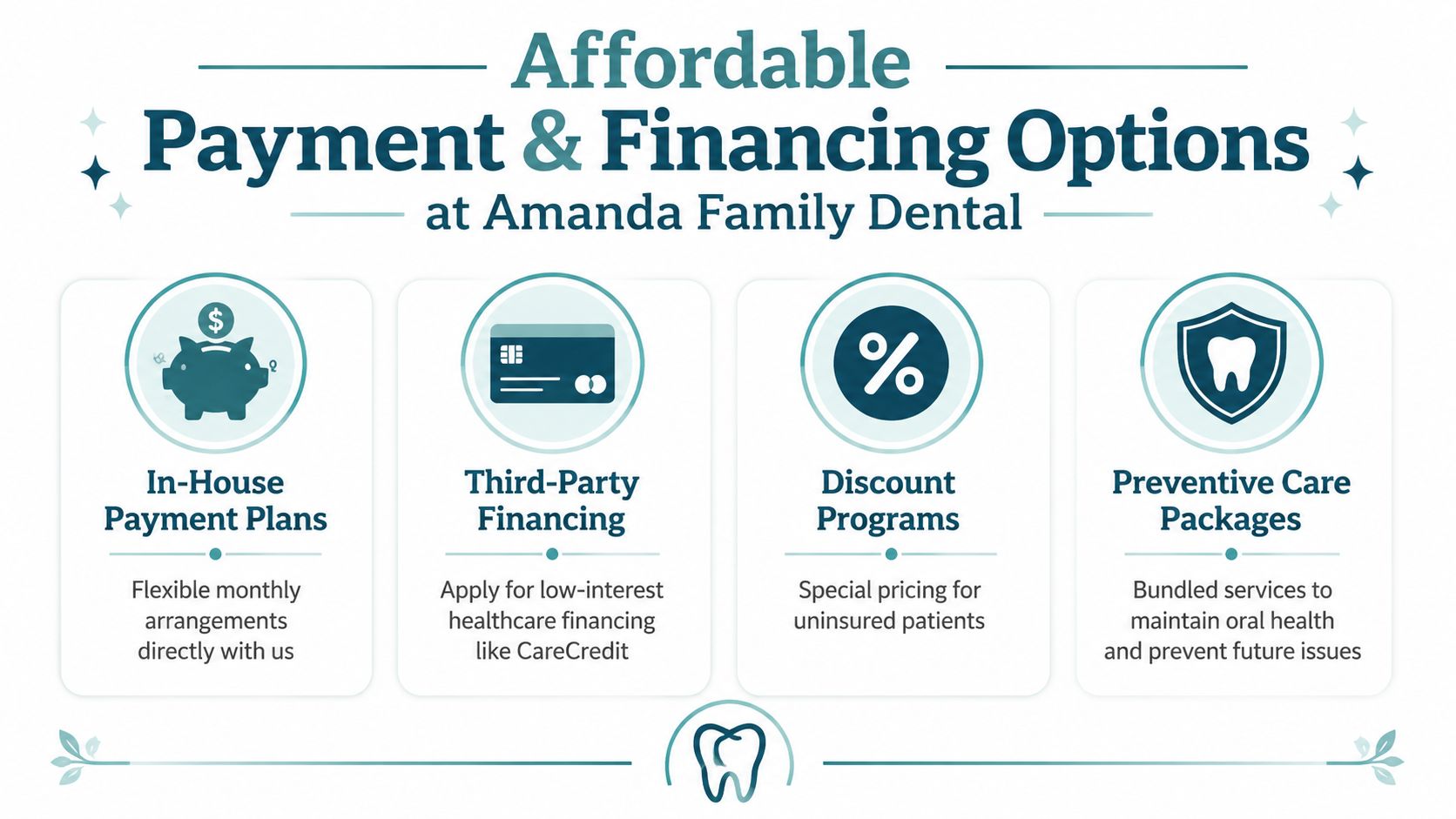
- In-office payment arrangements can spread costs into manageable monthly amounts when available through the dental office.
- Third-party healthcare financing may help patients handle larger treatment balances over time.
- Membership programs can be useful for people who don't have traditional dental insurance and want more predictable pricing for ongoing care.
- Health savings funds may also help with eligible expenses. Patients exploring that route can review this guide on using your HSA for dental care to understand how those funds may apply.
Amanda Family Dental lists financing information and a Power Plan Membership on its dental financing page, which gives local patients another way to review options before scheduling treatment.
Why acting sooner can protect the budget
The least expensive dental problem is often the one treated before it gets worse. A painful tooth doesn't always become unsalvageable, but delaying care can narrow the path between a more conservative treatment and a more complicated one.
Patients in Amanda, Carroll, Lancaster, and Circleville often benefit from asking a few direct questions during scheduling:
- What part of the fee applies to diagnosis and X-rays?
- Is the estimate for the root canal only, or does it include the final restoration?
- If a crown is likely, when would that part be completed?
- Are payment options available for larger restorative treatment plans?
That kind of conversation gives patients more control. It also reduces the stress of agreeing to treatment without fully understanding the financial plan.
When cost is a concern, the best first step isn't guessing. It's getting a written estimate that separates immediate treatment from follow-up restoration.
For uninsured patients looking for a dentist near me in the Amanda area, a clear payment roadmap can make urgent treatment feel much more manageable.
Root Canal vs Extraction A Long-Term Cost Comparison
A painful tooth can make extraction seem like the simplest answer. It's faster to imagine, and the upfront fee is usually lower. But the short-term savings don't always hold up when the missing tooth has to be addressed later.
The lower upfront cost
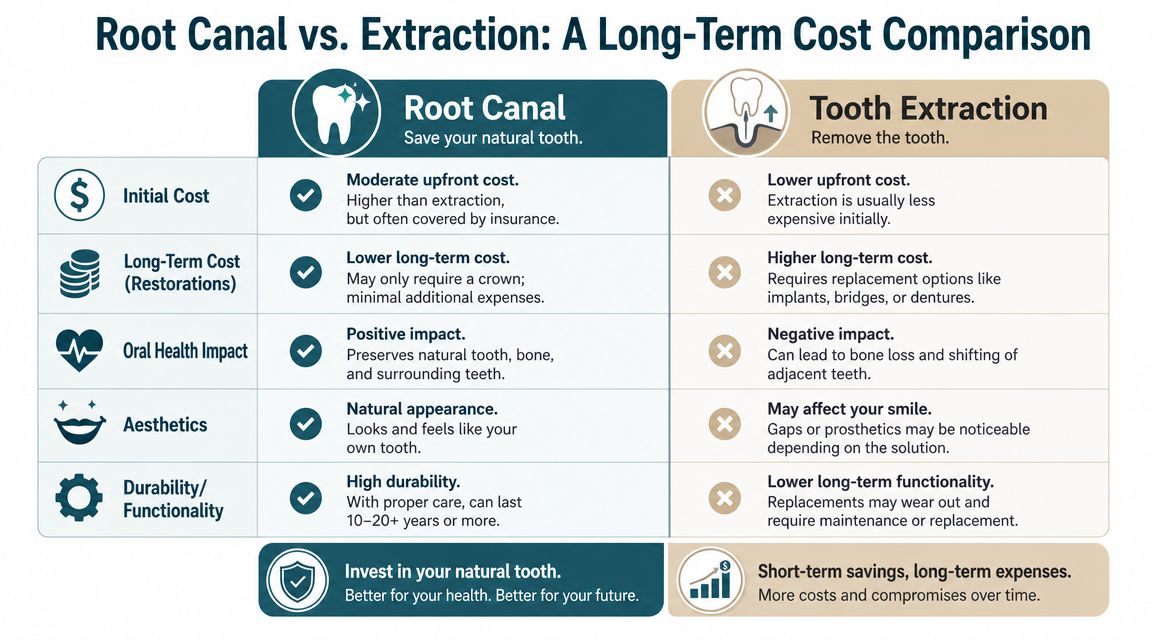
One published comparison places a simple extraction at about $200 to $600, according to Phan Endodontics' cost comparison. For a patient in immediate pain and paying cash, that can look much easier than a root canal.
That first number, however, only answers the day-of-procedure question.
The bigger long-term decision
The same comparison notes that replacing the missing tooth later can cost about $2,500 to $5,000 for a bridge or $4,000 to $6,000+ for an implant, while a root canal at an endodontist is typically $1,300 to $2,000 in that analysis. In many cases, saving the natural tooth is the more cost-effective choice over time.
| Option | Upfront picture | Long-term picture |
|---|---|---|
| Root canal | Higher initial cost | May avoid replacement costs if the tooth can be restored |
| Extraction only | Lower initial cost | Missing tooth may lead to bridge or implant expenses later |
There are also non-financial differences that matter.
- Keeping the natural tooth helps preserve normal chewing and avoids the gap left by extraction.
- Removing the tooth may solve the immediate problem, but it can create a second decision later about replacement.
- Replacing the tooth adds time, cost, and treatment planning that many patients didn't expect when they chose the cheaper first step.
For patients comparing tooth extraction against a root canal in Amanda or Lancaster, the most useful question isn't only “What costs less today?” It's “What will this choice likely cost over the life of the tooth area?”
Frequently Asked Questions About Root Canal Treatment
Patients usually still have a few practical worries after reviewing the cost. Most of them come down to comfort, timing, and what daily life will feel like afterward.
Common patient concerns
| Question | Answer |
|---|---|
| Is a root canal painful? | Modern root canal treatment is designed to treat pain, not create it. Patients are numbed carefully, and many say the procedure feels more manageable than they expected. |
| How long does the appointment take? | The exact timing depends on which tooth is treated and how complex the case is. Front teeth are often simpler, while molars can take longer. |
| Will the tooth feel normal right away? | Some tenderness can happen after treatment, especially when chewing, but many patients feel relief from the deep pressure and infection-related pain. |
| Does every root canal need a crown? | Not always, but back teeth often need one because they handle strong biting pressure and may be more vulnerable after treatment. |
| Should a patient wait if the pain comes and goes? | That isn't a good idea. Symptoms can ease temporarily even when the underlying problem remains. |
What helps recovery go more smoothly
A few habits usually make the recovery period easier:
- Follow the post-op instructions given by the dental team.
- Avoid heavy chewing on the treated side until the tooth has the recommended final restoration.
- Keep follow-up visits so the tooth can be checked and restored properly.
- Call promptly if pain, swelling, or bite discomfort feels unusual.
A root canal is often less frightening once the process is explained clearly. Patients looking for an emergency dentist, restorative dentistry, or new patient exams in Amanda, Lancaster, Circleville, or Carroll usually benefit most from a visit that combines diagnosis, digital X-rays, and a treatment plan they can understand.
Patients in Amanda, OH, Lancaster, OH, Circleville, OH, and Carroll, OH who are dealing with tooth pain and questions about root canal treatment cost without insurance can contact Amanda Family Dental to schedule an exam, review treatment options, and discuss payment solutions in clear, practical terms.