

A single dental implant in the U.S. typically costs $3,000 to $4,500 from start to finish. That's the number many people are trying to find first, but the actual cost depends on which replacement option fits the tooth, the bite, the surrounding teeth, and the budget for care in the Amanda, Ohio area.
A missing tooth often starts as a small daily annoyance. Food catches in the space. Smiling feels different. Speaking may feel a little off, especially if the gap is toward the front. For many families in Amanda, Lancaster, Circleville, and Carroll, the next question is simple and practical. What will it cost to fix it, and is there a more affordable way to do it without making the wrong long-term choice?
That concern is valid. Missing tooth replacement cost can feel confusing because different treatments solve the same problem in different ways. Some options are removable. Some stay in place. Some protect nearby teeth better than others. Some cost less upfront but may involve tradeoffs in comfort or maintenance.
Clear pricing starts with understanding the choices, what affects the final fee, and how payment options can make treatment manageable.
Table of Contents
- Understanding the True Cost of a Missing Tooth
- Your Tooth Replacement Options and Typical Cost Ranges
- Key Factors That Influence Your Final Treatment Cost
- Making Care Affordable with Insurance and Financing
- Example Scenarios Estimating Your Out-of-Pocket Cost
- Your Personalized Consultation at Amanda Family Dental
- Questions to Ask Your Dentist and How to Schedule Your Visit
Understanding the True Cost of a Missing Tooth
A missing tooth affects more than appearance. Many patients first notice the social side of it, but the day-to-day effects usually matter more. Chewing shifts to the other side. Certain words may sound different. The surrounding teeth can become harder to clean if the bite changes or food starts collecting in the gap.

In local communities like Amanda, Lancaster, Circleville, and Carroll, cost is often the reason people wait. That hesitation makes sense. Tooth replacement is a health decision, but it's also a household budget decision. Patients aren't only asking what works. They're asking what they can realistically move forward with.
Why this topic matters more now
Dental implants used to be far less common. A National Library of Medicine study on implant prevalence in U.S. adults missing teeth reported 0.7% around 1999 to 2000, with projections reaching as high as 23% by 2026 among adults missing teeth. That shift matters because implants are now a mainstream treatment option, not a rare specialty procedure.
Practical rule: The right question usually isn't “What's the cheapest way to fill the gap?” It's “Which option solves the problem well enough for this mouth, this budget, and this stage of life?”
That's where many people get stuck. They search missing tooth replacement cost and find a single number, but that number rarely tells the whole story. A front tooth, a back molar, one missing tooth, or several missing teeth can lead to very different recommendations.
What makes this decision confusing
Most confusion comes from three issues:
- Different treatments solve the same problem differently. A bridge, denture, and implant can all replace a tooth, but they don't work the same way.
- Quotes may include different steps. One estimate may include surgery and the final crown, while another may only reflect part of treatment.
- Personal oral health changes the plan. Bone support, gum condition, nearby teeth, and bite forces all affect what's possible.
Patients deserve a straightforward explanation before they commit to anything. Cost should be clear, and so should the reason behind it.
Your Tooth Replacement Options and Typical Cost Ranges
A missing tooth can be replaced a few different ways, and each option solves the problem a little differently. I often tell patients in Amanda that choosing between them is a bit like choosing between three ways to cross a creek. One is steady and permanent, one uses support from the sides, and one can be removed and put back in. All can work. The right fit depends on your mouth, your goals, and what feels manageable financially.
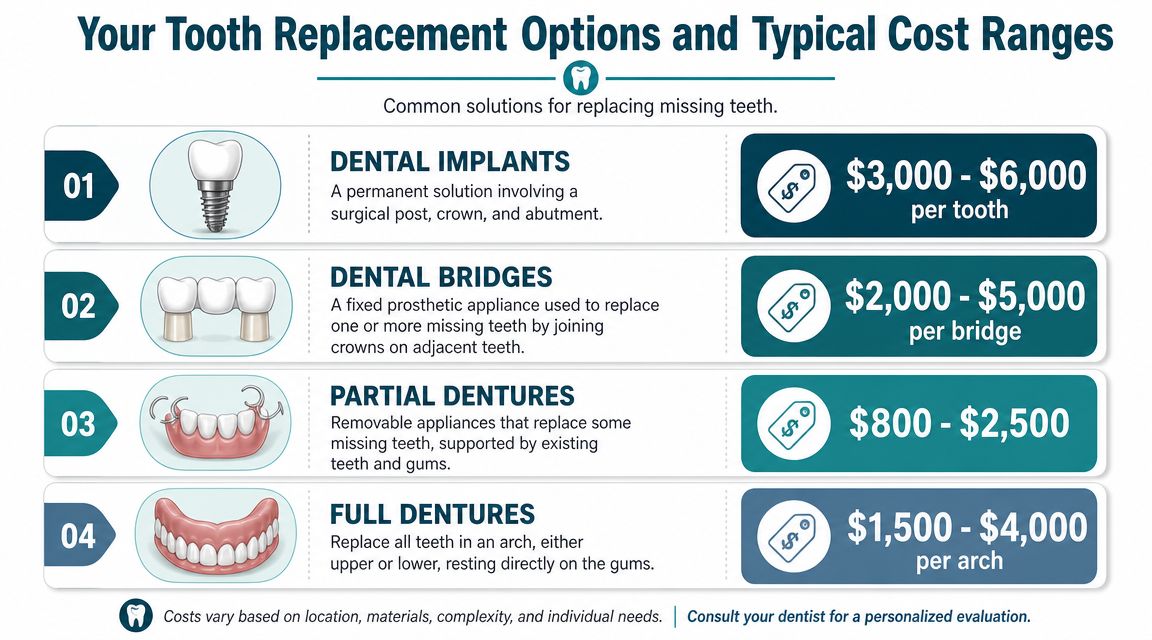
Consumer health organizations and dental cost guides consistently show the same pattern. Implants usually cost the most up front, bridges often fall in the middle, and removable partial dentures usually have the lowest starting cost. Those ranges are helpful for planning, but they are still only starting points until an exam shows what your mouth needs.
Single dental implant
An implant replaces the root and the visible tooth. A small post is placed in the jawbone, and the final crown attaches on top. Because it stands on its own, it does not depend on the teeth next to the space for support.
For a patient missing one tooth, this often feels closest to having a natural tooth back. It is fixed, so you do not remove it at night, and it can help preserve the bone in that area. The higher initial cost usually reflects the surgery, healing phase, and final restoration, not just the crown you see above the gumline.
If you want a local, plain-English explanation of pricing, our page on how much dental implants cost in Amanda, OH breaks down what may be included.
A short overview may help before comparing other options:
Traditional dental bridge
A bridge replaces a missing tooth by connecting an artificial tooth to crowns placed on the neighboring teeth. It stays in place, so it is still a fixed option, but it gets its support from the teeth on either side of the gap.
This can be a very sensible choice if those neighboring teeth already need crowns. In that situation, one treatment may solve two problems at once. The main question is whether those teeth are healthy and strong enough to carry the load over time.
A bridge often makes the most sense when the support teeth already need restorative work or when implant treatment is not the preferred choice.
Removable partial denture
A partial denture is a removable appliance that replaces one or several missing teeth. It usually has the lowest entry cost, which is why many patients ask about it first.
It can restore appearance and some chewing function without surgery. The tradeoff is that it does not feel as much like a natural tooth as a bridge or implant. Some patients adapt quickly. Others need a little time, a few adjustments, and realistic expectations about how it will feel.
| Option | How it works | Typical U.S. range |
|---|---|---|
| Single implant | Surgical post with final restoration | Often higher than other single-tooth options |
| Bridge | Fixed replacement supported by nearby teeth | Often mid-range, depending on the number of teeth involved |
| Acrylic partial denture | Removable appliance for one or more missing teeth | Usually the lowest upfront cost |
When more than one tooth is missing
When several teeth are missing, the plan often changes. A longer bridge, a removable partial, a full denture, or an implant-supported solution may all be considered. Where the spaces are matters just as much as how many teeth are missing.
That is why two neighbors in Amanda can search the same phrase online, see the same price range, and still receive very different recommendations in the office. One person may need a simple replacement. Another may need a design that spreads biting forces more safely.
At Amanda Family Dental, we try to make that conversation easier to follow. If cost is one of the biggest concerns, we can also review practical ways to reduce routine dental expenses, including our Power Plan Membership, before you decide which replacement option fits your health and budget best.
Key Factors That Influence Your Final Treatment Cost
Many patients notice that online prices don't match the quote they eventually receive. That doesn't mean anything is hidden. It usually means the starting price didn't account for the condition of the mouth or the steps needed to do the work safely.
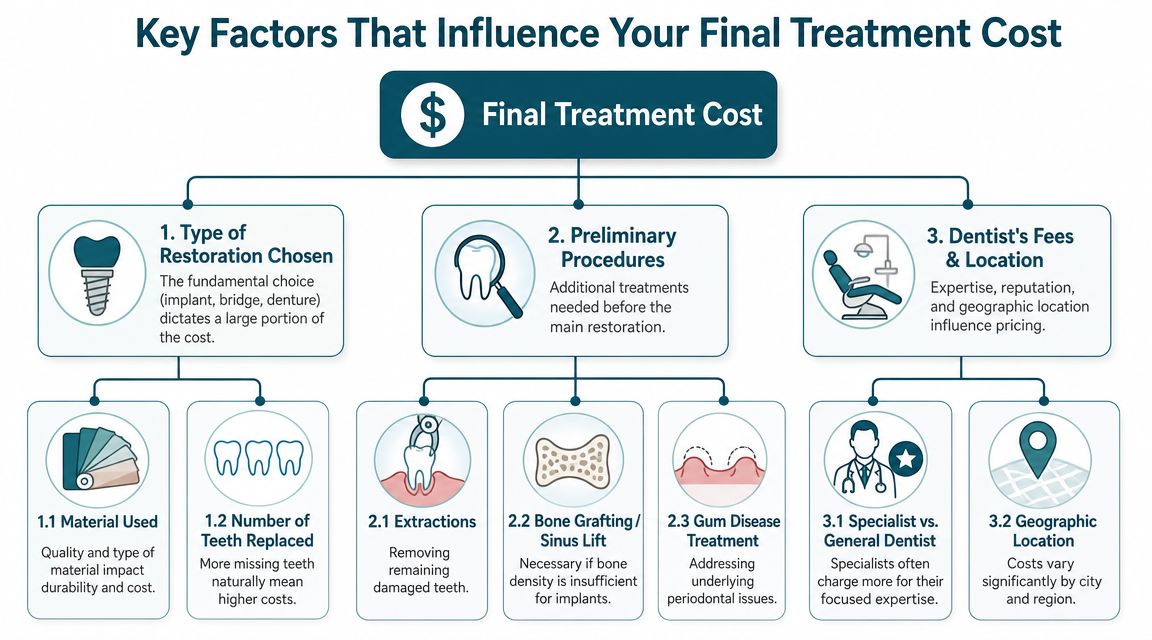
The treatment choice sets the baseline
The biggest cost driver is the restoration itself. A removable partial denture is built differently from a bridge. A bridge is built differently from an implant. Each choice carries its own lab work, chair time, planning, and follow-up.
The number of missing teeth also matters. Replacing one tooth is a different problem from replacing several teeth across the mouth. The design becomes more complex as more support, more materials, and more visits are involved.
Preparatory care can change the quote
Sometimes the missing tooth isn't the only issue. A patient may still need a damaged tooth removed before replacement begins. Another patient may need gum treatment first because inflamed tissue makes restorative work less predictable.
When a tooth can't be saved and needs to come out before replacement, the process often starts with tooth extraction treatment. That step is part of the total care plan, not a separate problem.
A few common reasons a quote changes after an exam include:
- Remaining tooth damage: A cracked or decayed neighboring tooth may need treatment before it can support a bridge.
- Bone support: Implant planning depends on the amount and quality of available bone.
- Gum health: Unhealthy gums can affect healing, comfort, and long-term stability.
- Bite forces: Heavy clenching or grinding can influence which materials and designs make sense.
Some price differences come from what the tooth needs. Others come from what the mouth needs around the tooth.
Materials imaging and provider fees
Materials can affect both appearance and durability. A front tooth often demands a different level of shade matching and esthetics than a back molar. Lab choices and restorative materials can shift the final fee even when the treatment category stays the same.
Imaging matters too. Digital X-rays are often part of diagnosis, and some cases need more detailed planning to see bone, roots, or spacing clearly. That level of evaluation helps avoid surprises and supports better decision-making.
Then there's the provider side. Geographic location, the complexity of the case, and whether care is handled in one office or coordinated across providers can all shape the total estimate. That's why a personalized consultation matters more than any generic online number.
Making Care Affordable with Insurance and Financing
A treatment plan can make sense clinically and still feel stressful once the conversation turns to cost. I tell Amanda-area patients to look at the financial side the same way we look at the dental side. Break it into parts, check what support is available, and build a plan that fits real life.
What insurance usually means in real life
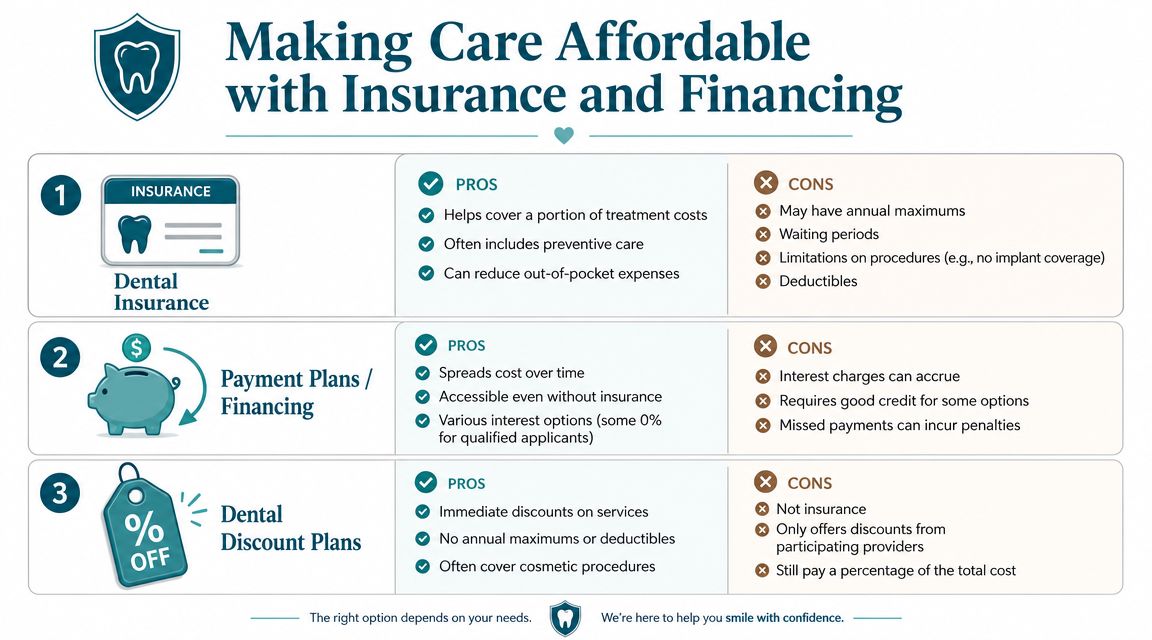
Insurance often helps, but it rarely answers the whole question by itself. Two patients can need the same tooth replacement and still have very different out-of-pocket costs because their plans handle deductibles, annual maximums, waiting periods, and replacement rules differently.
That is why a helpful cost conversation starts with specifics. Which procedure is being considered? Which parts of care might be covered? Is the plan more favorable toward a bridge than an implant, or does it only contribute to certain steps?
Some patients in Amanda and nearby communities do not have dental insurance at all. In those cases, people may compare private offices, membership programs, community clinics, or dental school settings, as noted earlier in the article. The goal is not to find a one-size-fits-all answer. The goal is to find a path you can realistically complete.
Other ways patients manage treatment costs
Many families combine benefits with monthly payments, phased treatment, or office membership savings (including a Power Plan Membership). That can make a larger treatment feel more manageable, especially when the preferred option has a higher upfront fee.
At Amanda Family Dental, patients can review financing information for payment options and ask how the Power Plan Membership may reduce costs for patients without insurance. For a lot of households, that changes the conversation from "Can I afford all of this today?" to "What is the smartest way to start?"
A few practical approaches often help:
- Use phased care: Some patients handle the urgent step first, then complete the final restoration on a planned timeline.
- Review financing terms carefully: Monthly payments can help, but the details matter. Ask about approval, payment length, and whether interest applies.
- Protect personal credit when possible: For anyone considering larger healthcare financing, this guide on the importance of building credit explains why credit history can affect borrowing options.
- Ask about membership plans: Offices sometimes offer in-house programs that lower fees on certain services for patients without insurance.
A lower sticker price does not always mean lower long-term cost. The better value is the treatment a patient can afford to finish, maintain, and live with comfortably.
Example Scenarios Estimating Your Out-of-Pocket Cost
Patients usually understand costs better when they see how a real-life decision could unfold. The details below are examples only. They show how treatment choice, coverage, and planning can shape out-of-pocket cost without promising a specific quote.
A single front tooth after an accident
A patient from Lancaster loses one visible front tooth and wants a fixed solution that looks as natural as possible. After the exam, the dentist recommends a single implant if bone and gum support look appropriate.
The patient learns that a typical single implant in the U.S. is commonly priced in the several-thousand-dollar range, as noted earlier. The final out-of-pocket amount depends on the individual insurance plan, whether any preliminary care is needed, and how the office structures payment. For some patients, that means using benefits toward eligible portions and financing the remainder over time.
Replacing a back tooth on a tighter budget
A patient from Amanda is missing one back tooth and wants chewing function back but needs to be careful with monthly expenses. The exam shows that the adjacent teeth could potentially support a bridge.
In that situation, the bridge may carry a lower upfront fee than an implant, but the choice also depends on the condition of those neighboring teeth. If the patient prefers a removable option to reduce initial cost, a partial denture may also enter the discussion. The actual out-of-pocket figure changes based on plan coverage, lab choices, and whether any extra treatment is needed first.
Several missing teeth and a phased plan
A patient from Circleville has multiple missing teeth and has delayed treatment for a while because the situation felt overwhelming. Instead of trying to solve everything at once, the care plan is broken into phases.
The first phase may focus on urgent concerns such as removing a failing tooth or stabilizing gum health. The next phase may restore function with a removable option or a bridge, while a later phase considers implant treatment if the patient wants something more fixed. This kind of staged approach often helps patients fit care into real budgets without feeling pressured into one large immediate expense.
The key point in all three examples is simple. A quote becomes much easier to understand once the dentist identifies the problem clearly, explains the choices plainly, and shows how benefits or financing apply to that individual case.
Your Personalized Consultation at Amanda Family Dental
A missing tooth consultation should answer two questions at the same time. What treatment makes sense clinically, and what does that treatment cost in a clear, usable way?
What happens at the first visit
The visit typically starts with a conversation about what the patient has noticed. Some people are most concerned about appearance. Others care more about chewing, soreness, or a loose neighboring tooth. Those details matter because they shape which replacement options fit the situation.
Digital X-rays may be used to look at the space, the roots, the surrounding bone, and the condition of nearby teeth. If the patient is new to the office, this may also be part of a broader new patient exam so the full oral health picture is considered, not just the missing tooth.
How the treatment plan becomes clear
After the evaluation, the dentist reviews the options in plain language. If more than one solution could work, the differences should be explained clearly. Which option is fixed. Which one is removable. Which one asks more of the neighboring teeth. Which one may involve more visits.
A useful consultation should also include a written cost breakdown, not just a verbal summary. Patients deserve to know what the fee covers, whether any preliminary care is recommended first, and how insurance or payment arrangements might affect timing.
Good treatment planning reduces guesswork. Patients should leave knowing what the problem is, what the options are, and why one path may fit better than another.
For many people in Amanda, Carroll, Lancaster, and Circleville, that kind of clarity removes a lot of anxiety. Once the plan is specific, the decision gets easier.
Questions to Ask Your Dentist and How to Schedule Your Visit
Before choosing a treatment, patients should feel comfortable asking direct questions. Good questions often prevent expensive misunderstandings later.
A short checklist can help:
- What exactly is included in this quote and what steps, if any, might be separate?
- Which option fits this tooth and bite best if the goal is long-term function?
- How will this affect nearby teeth and daily cleaning?
- Is any preliminary treatment needed first such as extraction or gum care?
- What payment options are available if the preferred treatment costs more upfront?
Patients searching for a dentist near me, a dentist in Amanda, OH, or dental implants near me often want two things. Clear answers and a local office that won't make the process harder than it already is.
Patients in Amanda, Lancaster, Circleville, and Carroll who want a personalized estimate for missing tooth replacement cost can schedule a consultation with Amanda Family Dental. The visit can identify the cause of the problem, review replacement options, and provide a straightforward treatment plan with clear next steps.