

An appointment on the calendar can bring on a fast heartbeat, tense shoulders, and the urge to cancel. For many people, fear starts long before they sit in the dental chair. It begins the night before, or even when they pick up the phone to schedule.
That reaction is common, and it deserves to be taken seriously. Nearly 73% of U.S. adults experience some degree of dental fear, with 27% reporting extreme fear, according to recent reporting on dental fear prevalence and its roots in childhood experiences. For many adults, that fear started years earlier with a difficult childhood experience.
Families in Amanda, Lancaster, Circleville, and Carroll often ask the same question in different ways. How can a patient get through the next visit without panic, and how can a parent keep that fear from becoming a family pattern? The answer usually isn't one trick. It's a combination of preparation, control, communication, and positive experiences that build over time.
Table of Contents
- Your Local Guide to Overcoming Dental Anxiety
- Understanding Why Dental Anxiety Is More Than Just Fear
- Your Pre-Appointment Checklist for a Less Stressful Visit
- Your Comfort Options Sedation Dentistry in Amanda OH
- A Parent’s Guide to Easing Children’s Dental Fears
- Building Lasting Confidence A Long-Term Approach to Dental Care
Your Local Guide to Overcoming Dental Anxiety
Dental anxiety isn't a personality flaw. It isn't stubbornness, weakness, or overreacting. It's a real barrier to care, and it affects people who otherwise manage work, parenting, and everyday stress just fine.
For local families, the problem often looks familiar. An adult puts off a cleaning for years. A child picks up on that tension. Then both parent and child start treating dental visits as something to brace for instead of a normal part of staying healthy.
That cycle can change. The first shift is simple but important. Fear has to be named clearly, without shame.
Fear usually has a reason
Some patients fear pain. Others fear loss of control, needles, sounds, bad news, embarrassment, or memories from earlier treatment. A person doesn't need to have all of those triggers for anxiety to become intense.
Dental fear tends to shrink when a patient knows what to expect, feels heard, and keeps some control during the visit.
A calmer dental experience isn't built on pretending fear doesn't exist. It's built on reducing uncertainty and avoiding rushed care. That matters for adults, and it matters even more for children who are forming their first impressions.
Local care matters when trust is the issue
Patients searching for a dentist near me, a dentist in Amanda, OH, or a dentist in Lancaster, OH are often looking for more than convenience. They want a place close to home where the team speaks plainly, doesn't judge delays in care, and respects pacing.
For anxious patients, that practical fit matters. A nearby office is easier to visit for a consultation, a short new patient exam, or a simple follow-up that helps rebuild comfort instead of overwhelming the patient with too much at once.
Understanding Why Dental Anxiety Is More Than Just Fear
Anxiety changes behavior. That is why it becomes a health problem, not just an uncomfortable feeling. People who are afraid of the dentist often delay routine care, skip cleanings and exams, and wait until pain forces action.
Research found that 39% of people with high dental fear follow a pattern of avoiding visits and only seeking care for problems, compared with 1% of people without fear, as described in this review of dental fear, avoidance, and oral health consequences. That same pattern is linked to a higher prevalence of decayed teeth and periodontal disease.
What delay usually looks like in real life
A small cavity rarely stays small forever. Gum inflammation doesn't usually improve because someone waited longer. Problems that might have been handled with a routine visit can become situations that require more involved restorative care.
That is one reason fear feels self-confirming. The longer a person waits, the more likely the next visit involves something more serious than a cleaning.
| If care happens early | If care is delayed |
|---|---|
| cleaning and exams | pain-driven visit |
| dental x-rays and monitoring | advanced decay or infection |
| small fillings or simple preventive care | root canals, tooth extraction, dentures, or dental implants |
| more time to ask questions | more urgency and more stress |
Control starts before the appointment
Patients can interrupt that pattern before stepping into the office. These steps help:
- Say clearly that anxiety is part of the visit. A scheduling call should include that information up front, so the team can plan for pacing and comfort.
- Ask what the first appointment includes. Many anxious patients do better when they know whether the visit is a conversation, exam, digital x-rays, cleaning, or treatment.
- Request a stop signal. A raised hand gives the patient a clear way to pause.
- Choose a manageable goal. For some people, success means completing treatment. For others, success means attending the consultation.
Practical rule: Don't wait for the “perfect time” to come back. The easiest visit is usually the one scheduled before pain and infection take over.
Patients looking for an emergency dentist or help with a painful tooth extraction often arrive after a long period of avoidance. They still deserve a clear plan, calm communication, and a path back to regular care.
Your Pre-Appointment Checklist for a Less Stressful Visit
A good plan lowers anxiety because it gives the patient something concrete to do. Instead of wrestling with dread, the patient can prepare in ways that make the visit feel more predictable.

Start by lowering uncertainty
Try this checklist before the appointment:
- Book a lower-stress time. Many people do better with an earlier appointment, before the day builds momentum and worry has hours to grow.
- Ask for a consultation first. Anxious patients often benefit from seeing the office, meeting the team, and discussing concerns before treatment starts.
- Write down triggers. Noise, injections, gag reflex, past trauma, embarrassment about the condition of the teeth, or fear of cost can all be discussed ahead of time.
- Learn what a routine visit includes. Reviewing a simple guide to what a dental cleaning includes can make a preventive appointment feel less mysterious.
- Pack a calming kit. Headphones, a stress ball, lip balm, water, and a short note with questions can all help.
Use CBT techniques in simple language
Cognitive Behavioral Therapy, or CBT, is highly effective for dental anxiety, and practical parts of it can be used before an appointment, not only in formal therapy, as explained in this overview of CBT approaches for dental anxiety.
The most useful starting point is often cognitive restructuring. That means catching a catastrophic thought and replacing it with a more accurate one.
A thought like “this will be unbearable” can be challenged with something more grounded, such as “modern anesthesia is designed to control pain, and the team can stop if a break is needed.” That replacement doesn't force fake optimism. It replaces panic language with realistic language.
Another strong tool is diaphragmatic breathing. A simple pattern is inhale for 4 seconds, hold for 4, then exhale for 6. A longer exhale helps the body slow down.
This short video can help reinforce that sense of control before the visit.
Bring tools that help the body settle
Not every coping strategy works equally well. Some are dependable. Some sound good but don't do much when stress spikes.
- Good options: music, guided breathing, sunglasses for bright lights, and a stop signal agreed on in advance.
- Sometimes helpful: bringing a supportive person, if that person is calm and not adding tension.
- Usually not enough on their own: trying to “just tough it out” or distracting yourself without telling the team you're anxious.
A patient trying to learn how to overcome fear of the dentist doesn't need to become fearless before booking. The better goal is to arrive with a plan and use that plan step by step.
Your Comfort Options Sedation Dentistry in Amanda OH
Some patients can get through care with preparation, clear explanations, and simple relaxation tools. Others need more help in the chair. That isn't unusual, especially for people who have delayed treatment, need complex restorative work, or know that their anxiety rises fast once treatment begins.
Comfort support is not one-size-fits-all
A comfort-focused visit can include small supports that make a meaningful difference. Headphones reduce the stress of dental sounds. A blanket can ease the body tension that many anxious patients carry without noticing. A slower pace, frequent check-ins, and a stop signal often matter just as much as anything else.
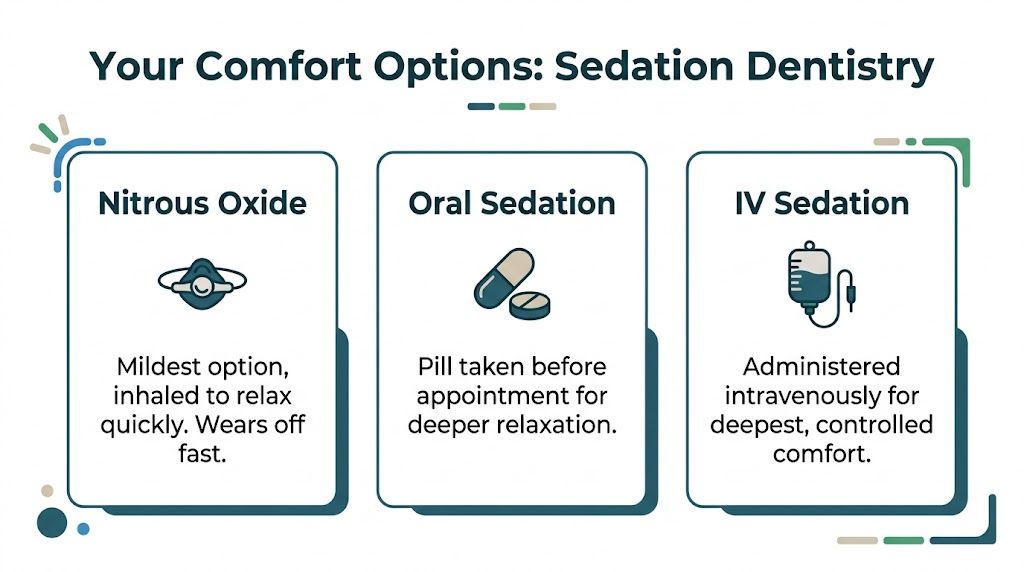
For some patients, though, those supports are only part of the answer. Sedation options can make treatment possible when fear would otherwise prevent care.
A clear explanation of sleep dentistry can help patients understand what level of support may fit their situation.
When deeper relaxation makes sense
The main trade-off in sedation dentistry is straightforward. Deeper relaxation can make treatment much easier, but it also requires more planning, more discussion of medical history, and in some cases extra logistical steps before and after the visit.
This quick comparison helps patients think about comfort levels:
| Option | What it helps with | Best fit for |
|---|---|---|
| Nitrous oxide | Takes the edge off anxiety during treatment | mild to moderate fear, shorter visits |
| Oral sedation | Promotes deeper relaxation before the appointment | stronger anxiety, longer visits, restorative care |
| Deeper monitored sedation options | Helps patients who can't tolerate treatment otherwise | severe anxiety, extensive procedures, strong gag reflex |
Patients looking for a dentist in Circleville, OH or a dentist in Carroll, OH often ask whether sedation means being completely unaware. Sometimes that's the wrong expectation. Many sedation approaches are meant to relax the patient substantially, not erase every memory or sensation.
The best sedation plan matches the procedure, the patient's health history, and the patient's specific trigger pattern.
What usually doesn't work well
Sedation is helpful, but it isn't a replacement for communication. A patient who receives a sedative but never explains what they're afraid of may still have a difficult experience.
These situations commonly create problems:
- Waiting until the day of treatment to mention severe fear. That limits planning options.
- Assuming every procedure requires the deepest sedation available. Some patients do better with a lighter option plus strong communication.
- Using sedation without a long-term plan. Relief during one visit matters, but future care still works best when trust is being rebuilt.
That is especially important for patients coming in for crowns, root canals, dentures, or dental implants near me searches after years away from care. Comfort measures can get treatment started, but confidence grows when each visit feels manageable and respectful.
A Parent’s Guide to Easing Children’s Dental Fears
Children don't need a lecture about dentistry. They need calm cues, simple language, and adults who act like the visit is safe and routine.

A major factor in childhood dental fear is parental anxiety. This discussion of fear of dental procedures and anxiety transmission notes that families can break the cycle by managing both verbal and nonverbal cues and by choosing child-friendly communication and office design.
Children read the room fast
A parent doesn't have to say “be brave” for a child to sense worry. Children notice facial tension, apologetic tones, nervous jokes, and last-minute changes in routine. Even well-meant warnings can create fear.
A better approach is steady and boring. The dentist should sound as ordinary as the grocery store or school drop-off.
Parents exploring pediatric dental care often help their child most by preparing themselves first. If the parent is highly anxious, practicing a calmer script before the appointment can prevent that anxiety from being passed down.
Words that help and words to avoid
Some phrases raise fear even when adults think they are being helpful.
Say this instead: “The dentist is going to count and clean your teeth.”
Not this: “Don't worry, it won't hurt.”
Say this instead: “If you have a question, you can ask.”
Not this: “You have to be good.”
Say this instead: “The team will show you what they're using.”
Not this: “They won't use any scary tools.”
A child usually does better with neutral, positive language than with big promises.
Children also respond well to tell-show-do communication. That means the team explains something in simple words, shows the tool or sensation in a non-threatening way, and then does the step gently. It removes the fear of the unknown without overwhelming the child.
For families, the long-term benefit is bigger than one successful visit. A calm first dental experience can reduce the chance that a child grows into an adult who avoids care until a problem becomes urgent.
Building Lasting Confidence A Long-Term Approach to Dental Care
Fear usually fades through repetition, not through one dramatic breakthrough. Patients build confidence when they have several manageable appointments in a row and leave each one thinking, “That went better than expected.”
Gradual exposure therapy supports that approach. According to this overview of gradual exposure for dental phobia, systematic desensitization has a 75% to 85% success rate in reducing dental phobia, and pre-appointment videos alone can cut anxiety by 40%. The same source describes a progression from low-anxiety steps such as an office tour to simple procedures like a cleaning.
Start smaller than you think
Patients often believe the next appointment has to solve everything. That belief can backfire. A better plan is to choose the smallest successful step that still moves care forward.
That might be:
- a consultation with no treatment
- a new patient exam and digital x-rays
- a short cleaning visit
- one filling instead of multiple procedures at once
This approach works well because it creates evidence. Each completed step gives the patient a new memory that competes with older, fearful ones.
Confidence grows from repetition
Long-term success usually depends on consistency more than intensity. A patient who returns for routine cleanings and exams is less likely to face the kind of advanced problems that require more invasive restorative treatment later.
That matters for comfort, but it also matters for function and appearance. Preventive care supports easier chewing, steadier oral health, fresher breath, and a smile that doesn't feel like a source of stress. For patients also considering cosmetic dentist near me searches, confidence often starts with feeling safe enough to receive basic care regularly.
A practical long-term plan usually includes:
- One trusted office. Familiarity lowers uncertainty.
- Predictable communication. Patients do better when explanations are clear and not rushed.
- Early intervention. Small concerns are easier to treat than advanced ones.
- A written comfort plan. Triggers, preferred coping tools, and sedation preferences should stay part of the record.
Relief is important. Routine is what makes relief last.
For many anxious adults, the hardest part is the first call. After that, progress often comes one low-pressure visit at a time.
If dental fear has been keeping treatment on hold, a small first step is enough. Amanda Family Dental provides family, preventive, restorative, cosmetic, pediatric, and comfort-focused dental care for patients in Amanda, Lancaster, Circleville, and Carroll, Ohio. Schedule a consultation, request a new patient visit, or contact the office to talk through concerns before treatment begins.