

A search for dental implants near me usually starts the same way. Someone smiles less in photos, chews on one side, or keeps adjusting a denture that never feels secure. In Amanda, Lancaster, Circleville, and Carroll, that search often comes after months, or years, of putting up with a missing tooth because the next step felt unclear.
A local guide helps most when it answers practical questions in plain language. What is an implant, who can get one, how long does it take, and how can a family fit treatment into a real budget? Those are the questions that matter when a person wants a lasting solution close to home, not a vague overview.
Table of Contents
- Your Search for a Permanent Smile Solution in Ohio
- What Is a Dental Implant
- Are You a Good Candidate for Dental Implants
- The Dental Implant Process Step by Step
- Implants vs Dentures and Bridges
- Costs and Payment Options at Amanda Family Dental
- Your Comfort During Treatment
- Frequently Asked Questions About Dental Implants
Your Search for a Permanent Smile Solution in Ohio
A common story sounds familiar. A resident in Lancaster loses a back tooth and assumes it isn't urgent because it doesn't show when talking. A parent in Circleville wears a partial denture but avoids certain foods because it shifts. Someone in Carroll has an older bridge that no longer feels dependable. The daily inconvenience builds slowly, then suddenly feels impossible to ignore.
That's why searches for dental implants near me are rarely casual. They usually come from people who want something more stable, more natural-looking, and less frustrating than what they have now.
Modern implants are widely used, not experimental. Success rates for modern dental implants consistently range from 95% to 98%, and approximately 3 million implants are placed annually in the U.S. according to 2025 dental implant statistics compiled here. For many patients, that matters because it turns an intimidating procedure into something easier to understand. It's a mainstream option for replacing missing teeth.
Why local care matters
A treatment like this involves more than one visit. It helps when the office is close enough for planning, follow-up, and questions that come up along the way. Patients in Amanda, OH often want care they can access without driving far for every step.
Local searches also reflect trust. People aren't only looking for technology. They're looking for a team that explains things clearly, respects budgets, and doesn't rush the decision.
Practical rule: If a missing tooth affects eating, speaking, or confidence, it's worth getting an implant consultation before the problem affects more of daily life.
Looking beyond the search result
People often compare providers online before they ever call. Some review educational materials, financing details, and treatment timelines. Marketing teams that focus on driving leads for dental implants have noticed how often patients start with highly specific local searches because they're actively evaluating treatment options, not just browsing.
For families across Amanda, Lancaster, Circleville, and Carroll, the true need is simple. They want a permanent smile solution that feels understandable, close to home, and realistic to pursue.
What Is a Dental Implant
A dental implant replaces the root of a missing tooth. It sits below the gums in the jawbone and supports the new tooth above it. That matters because a natural tooth has two jobs. The part you see helps you chew and smile, and the root underneath keeps that tooth stable.
For many patients in Amanda, Lancaster, and nearby Ohio communities, this is the point where implants start to make sense. A denture replaces a visible space. A bridge fills a gap. An implant adds support under the surface, which is why it often feels closer to having a natural tooth again.
The three parts that work together
An implant restoration usually includes three connected pieces:
- The implant post, which is placed in the bone
- The abutment, which joins the post to the final tooth
- The crown, which is the visible part that looks like a tooth
A simple way to understand it is to separate what is hidden from what is visible. The post does the support work under the gums. The abutment connects the pieces. The crown is the part you chew with and see in the mirror.
Patients sometimes hear the word "implant" and assume it means the whole finished tooth. Dentists often use the term that way in conversation, but the support post is the actual implant. The crown is the final restoration attached to it.
What materials are used
Many dental implants are made from titanium because it has a long history of use in dentistry and medicine. Some patients ask about metal-free options because of personal preference or sensitivity concerns. In certain cases, zirconia implants may also be considered.
Material choice is only one part of the decision. The shape of the bone, the condition of the gums, the location of the missing tooth, and the bite all play a role in planning.
A dental implant replaces more than a space in your smile. It replaces the support beneath that space.
Why implants feel different from other options
An implant is fixed in place, so the chewing pressure is supported from the jawbone upward. That is different from a removable denture, which rests on the gums, or a bridge, which depends on neighboring teeth for support.
That structural difference is why patients often describe implants as more secure and more natural to chew with. It also explains why treatment planning matters so much. The goal is not only to place a new tooth. The goal is to rebuild the foundation in a way that fits your mouth properly.
At Amanda Family Dental, this conversation is kept practical and easy to follow. Patients from Amanda, Lancaster, Circleville, and Carroll often want clear answers about what the implant does, what comfort options are available, and whether flexible payment plans can make treatment more realistic. Those questions are part of good planning, not an afterthought.
Are You a Good Candidate for Dental Implants
Many patients assume they've already ruled themselves out. They think they're too old, have been missing a tooth too long, or have been told in the past that treatment might be complicated. In reality, candidacy depends on a few practical factors that need a professional evaluation.
Healthy gums matter. Adequate jawbone support matters. Overall health and habits matter too. But those factors don't always lead to a simple yes or no.
Signs that someone may be a candidate
A person may be a strong implant candidate when they have:
- A missing tooth or teeth that affect chewing, speech, or appearance
- Healthy gum tissue or a willingness to treat gum issues first
- Enough jawbone support for secure placement, or a plan to build that support
- Commitment to follow-up care and daily home care after treatment
People in Amanda, OH and nearby communities often arrive thinking they need an emergency dentist because the missing tooth has started affecting the bite, neighboring teeth, or old dental work. Sometimes that's exactly what prompts the conversation about a more lasting fix.
What if there isn't enough bone
This is one of the biggest sources of worry. A patient may hear “bone loss” and assume the option is gone. That isn't always true.
Some patients need bone grafting before implant placement. That step is used when the jawbone needs more volume or support. It can be part of a normal treatment plan, especially after a tooth has been missing for a long time or after periodontal problems.
Patients shouldn't self-reject. A scan and exam give far better answers than an online guess.
Why an exam is the only real way to know
Internet searches can help someone understand the basics, but they can't measure bone levels or gum health. A new patient exam and digital x-rays help clarify whether a single implant, a larger restorative plan, or a different treatment makes the most sense.
That's especially helpful for residents of Lancaster, Circleville, and Carroll who want a clear answer without bouncing between offices. The right next step isn't trying to predict eligibility at home. It's getting the mouth evaluated carefully and building the plan from there.
The Dental Implant Process Step by Step
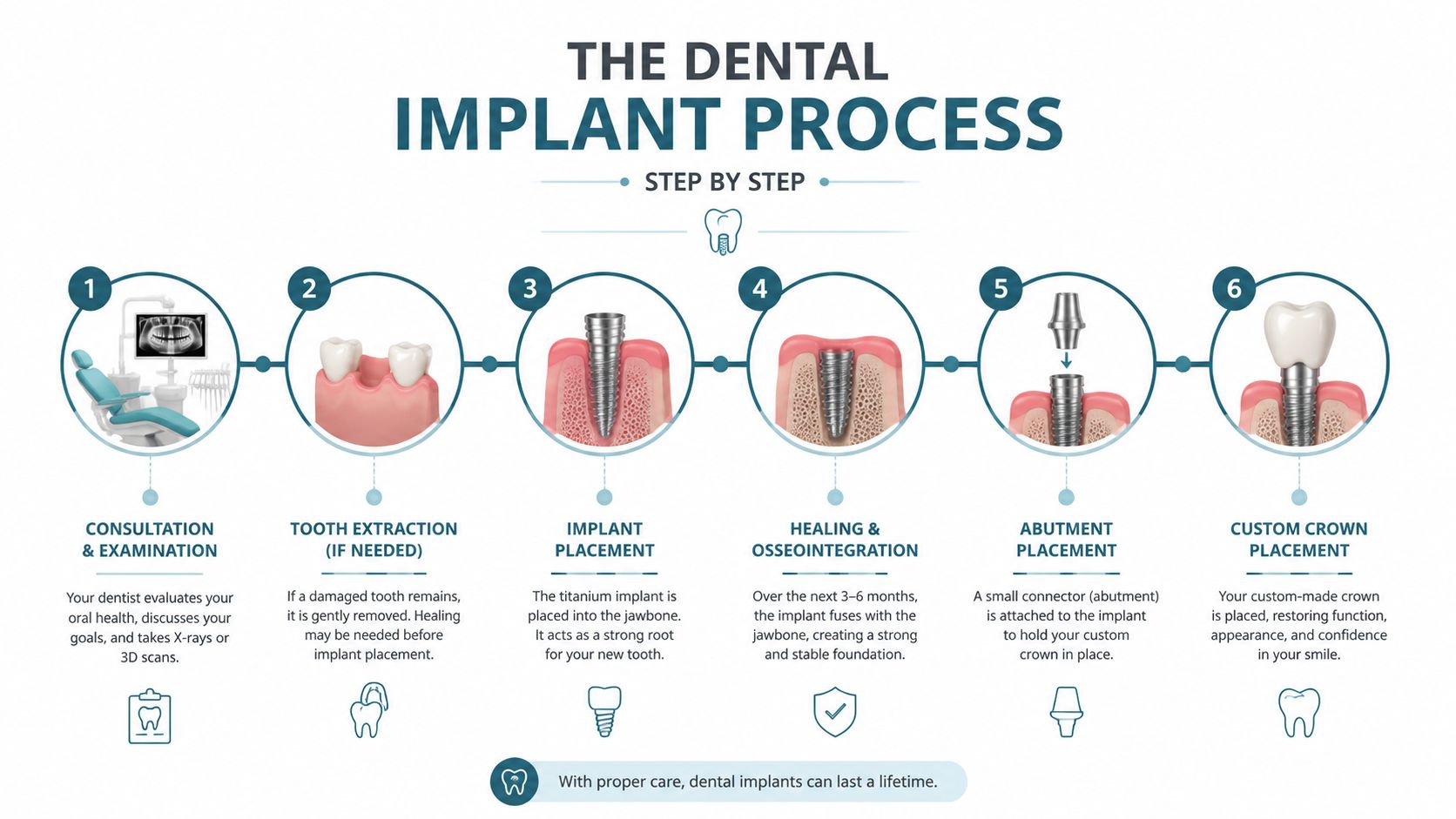
A lot of patients in Amanda and Lancaster picture implant treatment as one long appointment. The real process is more like building a house in stages. First the foundation is planned, then placed, then given time to settle before the finished tooth goes on top.
Step one begins with a clear plan
The first stage is careful planning. Your dentist studies imaging, checks the bite, reviews the gums, and maps the exact position of the implant so the final tooth looks right and works well when you chew.
That planning visit also helps answer practical questions patients often have. How many appointments will this take? Will a temporary tooth be possible? What comfort options are available? At Amanda Family Dental, those details matter because treatment should make sense on paper before it starts in the chair.
Patients who like to read ahead sometimes find it useful to review outside educational material such as Delaware Center's dental implant resources, which explain common expectations in patient-friendly language.
Step two places the implant
At the placement visit, the implant post is set into the jawbone in the planned location. That post acts like an artificial tooth root. For many patients, this is the part that causes the most worry ahead of time, but the visit often feels more controlled and predictable than expected once the numbness and comfort plan are in place.
In some cases, treatment is straightforward. In other cases, the dentist may recommend a staged approach so the site heals in the right order.
Step three gives the bone time to bond
After placement, the mouth needs time to heal and secure the implant. This stage is called osseointegration, which means the bone gradually bonds to the implant surface. Nevada Dentistry & Braces notes that this healing and integration period often takes several months, depending on the case.
A simple way to picture it is a fence post set in concrete. The post may be in position on day one, but it is the settling and hardening afterward that gives it long-term strength.
That is why patience matters here. The waiting period is not a delay without a purpose. It protects the stability of the final tooth.
Step four adds the connector and custom tooth
Once healing is where it should be, the visible part of treatment begins. The abutment, which connects the implant to the crown, is attached. Then the custom crown is made to match the nearby teeth in shape, color, and fit.
This is the part friends and family notice. The steps before it are what make that final result feel steady in everyday life.
Some cases need a broader plan
Not every patient is replacing one missing tooth. If several teeth are missing, your dentist may talk with you about full-arch options such as All-on-4 dental implants for full smile replacement. The sequence is similar, but the design and restoration plan are built for a larger section of the smile.
What the process usually includes
For many patients in Amanda, Lancaster, Circleville, and Carroll, the timeline follows the same general path:
- Exam and imaging to plan the exact position
- Implant placement at the treatment visit
- Healing time so the bone can bond to the implant
- Final restoration with the connector and custom crown
The steps are easier to handle when you know why each one happens. Patients usually feel more confident once they can see the process as a series of planned checkpoints, not a mystery.
Implants vs Dentures and Bridges
Most patients aren't choosing between treatment and no treatment. They're choosing between several ways to replace a tooth. The better question is which option fits long-term goals for stability, maintenance, and day-to-day comfort.
A comparison makes those trade-offs easier to see.
Dental Implants vs Traditional Alternatives
| Feature | Dental Implants | Dental Bridges | Traditional Dentures |
|---|---|---|---|
| Support | Anchored within the jaw | Supported by neighboring teeth | Rests on the gums |
| Feel while eating | Typically feels more fixed and stable | Can feel secure, but depends on support teeth | More likely to shift during chewing |
| Effect on nearby teeth | Doesn't rely on neighboring teeth for support | Requires support from adjacent teeth | Doesn't use nearby teeth for support |
| Jawbone support | Works with the bone-supported foundation discussed earlier | Doesn't replace the root structure | Doesn't replace the root structure |
| Cleaning routine | Similar to caring for a fixed restoration | Requires cleaning around the bridge carefully | Must be removed for cleaning |
| Best fit for | Patients seeking a long-term fixed replacement | Patients who need a fixed option without surgery | Patients who need a removable replacement |
Where bridges still make sense
Bridges are still a reasonable treatment in some cases. They can work well when the surrounding teeth already need crowns or when a patient needs a non-surgical solution. But a bridge depends on other teeth for support, which changes the planning.
Dentures also remain a useful restorative option, especially when replacing many teeth. For some patients, they're the most practical place to start.
When implants become the better long-term fit
Implants often stand out when a patient wants a tooth replacement that stays put and functions more like a natural part of the smile. That's especially true for a single missing tooth, where preserving nearby teeth can be an advantage.
For patients exploring full-arch options, All-on-4 dental implant treatment may also be part of the conversation when several teeth are missing and a more complete fixed solution is needed.
The right option depends on the condition of the whole mouth, not just the empty space.
In Amanda, Lancaster, Circleville, and Carroll, many people begin with “dental implants near me” because they're tired of movement, adhesives, or workarounds. Comparing options side by side helps turn that frustration into a clearer decision.
Costs and Payment Options at Amanda Family Dental
Cost is often the reason people wait. They may already believe implants would fit their goals, but the financial side feels harder to approach than the clinical side. A straightforward conversation helps more than vague promises.
Nationally, a single dental implant can cost between $3,000 and $5,000, according to this payment and affordability reference. That range helps explain why patients often compare options carefully before scheduling.

What affects the total cost
No two implant cases are identical. The final investment can depend on factors such as:
- How many teeth are being replaced
- Whether preparatory treatment is needed, such as bone grafting or extraction
- What type of restoration is planned, such as a single crown or a larger implant-supported option
- Insurance involvement and benefit structure
Patients often want one flat number from the first phone call. That's understandable, but the most accurate estimate usually comes after the exam and imaging.
Payment flexibility matters
For many Ohio families, affordability comes down to monthly planning rather than the headline cost. Practices that offer in-house support can make treatment more reachable. Amanda Family Dental offers flexible payment plans and a Power Plan Membership, which gives patients another way to approach restorative care without having to solve the full cost all at once.
Some people also like to review broader healthcare financing ideas before deciding how to pay. This One For All Medical Billing payment guide gives a general overview of payment solution concepts that can help patients prepare better questions.
A more specific overview of treatment pricing is available on the practice's dental implant cost page.
A useful cost conversation includes two parts: the treatment fee itself and the payment path that makes the treatment possible.
For patients in Amanda, Lancaster, Circleville, and Carroll, that second part is often what turns interest into action.
Your Comfort During Treatment
Fear keeps many people from moving forward, even when they already know a missing tooth is affecting their health or confidence. That's not unusual. Dental anxiety affects up to half of all patients, and comfort-focused options like sleep dentistry can increase implant treatment acceptance by 25%, according to this dental implant and patient comfort overview.
A typical anxious patient visit often goes better than expected because the pace is slower and the explanations are clearer than people imagine. The team reviews the steps, answers questions, and discusses comfort options before treatment starts. That alone can lower a lot of tension.
What comfort-focused care can look like
Patients usually want to know whether they'll feel trapped in the chair or overwhelmed by the process. Comfort-centered care addresses that in practical ways:
- Sleep dentistry options help patients who avoid care because of fear
- A personalized pace gives anxious patients time to ask questions and understand each step
- Clear expectations reduce the stress that comes from not knowing what happens next
Why comfort affects outcomes
When patients feel calmer, they're more likely to keep appointments, follow instructions, and complete care. That matters in implant treatment because consistency supports healing and follow-up.
For families in Amanda, OH, Lancaster, Circleville, and Carroll, comfort isn't a luxury add-on. It's part of whether treatment feels doable at all.
Frequently Asked Questions About Dental Implants
Are dental implants painful
Most patients are more anxious before treatment than during it. The area is numbed, and comfort options can be discussed in advance. Mild soreness during recovery is common, but the process is usually more manageable than people expect.
How long do dental implants last
Implants are designed as a long-term tooth replacement. Their longevity depends on healing, home care, regular dental visits, and the health of the surrounding gums and bone.
Can someone get an implant if a tooth has been missing for years
Possibly. A long time without a tooth can affect the bone, but that doesn't automatically rule treatment out. An exam and imaging are needed to know whether added preparation is necessary.
Are same-day teeth always possible
Not always. Some cases allow faster restoration steps, while others need more healing time before the final crown is placed. The safest timeline depends on the condition of the bone, gums, and bite.
How should implants be cared for
Implants need daily brushing, cleaning around the restoration, and regular professional checkups. This guide to how to care for dental implants explains the maintenance basics in more detail.
Patients in Amanda, Lancaster, Circleville, and Carroll who are searching for a steady, natural-looking way to replace missing teeth can schedule a consultation with Amanda Family Dental to discuss implant options, comfort choices, and payment planning in one visit.