

Most dental insurance plans cover routine cleanings at 100% as preventive care, but coverage depends on network status, frequency limits, and whether the visit is coded as a routine cleaning rather than periodontal treatment. In the United States, 100% of stand-alone adult dental plans offered through HealthCare.gov in 2021 covered routine preventive services, including examinations, cleanings, and X-rays.
A patient calling a dental office usually wants one simple answer: “Will the cleaning cost anything?” The honest answer is usually yes, routine cleanings are covered, but the advertised percentage is only the starting point. Patients in Amanda, Lancaster, Circleville, Carroll, and nearby Ohio communities still need to confirm how their plan applies to the specific visit.
A cleaning can become more complicated when the dentist is out of network, the patient has already used the plan's allowed visits, or the gums need periodontal treatment instead of routine prophylaxis. Amanda Family Dental helps local families understand those distinctions before treatment, whether the appointment involves cleaning and exams, dental X-rays, restorative dentistry, or urgent care.
Table of Contents
- The Short Answer and the Four Things That Change It
- How Dental Plans Categorize Cleanings and Other Services
- In-Network Versus Out-of-Network Cleanings
- How to Verify Your Cleaning Benefit Before You Schedule
- Why 100% Coverage Can Still Leave a Bill
- Maximizing Your Cleaning Coverage at Amanda Family Dental
- Frequently Asked Questions About Cleaning Coverage
The Short Answer and the Four Things That Change It
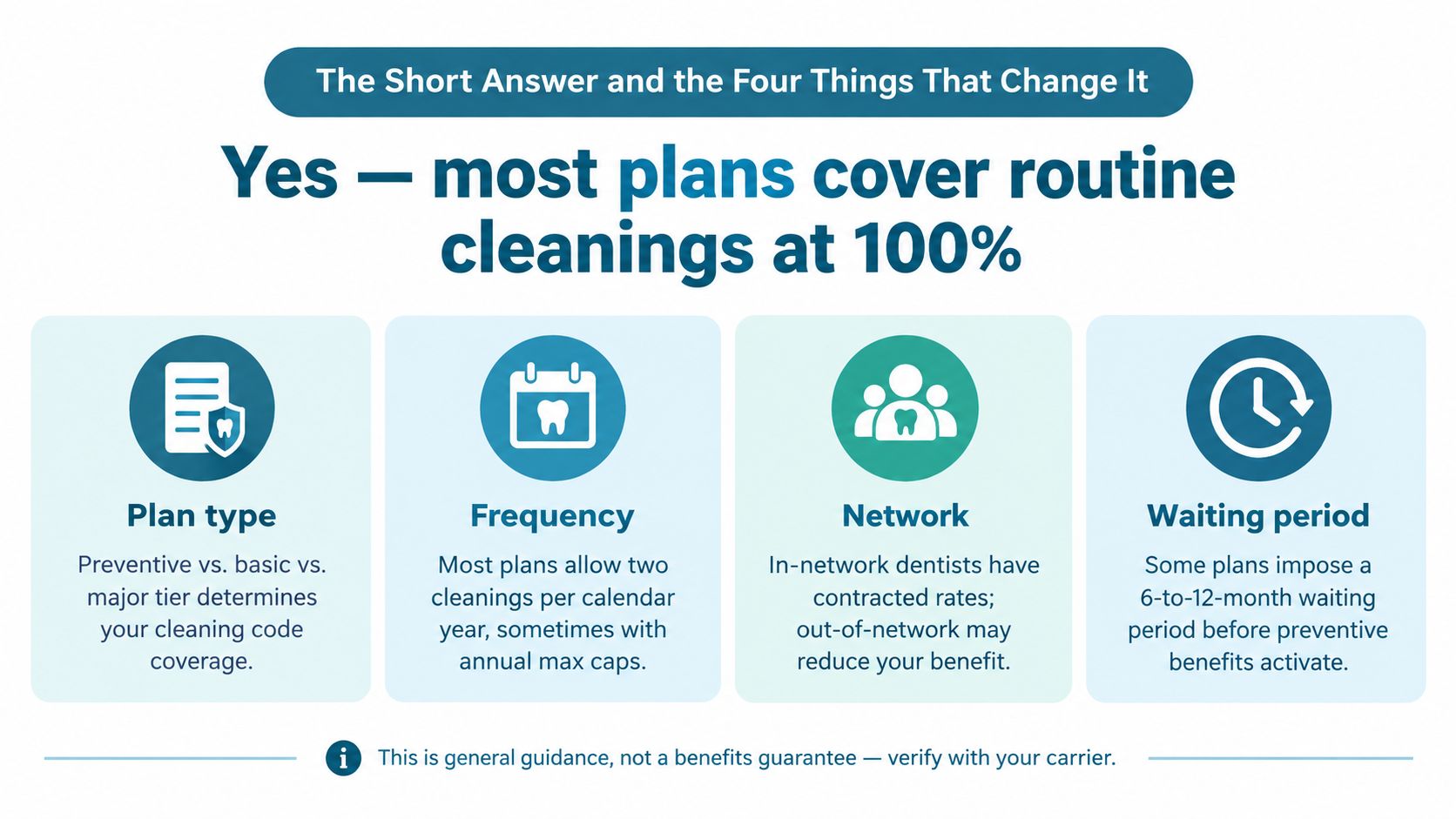
Most private dental plans classify a routine cleaning as preventive care and commonly cover it at 100%. The American Dental Association reports that most plans cover about 100% of preventive services, compared with roughly 80% of basic procedures and 50% of major procedures. KFF explains how dental plans commonly structure preventive benefits, including the limits that can still create a patient balance.
The front desk question should never stop at “Is preventive care covered?” A benefits representative or dental coordinator needs to check four details:
Provider network: An in-network office accepts the plan's contracted allowed fee. An out-of-network office may leave the patient responsible for the difference between the allowed amount and the office fee.
Frequency limit: Many plans limit routine cleanings to a set number during the calendar or benefit year, commonly twice per year. The reset may not follow the date of the previous appointment.
Cleaning code: Routine adult prophylaxis is commonly submitted as D1110. Periodontal maintenance is commonly submitted as D4910 and may receive different treatment under the plan.
Exam and X-ray benefits: An examination or bitewing X-rays may be bundled into the preventive visit, separately limited, or subject to different plan rules. A cleaning covered at 100% doesn't automatically mean every service performed that day is covered at the same level.
Practical rule: “100% preventive coverage” usually means the insurer pays the allowed in-network amount. It doesn't necessarily mean every charge from every dentist is free.
Patients should also check the deductible, waiting period, annual maximum, and whether periodontal maintenance is treated differently from routine prophylaxis. The exact benefit depends on the policy, network, frequency limits, and plan administration.
How Dental Plans Categorize Cleanings and Other Services
Dental insurance usually separates services into preventive, basic, and major categories. Routine adult prophylaxis, identified by code D1110, and child prophylaxis, identified by D1120, generally belong in the preventive category. That category commonly includes cleaning, examinations, and some dental X-rays.
The American Dental Association's plan-design guidance recommends first-dollar preventive coverage, meaning the deductible shouldn't have to be satisfied before preventive benefits apply. It also recommends 100% coverage without copayments or coinsurance and at least two covered preventive visits per calendar or plan year when a plan uses frequency limits. The ADA's dental benefit plan design guidance explains why advertised coverage should be checked against the actual policy language.
| Service Category | Typical Coverage | Common Procedures | Example ADA Code |
|---|---|---|---|
| Preventive | About 100% | Routine cleanings, exams, selected X-rays | D1110, D1120 |
| Basic | About 80% | Fillings and other basic treatment | Varies by procedure |
| Major | About 50% | Crowns, bridges, and dentures | Varies by procedure |
The 100/80/50 structure is a guideline, not a guarantee. A plan can apply waiting periods, deductibles, coinsurance, frequency limits, or alternate-benefit rules. Coverage for a routine cleaning also doesn't predict coverage for a filling, crown, tooth extraction, dental implant, or periodontal procedure.
Periodontal maintenance is where many patients receive an unwelcome surprise. A patient with a history of gum disease may need maintenance below or around the gumline rather than a routine cleaning above the gumline. That appointment may be billed under D4910, so the plan may process it differently from D1110. The dental office should explain the clinical recommendation and expected benefit before treatment begins.
For a plain-language overview of how insurers and plan structures differ, patients can review My Policy Quote's dental guide. Patients can also read what a dental cleaning includes before calling a dentist in Amanda, OH, Lancaster, OH, Circleville, OH, or Carroll, OH.
In-Network Versus Out-of-Network Cleanings
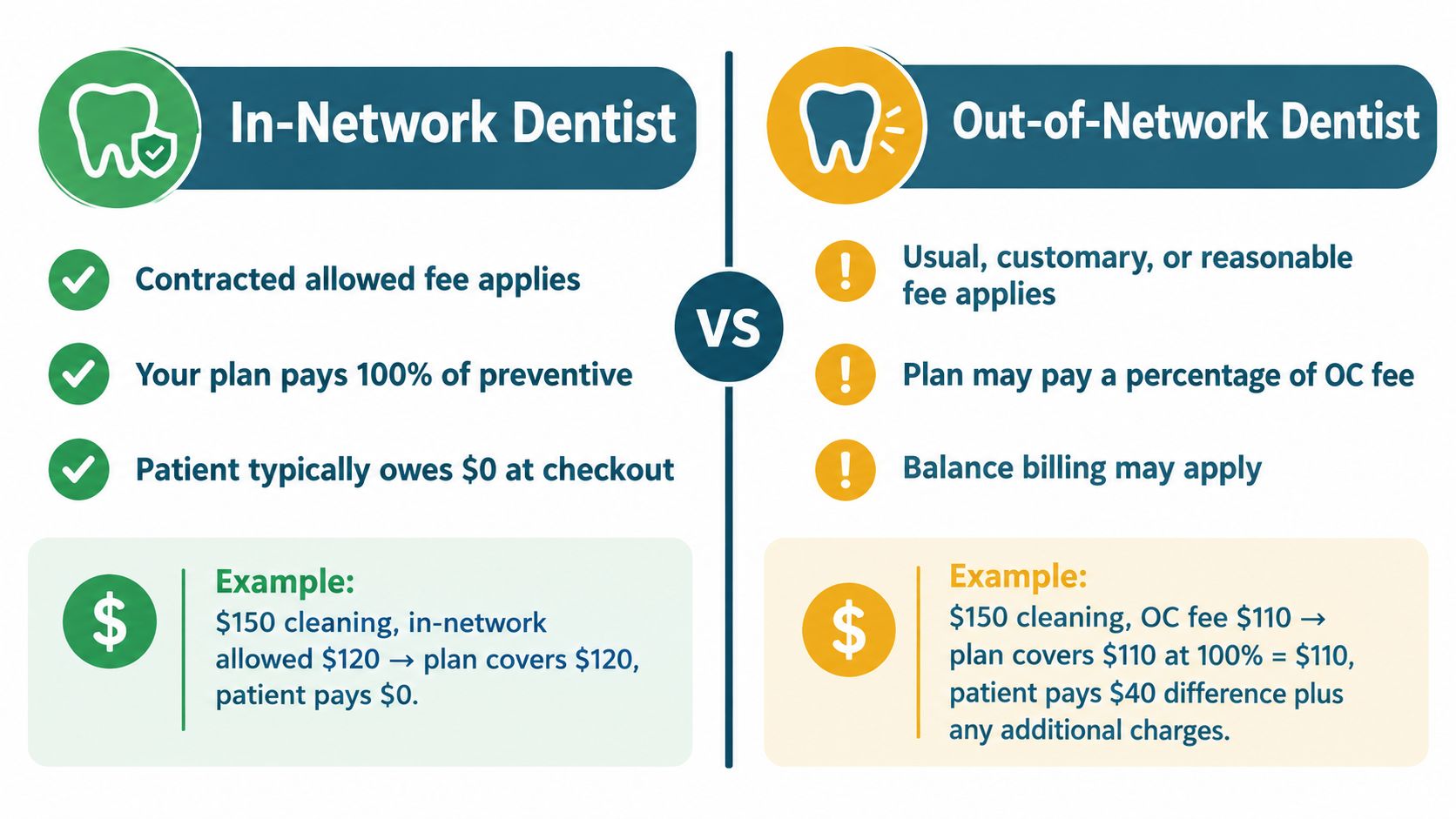
Network status can determine whether a covered cleaning produces no patient balance or an unexpected charge. An in-network dentist has agreed to a contracted allowed fee with the insurance company. If the plan pays the full allowed amount for preventive care, the patient generally doesn't owe the difference between the office's standard charge and that contracted fee.
An out-of-network dentist may still submit the claim, but the plan can calculate payment using its allowed amount or usual, customary, or reasonable fee schedule. The insurer may pay the covered percentage of that amount while the office bills the patient for the remaining difference. That practice is commonly called balance billing.
Assignment of benefits can make the process easier because the insurer sends payment directly to the dental office, but it doesn't guarantee that the patient has no responsibility. A dental office may also be in network for one plan and out of network for another, so the member card and carrier directory need to be checked together.
A patient choosing an out-of-network dentist should ask for the office fee, the insurer's allowed amount, and the estimated balance before scheduling.
DHMO plans usually restrict benefits to participating dentists and may pay nothing for out-of-network care. PPO plans may offer some out-of-network benefits, but the patient can still face a larger balance because of the fee difference or a less favorable reimbursement schedule.
The decision isn't only financial. A patient may prefer a specific dentist because of location, comfort-focused care, emergency availability, or experience with dental anxiety. The practical recommendation is to compare the estimated out-of-pocket amount with the convenience and continuity of care, then make that choice with complete information.
How to Verify Your Cleaning Benefit Before You Schedule
A short benefits call can prevent a long billing conversation later. Patients shouldn't rely on a general statement that cleanings are covered. The representative needs the exact procedure, provider, frequency, and plan-year details.
Start with the cleaning code
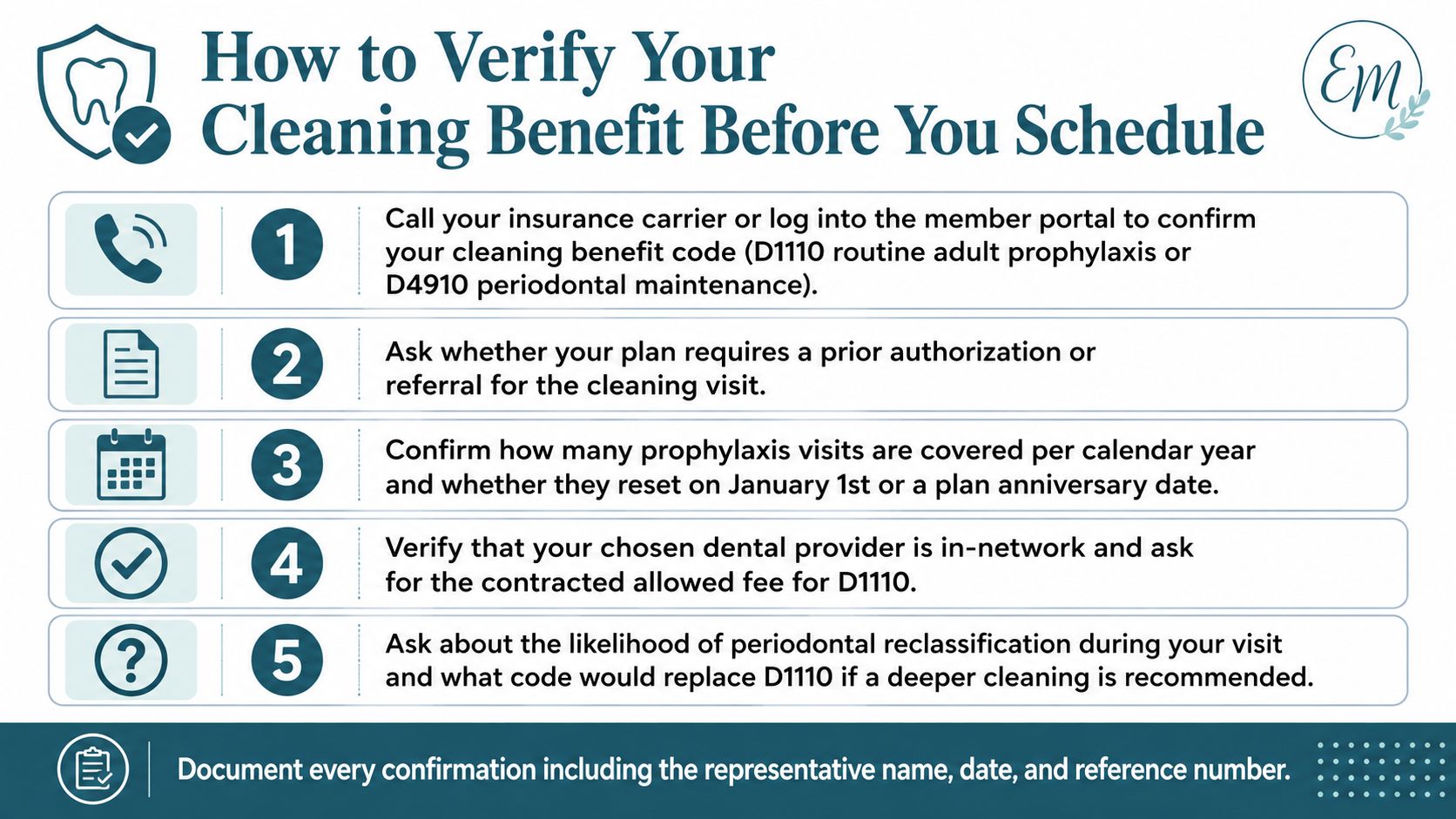
The first question should be: “Does this plan cover D1110 for routine adult prophylaxis, and how is D4910 for periodontal maintenance handled?” Parents should ask whether the plan covers D1120 for child prophylaxis. A patient with a gum-disease history should ask which code the dental office expects to submit.
The office can also confirm whether the appointment is likely to involve routine prophylaxis or a periodontal procedure. That distinction matters because a deeper cleaning may fall under another benefit category.
Confirm dates and related services
Patients should ask how many prophylaxis visits remain and when the benefit resets. The relevant date may be the start of the calendar year or the plan's benefit year. Two cleanings in a year don't automatically mean two free visits if one has already been used, the visits fall outside the plan period, or the plan applies a different frequency rule.
The next questions should cover the exam and X-rays:
- Bundling: Is the oral examination included with the preventive cleaning benefit?
- Imaging: Are bitewing or other dental X-rays covered separately?
- Network: Is the chosen dentist participating for the specific plan?
- Estimate: What patient responsibility does the insurer estimate for each submitted code?
- Administration: Does the plan require a referral or prior authorization for any part of the visit?
Patients should record the representative's name, the call date, and the reference number. A written estimate from the dental office adds another layer of protection, although an estimate isn't the same as a final claim determination.
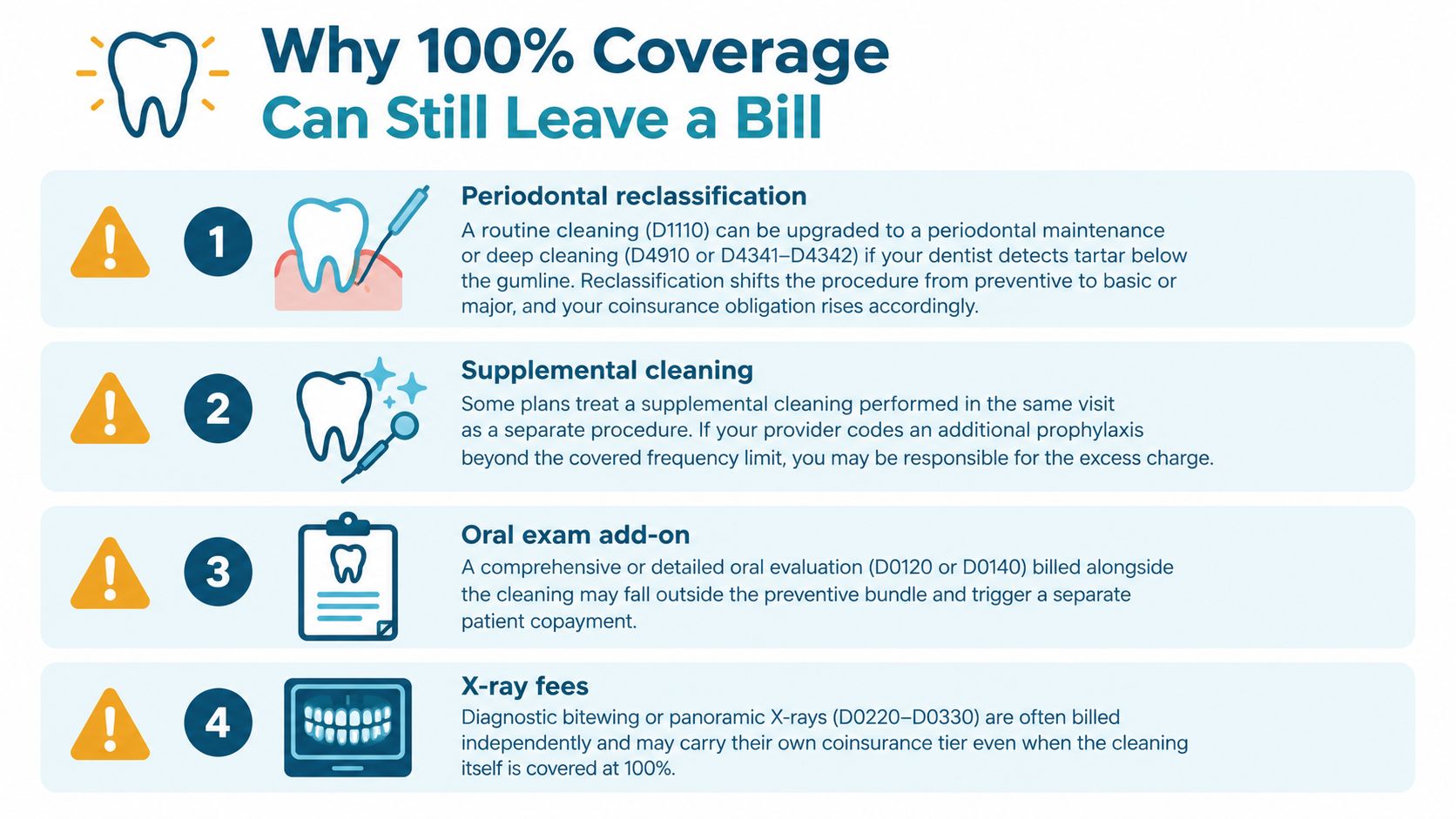
Why 100% Coverage Can Still Leave a Bill
A plan can advertise full preventive coverage and still produce a patient balance. The most common reason is that the visit no longer qualifies as the routine preventive service the patient expected.
A dentist may identify gum-disease concerns that require periodontal maintenance or scaling and root planing rather than routine prophylaxis. That clinical change can move the appointment into a different benefit category. The patient should receive an explanation of the findings, proposed code, insurance estimate, and treatment cost before the deeper procedure is performed.
Four common billing triggers
Periodontal reclassification: A routine D1110 cleaning may be replaced by periodontal maintenance or another gum-treatment code when the patient's condition requires it. The plan may apply coinsurance or a different frequency limit.
An additional visit: A cleaning beyond the plan's permitted frequency may be excluded or processed as a patient-paid service. Patients should confirm remaining visits before booking.
A separate examination: A detailed evaluation may not be processed as part of the same preventive bundle. The office should identify the examination code on the estimate.
Separate X-ray billing: Bitewing or panoramic X-rays may be submitted independently and may have their own coverage limits or coinsurance.
Annual maximums create another important boundary. The ADA data cited in a Colorado Division of Insurance analysis shows that 32.8% of in-network annual maximums fall between $1,000 and $1,500, while 48.2% fall between $1,500 and $2,500. The Colorado Division of Insurance analysis shows why a plan can support routine prevention yet offer limited protection when treatment becomes more extensive.
The same analysis reports that 72.4% of people with private insurance had visited a dentist during the previous 12 months. Insurance can improve access, but network restrictions, scheduling, transportation, benefit timing, and separate periodontal rules can still discourage regular care.
For patients comparing insurance with cash payment or a membership option, the sensible comparison includes premiums, deductibles, waiting periods, frequency limits, and annual maximums. Dental cleaning costs without insurance can be discussed directly with the office before care.
Maximizing Your Cleaning Coverage at Amanda Family Dental
The most useful insurance service happens before the patient sits in the dental chair. A local office can review the member information, confirm network participation, check the planned cleaning category, and prepare an estimate that separates the cleaning, examination, and X-rays.
Patients should bring the insurance card, identification, and any information about a recent job change or new plan. The office can then verify the available preventive benefit and explain whether the appointment is expected to be routine prophylaxis or periodontal maintenance.
What the appointment process should include
A patient-focused visit should follow a clear sequence:
- Before the visit: The office checks benefits and identifies questions that require confirmation from the carrier.
- During the examination: The dentist evaluates the teeth and gums, reviews any digital X-rays, and explains findings in plain language.
- Before additional treatment: The patient receives an explanation of recommended restorative dentistry, tooth extraction, periodontal care, or other services before deciding.
- At checkout: The office reviews the claim estimate and any known patient responsibility rather than treating “100% preventive” as a promise that every item is free.
Families in Amanda, Lancaster, Circleville, and Carroll can also ask whether appointments for several household members can be coordinated on the same day. That can reduce travel and make it easier to use eligible preventive benefits before a plan year resets.
The same conversation applies when a patient is searching for a dentist near me, a cosmetic dentist near me, an emergency dentist, or a provider for dental implants near me. Insurance usually treats cleanings differently from teeth whitening, veneers, implants, crowns, root canals, and emergency dental services, so each proposed service needs its own benefit review.
Patients who need flexible payment options can ask about payment plans for dental care. The recommended next step is to contact Amanda Family Dental with the insurance card ready, ask for a cleaning-benefit review, and request an estimate before scheduling.
Frequently Asked Questions About Cleaning Coverage
How often should children receive cleanings?
Eligible Ohio Medicaid children have dental cleanings covered twice per year, according to the Ohio children's dental benefits summary. Sealants and fluoride may use separate benefit categories, so parents should ask whether those services are covered during the same visit.
What is the difference between a denial and a downgrade?
A denial means the insurer doesn't pay the submitted service under the plan rules. A downgrade means the insurer processes a more extensive service as a less costly alternate benefit, leaving the patient responsible for the difference. The estimate should identify the submitted and downgraded codes.
What happens without dental insurance?
Patients can still schedule a cleaning and pay the office directly. The cash price varies by office and by whether an examination, X-rays, periodontal treatment, or other services are included. An office membership plan may offer an alternative, so patients should compare the total terms before enrolling.
Do benefits carry over after changing employers?
Previous cleanings may not carry over under a new carrier. The new plan may use a different benefit-year reset, frequency history, network, deductible, or waiting-period rule. Ohio Medicaid coverage can also vary by eligibility category, including special provisions for pregnant women and certain other groups, as described in Ohio Medicaid's dental policy.
Amanda Family Dental provides preventive cleanings and exams, digital X-rays, periodontal evaluations, restorative care, cosmetic dentistry, dental implants, and emergency dental services for patients in Amanda, Lancaster, Circleville, and Carroll. Patients can visit Amanda Family Dental to request an appointment or contact the office for a benefits check and a clear estimate before treatment.