

A parent in Amanda may notice a brown spot on a five-year-old's molar while helping with brushing. Another family may hear “cavity” during a routine checkup and feel an immediate knot in the stomach. The next step isn't panic. It's a timely dental evaluation that shows how deep the decay is, whether the tooth can be restored, and which approach fits the child's age, comfort level, and everyday needs.
Pediatric cavity treatment can include a tooth-colored filling, a crown, pulp therapy, silver diamine fluoride, or extraction. The right choice depends on the tooth, the stage of decay, cooperation during care, appearance concerns, and whether the tooth needs to remain healthy until the permanent successor arrives. Families searching for a dentist near me, a dentist in Amanda, OH, or a pediatric dentist serving Lancaster, Circleville, and Carroll can use the information below to prepare for a calm, informed visit.
Table of Contents
- When Your Child Has a Cavity and What Comes Next
- How Common Childhood Cavities Really Are
- Treatment Options Explained for Parents
- What Happens During the Dental Visit
- Aftercare and Recovery at Home
- Prevention That Stops the Next Cavity
- Costs, Insurance, and Why Local Families Choose Amanda Family Dental
- FAQs and Scheduling Your Child's Visit
When Your Child Has a Cavity and What Comes Next
A visible spot isn't always the full story. Decay can develop between teeth or beneath a surface that still looks fairly normal, which is why a dental examination may include dental X-rays and close visual inspection. The sooner a parent schedules an appointment, the more options may remain available.
The first practical steps
A family can start with three simple actions:
- Call for an evaluation. The dental team can determine whether the child needs a routine restorative visit or a faster appointment because of pain, swelling, or a broken tooth.
- Gather health and coverage information. Insurance cards, Medicaid information, medication details, and a list of allergies help the office prepare for the visit.
- Bring the child's questions. Children often cooperate more readily when adults explain that the dentist will look, count, and take pictures before deciding what happens next.
A cavity isn't treated automatically just because a parent sees discoloration. The clinician considers whether the lesion is an early area of enamel change, a true cavity with a break in the surface, or decay that has reached the inner part of the tooth. The American Academy of Pediatric Dentistry's restorative-care guidance supports restoration when examination shows enamel cavitation or shadowing, or when X-rays show progression. Early, noncavitated lesions may instead be monitored with prevention.
Practical rule: A filling repairs a damaged area, but it doesn't remove the child's risk of developing another cavity.
The visit may lead to a small composite filling, a full-coverage crown, pulp therapy, silver diamine fluoride, or extraction. A parent doesn't need to choose before the examination. The dental team can explain why a particular treatment is being recommended, what the child may feel, how long the visit may take, and what follow-up will be needed.
How Common Childhood Cavities Really Are
A child from an Amanda or Fairfield County family may brush regularly, eat a fairly balanced diet, and still develop a cavity. U.S. national surveillance found that about 50% of children ages 6 to 9 had experienced at least one cavity in a primary or permanent tooth, according to the Centers for Disease Control and Prevention's cavity and tooth-decay information. That diagnosis does not mean a parent has failed. Tooth decay develops through several interacting factors, including enamel strength, oral bacteria, food and drink patterns, fluoride exposure, brushing habits, access to care, and a child's individual susceptibility.
The same national data show that Nearly 17% of children ages 6 to 9 had at least one primary or permanent tooth with untreated decay. Untreated decay affected approximately 11% of children ages 2 to 5 in primary teeth and nearly 18% of children ages 6 to 8. Among children in the high-poverty group, the figure was 26.3%, compared with 10% in the low-poverty group. The data also reported that 1 in 10 adolescents ages 12 to 19 had at least one untreated cavity. These differences help explain why transportation, insurance, appointment availability, and access to a nearby dental office can affect whether a cavity receives timely care.
For a young child who cannot comfortably describe tooth pain, an untreated cavity may first appear as trouble chewing, irritability, or sensitivity to cold drinks. An older child may point directly to the sore tooth. A front tooth can also raise appearance concerns, while a back baby tooth may need attention because it helps a developing bite stay on course. Age, the specific tooth, cooperation during visits, and esthetic concerns all shape the family's next conversation with the dentist.
Baby teeth still matter even though they eventually fall out. They support eating and speaking, guide the developing bite, and can become painful as decay advances. A child with untreated disease may need urgent care instead of a routine repair.
Pediatric cavity treatment works best as a disease-management plan. Depending on the examination, that plan may combine diagnosis, restorative care when needed, fluoride, cleaning, food and drink guidance, and reassessment. Parents can review plain-language information in Amanda Family Dental's children's dental health resource. A local visit helps the dental team identify contributing factors and match the plan to the child's development, risk, and family circumstances.
Treatment Options Explained for Parents
A small cavity in a cooperative older child presents a different decision from extensive decay in a young child who struggles to sit still. The treatment isn't selected by age alone. The dentist considers the lesion's depth, the tooth's location, how much healthy structure remains, whether the tooth is close to shedding, and the family's preferences about appearance and appointments.
Small cavities and tooth-colored fillings
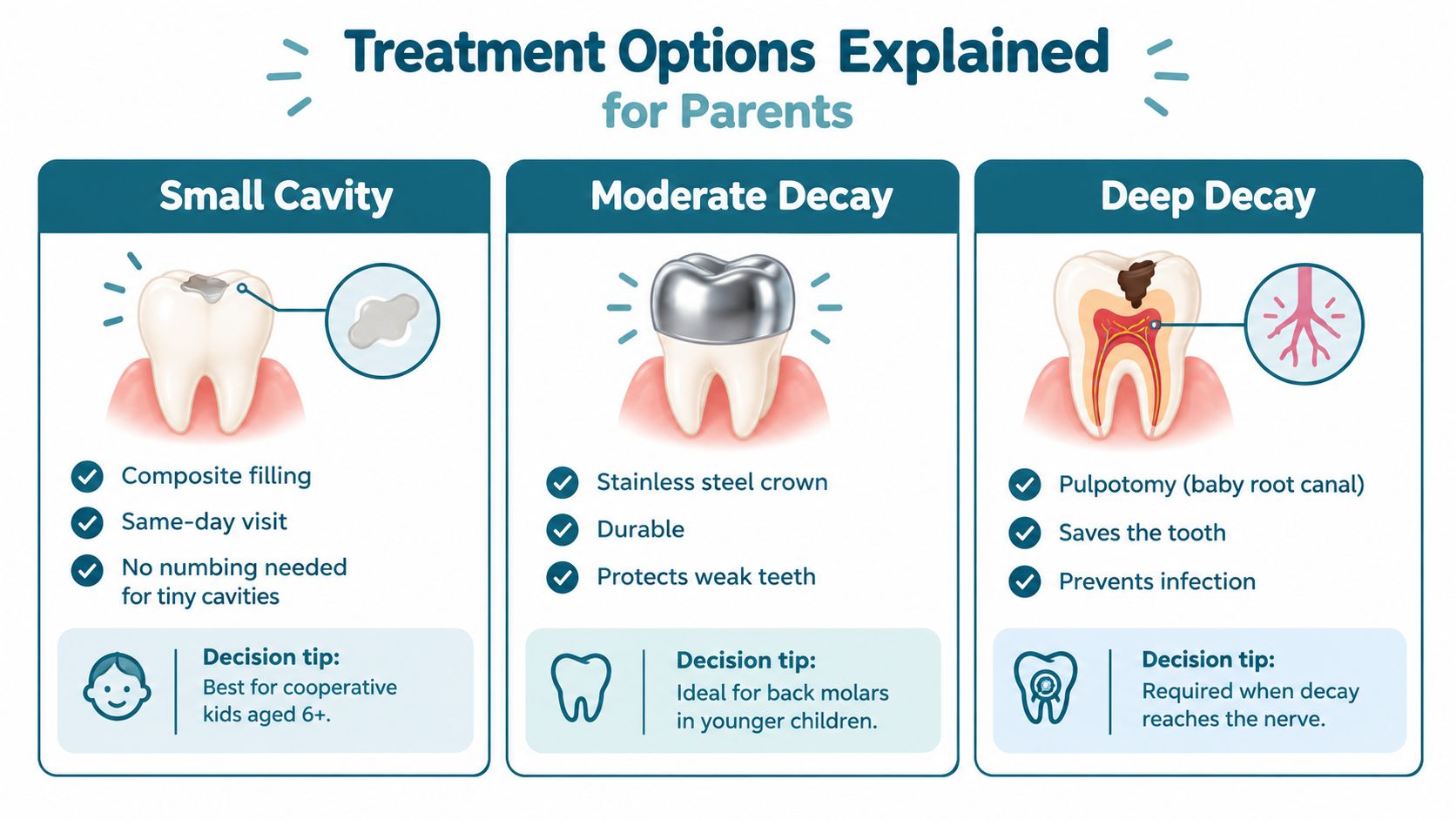
A composite filling removes diseased tooth structure and replaces it with tooth-colored material. It can suit a small or moderate cavity when the remaining tooth is strong enough to support a filling. The approach may work for a permanent tooth or a visible baby tooth, especially when appearance matters and the child can cooperate with the cleaning and bonding steps.
A filling usually preserves more natural tooth structure than a crown. It may require local anesthetic if the cavity is deep or sensitive, while a very small early repair may need less preparation. The limitation is structural. A filling may not protect a badly weakened molar from breaking.
Moderate decay and crowns
A stainless steel crown covers a damaged baby molar and protects the remaining tooth from chewing forces. Dentists may recommend one when decay affects several surfaces, when a filling would leave too little strong enamel, or when the tooth needs dependable coverage until it naturally sheds. Stainless steel is durable but visibly metallic.
A zirconia crown offers a tooth-colored appearance and full coverage. It may require careful moisture control and more preparation than a simple filling. The choice between stainless steel and zirconia depends on the tooth, the child, the clinician's assessment, and the family's esthetic priorities.
Deep decay and pulp therapy
When decay reaches the pulp, the living tissue inside the tooth, a filling alone may not control the disease. A pulpotomy removes the affected portion of the pulp in a baby tooth while preserving the healthier tissue deeper in the tooth. A crown often follows because the remaining tooth needs protection.
A pulpectomy removes infected pulp tissue throughout the roots when infection has extended through the canals. The purpose is to control infection and retain a restorable baby tooth. Pain, swelling, changes visible on an X-ray, and the tooth's remaining structure all influence the recommendation.
Arresting decay without traditional drilling
Silver diamine fluoride, or SDF, can arrest some cavitated decay without drilling. It may be considered for a very young child, an anxious child, a child with special health-care needs, or a family facing a delay before conventional restoration. The Cochrane review of SDF in children found that SDF may arrest caries in primary teeth compared with no treatment or placebo, although the evidence certainty was low.
SDF's major trade-off is appearance. The arrested decayed area typically turns dark, and SDF doesn't rebuild missing tooth structure or restore chewing anatomy. Families can review the treatment details at the SDF treatment information page, then discuss whether arresting disease or restoring the tooth is more appropriate.
When extraction becomes necessary
An extraction is reserved for a tooth that can't be predictably restored, has extensive infection, or has insufficient structure remaining. Removing a baby tooth too early can affect spacing, so the dentist may discuss a space maintainer when the developing permanent tooth needs room to emerge.
| Treatment | Often considered when | Main advantage | Important trade-off |
|---|---|---|---|
| Composite filling | Small to moderate cavity | Preserves tooth structure and blends with the tooth | May not protect a severely weakened molar |
| Stainless steel crown | Extensive decay in a baby molar | Strong full-tooth coverage | Metallic appearance |
| Zirconia crown | Extensive decay where appearance is important | Tooth-colored full coverage | Requires careful planning and moisture control |
| Pulpotomy | Decay reaches part of the pulp | Can preserve a restorable baby tooth | Usually needs a protective crown |
| Pulpectomy | Infection extends through the root canals | May retain the tooth and control infection | More involved treatment |
| SDF | Drilling or cooperation is difficult | Can arrest some decay without conventional drilling | Treated decay commonly turns black |
| Extraction | Tooth can't be restored | Removes a source of disease | May require space management |
The comparison of minimally invasive pediatric cavity approaches emphasizes that SDF, the Hall technique, resin infiltration, atraumatic restorative treatment, fluoride varnish, and selective caries removal aren't interchangeable. Lesion stage, location, depth, symptoms, cleansability, and follow-up all matter.
What Happens During the Dental Visit
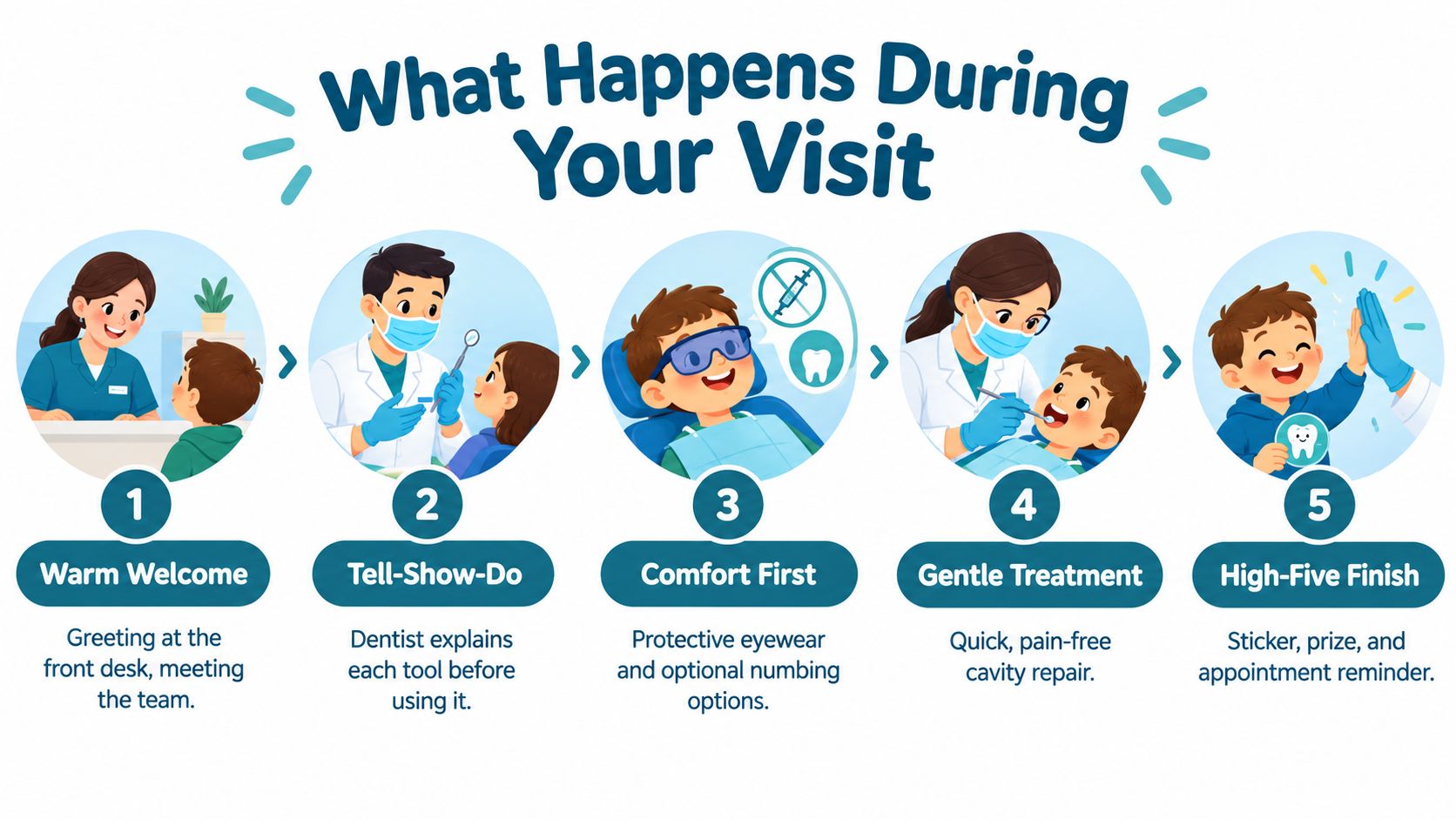
A child's appointment usually begins before treatment. The team greets the family, reviews health information, and explains what will happen in simple language. A dentist may use tell-show-do, first describing an instrument, then demonstrating it, and only afterward using it in the child's mouth.
Digital X-rays and intraoral images can help the clinician locate decay that isn't visible during a quick look. They also give parents a clearer view of why a filling, crown, pulp treatment, or observation plan may be appropriate. The child's age, temperament, treatment needs, and ability to keep the mouth open all influence the pace.
Comfort and behavior support
For a nervous child, the dental team may use calm voice guidance, distraction with a cartoon, protective eyewear, and frequent reassurance. Local anesthetic is sometimes described as “sleepy juice,” because it makes the tooth and nearby tissues numb during treatment. Nitrous oxide may help some anxious children relax, while oral conscious sedation or general anesthesia may be considered for more extensive treatment or when in-office care can't be completed safely.
Sedation decisions require a review of medical history, fasting instructions when applicable, medications, monitoring, and aftercare. The dentist explains the risks and benefits rather than treating sedation as a default.
Parents may be invited to remain chairside or choose the waiting area, depending on the child's needs and office protocols. A young child may need a shorter visit, while a crown or multiple restorations may require more time. The dentist checks the tooth before treatment, confirms the repair afterward, and gives the family specific instructions.
The composite filling procedure information can help a parent understand the general sequence of a tooth-colored restoration.
A short video can also help a child recognize familiar dental sounds and steps before arriving.
A calm first appointment can give a child a more predictable experience. The goal isn't to rush. It's to build enough trust for safe care now and easier visits later.
Aftercare and Recovery at Home
Most children return home the same day, but the first hours require supervision. Numbness from local anesthetic can make a child chew the cheek, lip, or tongue without realizing it. A parent can keep the child occupied with a cartoon, offer a smoothie once the dental team says eating is appropriate, and avoid hard or crunchy foods until normal sensation returns.
A simple home timeline
- Immediately after treatment: Follow the office's instructions about eating and drinking. Keep the child from biting numb tissues.
- After sensation returns: Offer soft, lukewarm foods. Sticky candy and foods that could pull at a new restoration are poor choices on the first day.
- That evening: Resume gentle brushing as directed. A crown or filling still needs regular cleaning around its edges.
- During follow-up: Keep cleaning, sealant, or reassessment appointments even if the child feels comfortable.
Mild soreness can occur after a filling or pulp treatment. A parent should use only a child-appropriate over-the-counter pain reliever and follow the product's weight-based directions or the dental office's instructions. Aspirin shouldn't be given to a child unless a qualified clinician specifically directs it.
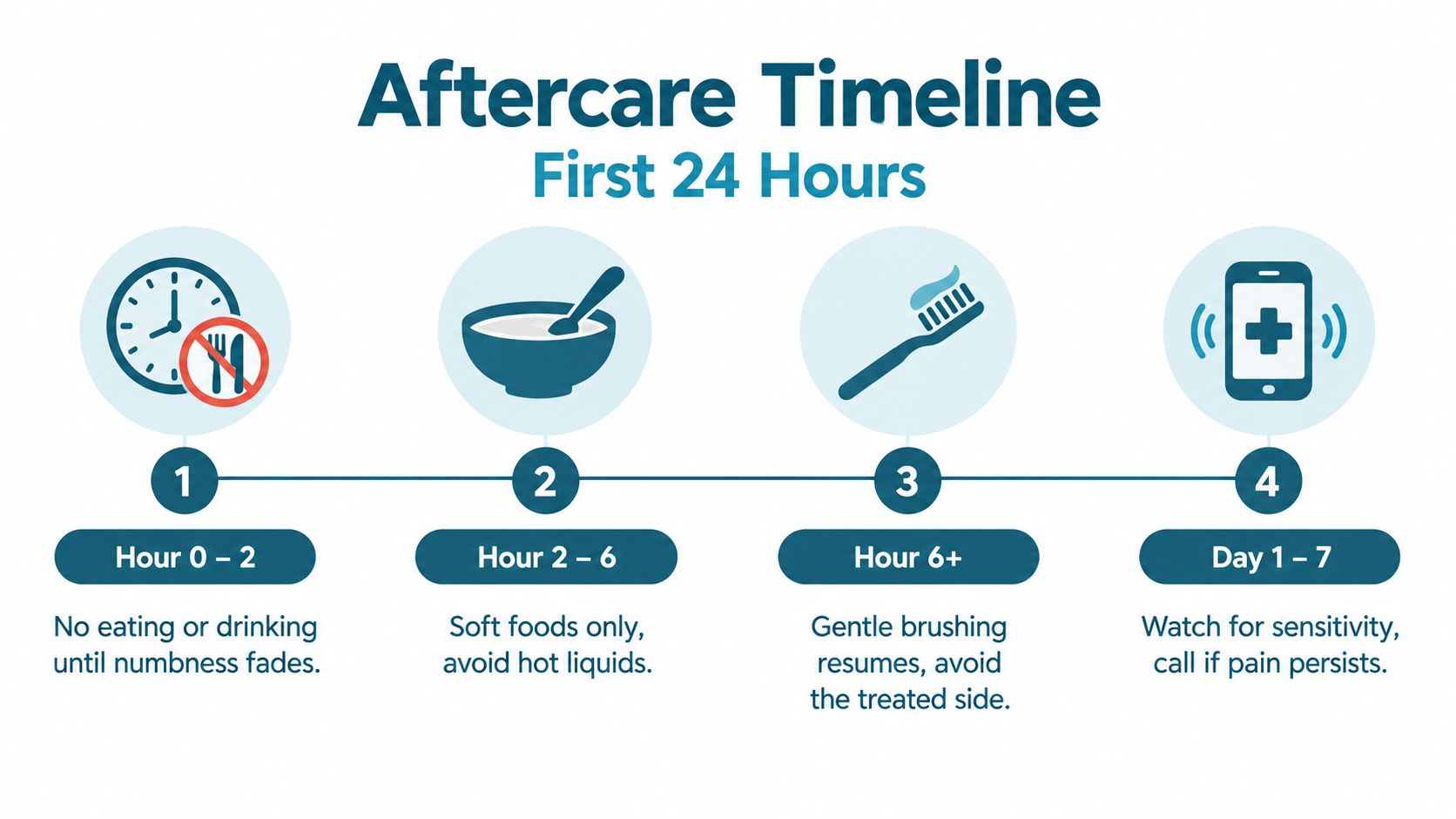
Persistent throbbing, increasing swelling, fever, worsening pain, or a crown that feels too high warrants a call to the dental office. If SDF was used, the family should expect the treated decayed area to darken and should watch the gum tissue for irritation according to the office's instructions.
A family in Amanda, Lancaster, Circleville, or Carroll should keep the office's daytime and after-hours contact information available. Severe swelling, trouble breathing, or difficulty swallowing requires urgent medical attention.
Prevention That Stops the Next Cavity
A prevention plan should match the reason the cavity developed. A child who sips sweet drinks throughout the day needs a different conversation from a child whose molars have deep grooves that a toothbrush can't clean well. The dental team can combine home care, fluoride exposure, diet changes, sealants, and follow-up based on the child's risk.
Daily habits that make a difference
Children need brushing with fluoridated toothpaste twice daily, with adults supervising the routine closely. AAPD guidance recommends no more than a pea-sized amount for children ages 3 to 6, supervised brushing twice daily, and minimizing or eliminating rinsing afterward so fluoride remains available on the teeth, as explained in the AAPD fluoride-therapy guidance.
Flossing becomes important as soon as neighboring teeth touch. Parents may need to do the flossing or finish the brushing because a child can hold a toothbrush without effectively cleaning every surface. Frequent sipping of juice boxes, sports drinks, and sweetened beverages can expose teeth repeatedly. Water between meals, cheese or nuts as snacks, and sweets served with a meal rather than grazed throughout the day are practical household changes.
Office prevention
Sealants protect the pits and grooves of permanent back teeth where brushing can be difficult. CDC information reports that approximately 9 in 10 cavities occur in permanent back teeth, and sealants reduce cavities in permanent molars by 80% during the first two years after placement while continuing to protect against 50% of cavities for up to four years, according to CDC information on dental sealants and oral disease. A dentist evaluates the tooth's anatomy and the child's caries risk before recommending them.
Fluoride varnish, professional cleaning, monitoring of early lesions, and SDF may also have a place in a personalized plan. SDF is an arresting treatment, not a substitute for cleaning, diet changes, examinations, or restoration when the tooth needs its structure rebuilt.
A fridge checklist can keep prevention manageable:
- Morning: Supervised fluoride-toothpaste brushing.
- Meals: Water between meals and fewer sweet drinks.
- Evening: Brushing and flossing where teeth touch.
- Weekly: Check for changes, sensitivity, or food trapping.
- Appointments: Keep examinations and preventive visits scheduled by the dental team.
Costs, Insurance, and Why Local Families Choose Amanda Family Dental
The cost of pediatric cavity treatment can't be responsibly quoted without an examination. A small filling, a full-coverage crown, pulp therapy, SDF, and extraction involve different materials, clinical time, imaging, and follow-up. Insurance benefits also vary by plan, employer, eligibility, and the child's coverage.
| Treatment | Typical Fee Range | Common Insurance Category | Avg. Patient Cost After Benefits |
|---|---|---|---|
| Composite filling | Varies by tooth and surfaces treated | Basic restorative | Depends on plan benefits and deductible |
| Pediatric crown | Varies by crown material and tooth condition | Basic or major restorative | Depends on plan benefits and deductible |
| Pulpotomy or pulpectomy | Varies by procedure and follow-up restoration | Often restorative | Depends on plan benefits and deductible |
| SDF application | Varies by office policy and treatment plan | Plan-specific preventive or restorative coverage | Depends on plan benefits and deductible |
| Extraction | Varies by tooth and complexity | Basic oral surgery or restorative coverage | Depends on plan benefits and deductible |
A pre-treatment estimate can clarify the expected insurance contribution before care begins, but it isn't a guarantee of payment. Families should ask whether the plan has waiting periods, annual maximums, frequency limits for sealants, or material downgrades that affect tooth-colored crowns. Medicaid and CHIP eligibility and covered services should be confirmed directly with the plan and the dental office.
Questions that help families plan
A parent can ask for:
- A written treatment plan: The document should identify the tooth, proposed procedure, alternatives, and follow-up.
- A benefits estimate: The office can submit information to the insurer, while the family confirms plan-specific details.
- Payment options: Families can ask whether a membership plan, financing arrangement, or staged treatment is available.
- Urgent-care guidance: A painful or swollen tooth may need faster evaluation than a routine cavity.
Families in Amanda, Lancaster, Circleville, and Carroll often value a nearby office that can coordinate children's cleaning and exams, dental X-rays, fillings, crowns, restorative care, and emergency dental services in one setting. For some households, continuity matters as much as convenience. A child can become familiar with the same team from an early examination through later preventive and restorative visits.
FAQs and Scheduling Your Child's Visit
How soon should a cavity be treated?
A parent should schedule an evaluation soon after a cavity is suspected. Pain, facial swelling, fever, a broken tooth, or trouble eating calls for prompt contact with a dental office. Early lesions may be monitored, but a cavitated or progressing lesion may need restoration.
Can a toddler receive treatment in a general dental office?
Many young children can receive an examination and some treatment in a family dental setting. The dentist considers age, communication, medical history, cooperation, lesion severity, and whether a referral or additional comfort support is safer.
What anesthesia may be used?
Some repairs use local anesthetic. Nitrous oxide may help a child relax, while oral sedation or general anesthesia may be considered for selected cases. The dental team reviews the child's health history and explains monitoring, preparation, risks, and recovery before recommending any sedation.
Why does SDF turn a tooth black?
SDF commonly darkens the decayed portion after arresting the disease. It may be useful when drilling is difficult or treatment needs to be delayed, but it doesn't restore lost anatomy and may not suit a family that prioritizes an unchanged tooth color. The AAPD guidance on silver diamine fluoride describes it as a minimally invasive option within caries management.
What if a child is terrified?
A parent can tell the office about previous difficult experiences before the appointment. Tell-show-do, distraction, gradual introductions, a familiar comfort item, and an agreed signal for a break may help. A dentist can also discuss nitrous oxide or other options when routine behavior guidance isn't enough.
Does a baby tooth really need treatment?
A baby tooth may still need care if decay causes pain, infection, difficulty eating, or risk to surrounding tissues. Its expected time until shedding, remaining structure, and the developing permanent tooth all influence the decision.
Parents who want to make dental questions easier to organize can review this practical resource on how to write FAQs for Google and, which also illustrates how clear questions and direct answers help families find useful information online.
For a new-patient visit, a family can bring insurance or Medicaid details, medical and medication information, prior dental records when available, and the child's questions. The appointment may include a welcome, examination, digital X-rays when appropriate, a discussion of findings, and a personalized plan. Online booking or a direct call can help a family request care for a suspected cavity, tooth pain, or an emergency dental concern.
Amanda Family Dental provides children's examinations, digital X-rays, tooth-colored fillings, crowns, preventive care, and personalized pediatric cavity treatment for families in Amanda, Lancaster, Circleville, and Carroll. Families can visit Amanda Family Dental to request an appointment, ask about a child's treatment options, or arrange a consultation for pain, decay, or anxiety.