

A parent in Amanda, Lancaster, Circleville, or Carroll might be reading this with a knot in the stomach. A child needs dental treatment, but the bigger challenge isn't always the tooth. It's the fear, the tears, the refusal to sit still, or the worry that one bad visit could shape how that child feels about dentistry for years.
That concern is valid. For some children, a routine cleaning and exam goes smoothly. For others, even opening wide feels overwhelming. In those moments, sedation dentistry for children can become a gentle way to protect both oral health and emotional well-being. The goal isn't to force treatment. The goal is to help a child receive needed care with comfort, dignity, and as little stress as possible.
Families searching for a dentist near me, a dentist in Amanda, OH, or a dentist in Lancaster, OH often want more than technical skill. They want calm answers, clear safety steps, and a plan that gives them control. That's especially true when treatment may involve tooth pain, a tooth extraction, urgent care from an emergency dentist, or a longer visit that a nervous child may struggle to manage.
Table of Contents
- A Gentle Solution for Your Child's Dental Fears
- What Is Pediatric Sedation Dentistry
- Comparing Sedation Options for Children
- Is Your Child a Good Candidate for Sedation
- Our Unwavering Commitment to Your Child's Safety
- The Sedation Process at Amanda Family Dental
- Frequently Asked Questions About Children's Sedation
A Gentle Solution for Your Child's Dental Fears
A child with a cavity doesn't always act like a child with a cavity. Sometimes that child hides behind a parent's leg, cries in the parking lot, or says the tooth doesn't hurt anymore just to avoid the chair. Parents often carry their own stress into the visit, especially if they've been searching for a dentist in Circleville, OH or dentist in Carroll, OH after a difficult dental experience somewhere else.
Sedation can help break that cycle. Used thoughtfully, it gives a fearful child a better chance to stay calm and get through treatment without feeling overwhelmed. That can matter during restorative dentistry, a difficult cleaning, or an urgent visit for swelling or pain that can't wait.
Practical rule: The best pediatric sedation plan should protect two things at the same time, the child's safety and the child's sense of trust.
Parents often assume sedation means a child is completely asleep. That isn't always the case. In many situations, the gentlest option is enough to take the edge off fear while still allowing the child to respond and recover smoothly. For some children, comfort measures and a slower pace are all that's needed. For others, sedation becomes the bridge that makes necessary dental care possible.
Children who already struggle with dental fear may benefit from support before the appointment even begins. Helpful preparation often includes honest, simple language, avoiding scary surprises, and using familiar routines at home. Families looking for more ideas can review ways to overcome fear of the dentist before a child's visit.
The bigger goal is a positive memory. Whether a family is coming in for pediatric dental care, cleaning and exams, new patient exams, dental x-rays, or same-day help from an emergency dentist, a child's first impression matters. Sedation isn't about convenience alone. It's about making treatment feel manageable when fear would otherwise get in the way.
What Is Pediatric Sedation Dentistry
A lot of parents hear the word "sedation" and picture a child being fully asleep. In pediatric dentistry, that is only one possible level of support. More often, sedation means using medication in a careful, measured way, along with close monitoring and child-friendly guidance, so a child can stay calm enough to receive needed care safely.
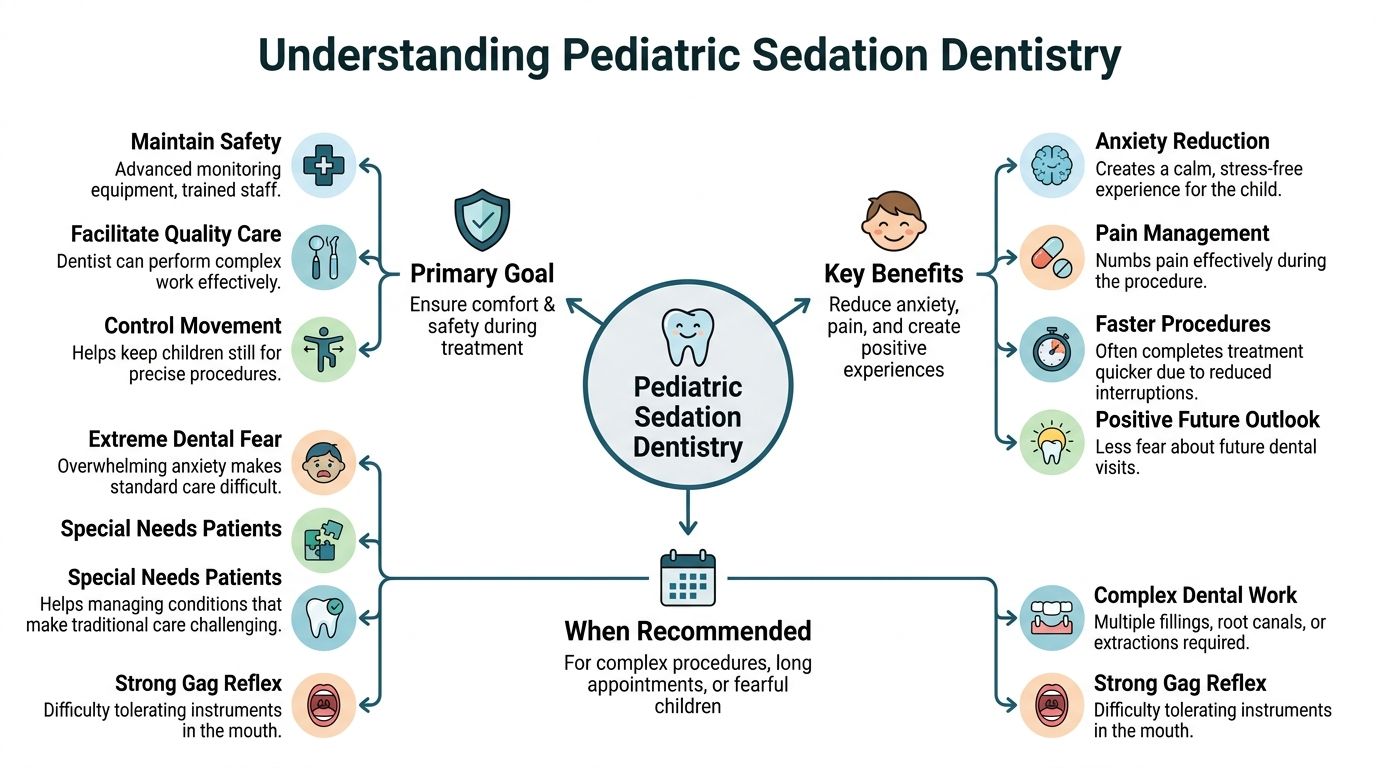
For families in Amanda, OH and nearby communities, that distinction matters. Parents are not looking for a child to be "knocked out." They want to know what their child will feel, how the team stays in control, and what steps make the visit safer from start to finish. Those are the right questions to ask.
Why sedation is used
Sedation can help for many different reasons. Some children have strong dental anxiety. Some are very young and cannot sit still long enough to complete treatment safely. Others have a sensitive gag reflex, special health care needs, or an urgent dental problem that should be treated before pain or infection gets worse.
The goal is not only to make the appointment easier for the dental team. The goal is to lower distress, limit sudden movement, and create conditions where treatment can be done carefully instead of under pressure.
That can help protect a child's trust.
Here is what parents are usually hoping sedation will do:
- Reduce fear: A calmer child is less likely to connect dentistry with panic.
- Improve cooperation: Relaxation can help a child follow simple directions more comfortably.
- Support safer treatment: Less movement allows the dentist to work with more precision.
- Protect future dental habits: A better experience now can make the next visit feel less threatening.
Sedation also works best as one part of a larger comfort plan. Clear explanations, breaks, distraction, and a gentle pace still matter. Families who want a broader overview can read more about what sleep dentistry means for different kinds of patients.
The sedation continuum in plain language
Sedation works more like a dimmer switch than a simple on and off button. Some children need only a small amount of help to relax. Others need a deeper level of support so treatment can happen without fear, struggling, or unsafe movement.
Dentists often describe this as a continuum. On the lighter end, a child may feel relaxed but stay awake and responsive. In the middle, a child may become sleepy and less aware of the appointment. On the deeper end, a child may be nearly or fully asleep and require a more advanced level of medical monitoring.
A simple comparison helps:
| Sedation level | What a child may seem like | Recovery |
|---|---|---|
| Minimal sedation | Relaxed, awake, responsive | Often shorter |
| Oral conscious sedation | Sleepy, less aware, still monitored closely | Often longer |
| Deep sedation or general anesthesia | Fully asleep or nearly so, with more intensive monitoring | Depends on the setting and medications |
Parents in Amanda and surrounding areas often tell us the same thing. They feel better once they understand that sedation is not one fixed experience. It is a carefully chosen level of support based on the child's health history, age, anxiety, and the type of dental work being done.
That is why the best question is not "Does my child need sedation or not?" A better question is "What level of support gives my child the safest, calmest experience for this specific visit?"
Comparing Sedation Options for Children
A parent from Amanda once asked a question we hear often: “If my child needs help relaxing, how do I know what is enough, and what is too much?” That is the right question.
Sedation choices are not about picking the strongest option. They are about matching the level of support to the child, the procedure, and the safety plan around it. For families in Amanda, OH and nearby communities, that usually brings the biggest sense of relief. There is a thoughtful process behind the recommendation.
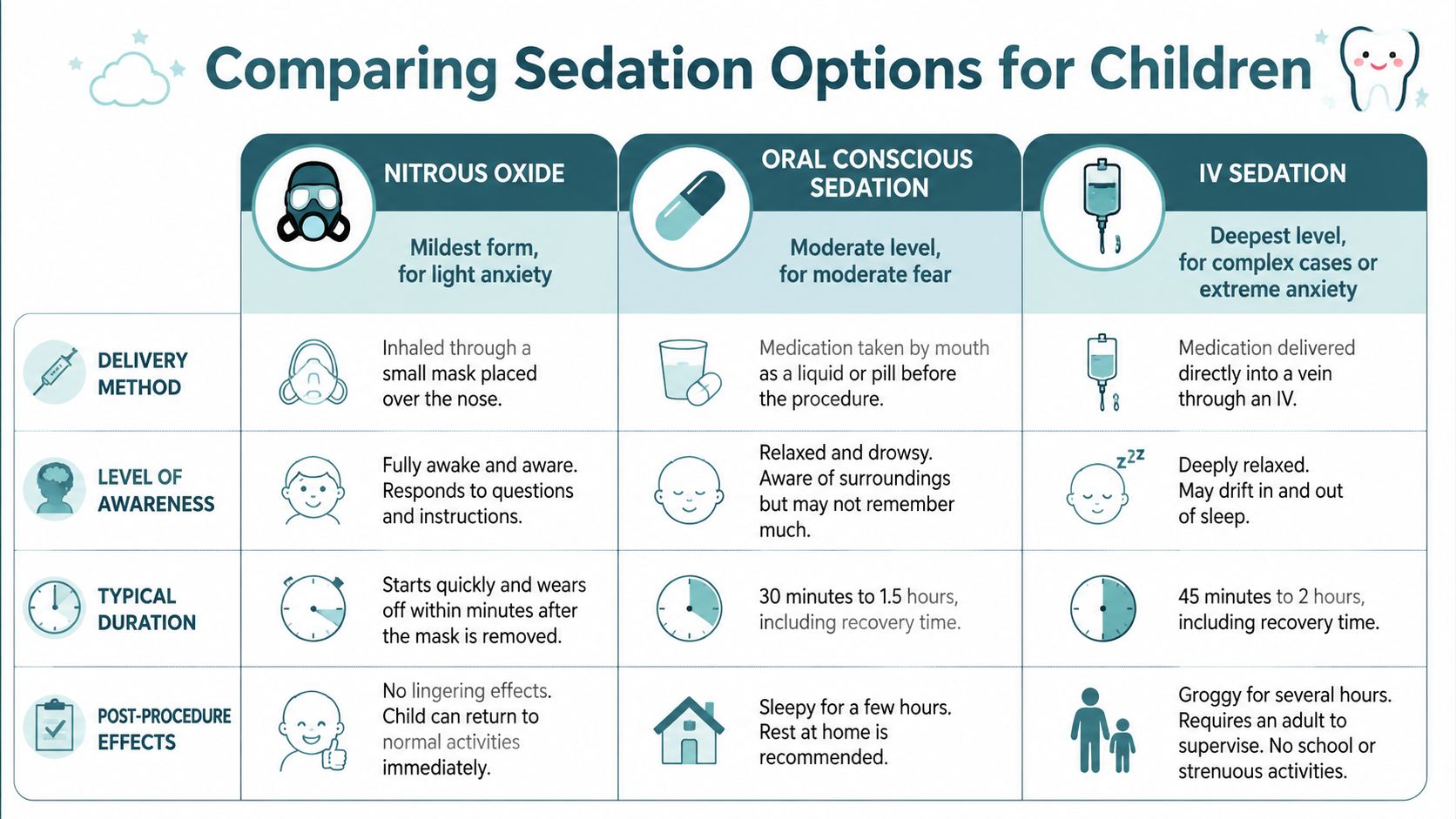
The simplest way to compare options is to focus on four questions parents care about most. How is it given? Will my child be awake? How quickly does it wear off? What type of visit is it usually used for?
Nitrous oxide
Nitrous oxide is the lightest sedation option many parents hear about first. It is breathed in through a small nose mask, and the child stays awake, can respond to the dental team, and usually feels calmer within a few minutes. A good comparison is training wheels on a bike. It adds support, but your child is still actively participating.
This option often works well for mild anxiety, short appointments, and children who can follow simple directions once they feel settled. It also wears off quickly, which is one reason many families ask about it first. If you want a closer look at how this option works, Amanda Family Dental explains nitrous oxide dentistry in more detail.
Oral conscious sedation
Oral conscious sedation uses medicine taken by mouth before treatment. Children often become sleepy, less focused on the procedure, and more relaxed, but they are not meant to be fully unconscious. Parents sometimes find this part confusing because a child may look very asleep. That appearance can be misleading. Careful monitoring still matters the entire time.
Oral sedation may be a reasonable choice for a child with moderate anxiety, a strong gag reflex, sensory sensitivity, or treatment that is hard to complete with nitrous oxide alone. For some children, planning starts even earlier by identifying sounds, textures, or transitions that trigger distress. This resource on sensory trigger identification for autism can help families notice patterns that make a dental visit harder before deciding what level of support may help.
Recovery is usually slower than with nitrous oxide. Some children bounce back quickly. Others stay sleepy, clingy, or groggy for several hours, which is normal and part of the reason we review aftercare carefully with parents.
A side by side comparison helps:
| Option | How it's given | Awareness level | Best suited for |
|---|---|---|---|
| Nitrous oxide | Inhaled through a nose mask | Awake and responsive | Mild anxiety, shorter visits |
| Oral conscious sedation | Liquid or pill by mouth | Drowsy, less aware | Moderate anxiety, longer care |
| IV sedation or general anesthesia | Administered by trained anesthesia professionals | Very deep sedation or fully asleep | Complex care, extreme anxiety, selected cases |
To see how these options are often explained visually, this short video gives a useful overview for parents:
IV sedation and general anesthesia
IV sedation and general anesthesia are used for a narrower group of situations. These include extensive treatment, severe anxiety, special healthcare needs, or cases where a child cannot receive care safely while awake or lightly sedated.
Parents should slow down and ask more detailed questions. The medicine matters, but the surrounding safety system matters just as much. Who is providing the anesthesia? What monitoring equipment is used? How is breathing tracked? What training does the team complete for emergencies? Those questions are not overcautious. They are part of choosing care wisely.
At a community practice serving Amanda and surrounding areas, trust is built through clarity. Parents deserve plain answers about benefits, limits, and risks. The goal is never to scare families away from treatment a child needs. The goal is to help parents choose a setting where comfort, close monitoring, and preparation are treated with the seriousness they deserve.
Is Your Child a Good Candidate for Sedation
Not every nervous child needs medication. Some need more time, more trust-building, and simpler language. Others need a stronger support plan because anxiety, age, or sensory challenges make routine care too difficult.
When sedation may help
A child may be a reasonable candidate for sedation when one or more of these factors are present:
- Severe dental fear: The child can't settle enough for treatment, even with reassurance.
- Very young age: The child is too little to understand and cooperate for the full visit.
- Special healthcare needs: Medical, developmental, or communication differences may make treatment more complex.
- Strong gag reflex: Even simple care becomes hard to complete comfortably.
- Extensive treatment needs: Combining care into fewer visits may be kinder and more realistic.
Children with sensory processing differences deserve especially individualized planning. For families of autistic children, identifying sounds, textures, smells, or transitions that cause overload can make a major difference before any sedation decision is made. This guide to sensory trigger identification for autism can help parents organize those observations before a dental consultation.
Why behavior guidance comes first
Responsible pediatric care doesn't jump straight to sedation. Behavior management techniques often come first, especially when anxiety is mild or moderate. That may include tell-show-do, distraction, modeling, short visits, praise, and offering the child predictable steps.
The reason is simple. These methods can work, and they can reduce how much medication is needed if medication is still helpful. Peer-reviewed studies show combining behavior management techniques with minimal pharmacologic intervention can reduce medication dosage, sedation depth, and adverse event frequency by up to 28% compared to sedation alone. That supports a careful, conservative approach that explores gentler options first.
The best sedation conversation often begins with a different question. What helps this child feel safe enough that less medication may be needed, or none at all?
That approach also helps families feel more in control. A parent looking for a dentist near me or a dentist in Amanda, OH for a child with anxiety doesn't just need treatment options. That parent needs to know the dental team sees the whole child, not only the procedure.
Our Unwavering Commitment to Your Child's Safety
Safety should be the center of every sedation discussion. Parents deserve honesty here. Sedation can be a very helpful tool, but it isn't casual care, and it should never be treated that way.
What the risk data tells parents
A widely discussed review found that sedation for pediatric dental procedures has been implicated in a disproportionate number of cases involving death or permanent neurologic damage, with the youngest children facing the greatest risk (patient safety review in pediatric dental sedation). Another historical analysis of 44 pediatric deaths linked to dental sedation in the United States identified especially concerning patterns. 21 of the 44 deaths (47.7%) occurred in children ages 2 to 5, 21 of 44 (47.7%) occurred in an office setting, and 25 of 44 (56.8%) involved general or pediatric dentists acting as the anesthesia provider. Within that group, 17 of the 25 deaths (68%) were linked to use of a sedation anesthetic (historical analysis of pediatric dental sedation deaths).
Those numbers are sobering, but they don't mean parents should avoid necessary treatment. They mean parents should choose carefully, ask direct questions, and understand that pediatric sedation is safest when the clinical setup is rigorous.
Good sedation care isn't built on reassurance alone. It's built on preparation, monitoring, training, and case selection.
What safe care requires
Strong safety standards focus on the basics that matter most before, during, and after treatment.
- Appropriate patient selection: The child's age, medical history, airway concerns, anxiety level, and treatment needs all matter.
- Behavior support before medication: Sedation should support care, not replace thoughtful pediatric guidance.
- Continuous monitoring: Modern practice includes close observation of breathing, oxygenation, and overall responsiveness. End-tidal carbon dioxide monitoring is described as a newer standard of care for early detection of hypoventilation.
- Qualified personnel in the room: Sedation is not a solo activity.
- Recovery oversight: A child must be watched until it's safe to go home.
Professional guidance also states that procedural sedation in pediatric dentistry should include at least two trained personnel in the room, with one acting as the operator and the other as an independent observer qualified to provide advanced life support if needed. That framework exists because a child's condition can change quickly, and immediate response matters.
Parents don't need to memorize every clinical term. They do need to remember this: when a practice is transparent about training, monitoring, staffing, and recovery protocols, that's a sign of respect for both the child and the parent.
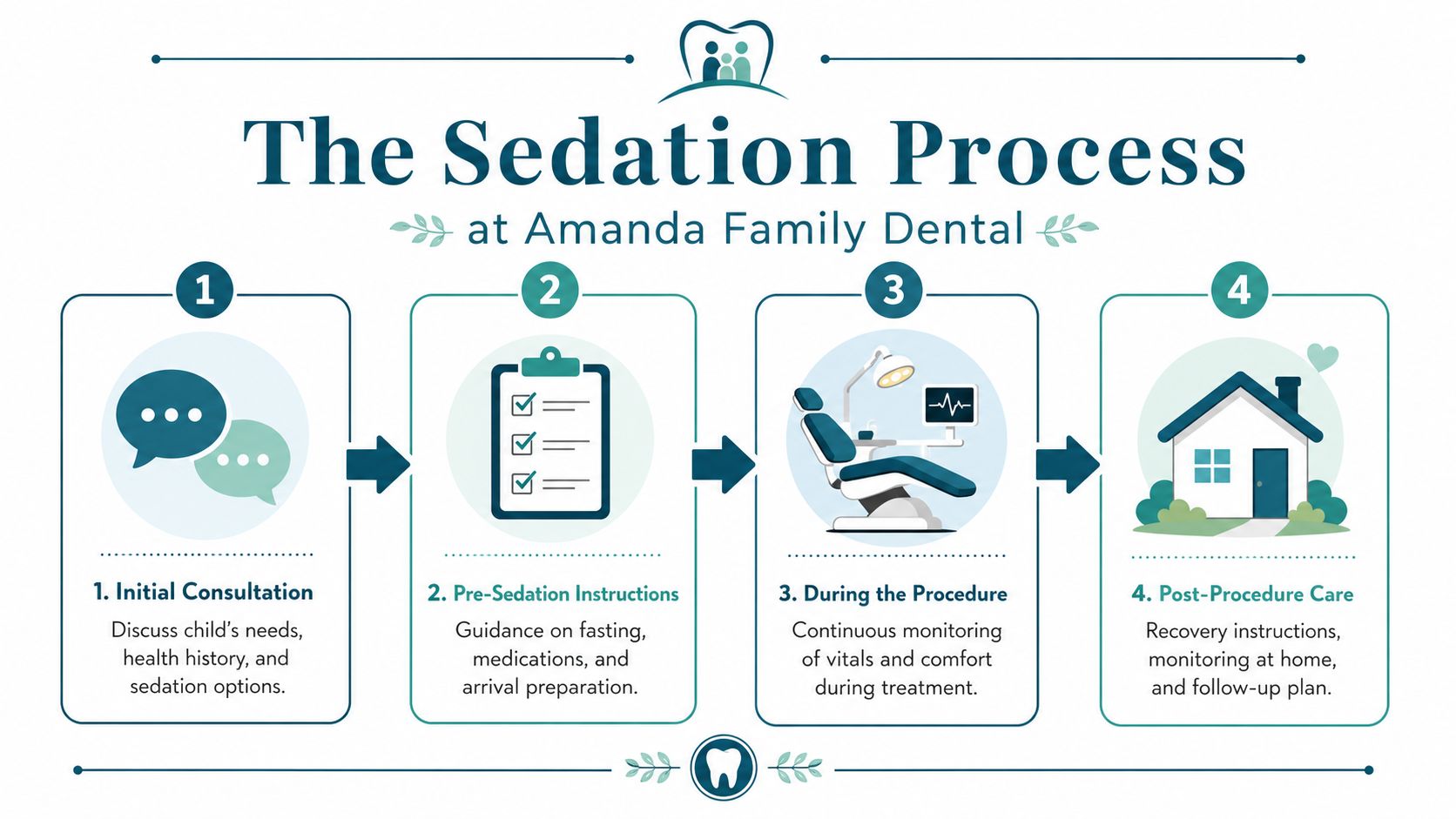
The Sedation Process at Amanda Family Dental
For parents, the unknown is often the hardest part. A clear process lowers stress because it replaces guesswork with steps.
Before the appointment
The process starts with a consultation, not with medication. The team reviews the child's dental needs, health history, medications, behavior patterns, and the parent's concerns. If the child needs treatment for decay, discomfort, a possible tooth extraction, or urgent care, the discussion centers on what level of support fits that situation safely.
Parents are also given preparation instructions. These may include fasting directions, what time to arrive, what to bring, and whether routine medications should be taken as usual. Clear preparation matters because sedation safety begins before the child ever sits in the chair.
New families often appreciate that this first step feels familiar. It includes the same thoughtful foundation expected from quality dental care, such as reviewing records, discussing digital x-rays, and building a personalized treatment plan rather than rushing toward a one-size-fits-all answer.
During treatment and recovery
On the day of care, the team keeps the environment calm and predictable. The child is welcomed, the parent reviews last-minute questions, and the planned sedation approach is confirmed. During treatment, current safety standards require at least two people in the room trained to provide advanced life support, including the dentist and an independent, qualified observer who monitors the child's vital signs until the child wakes (AAP parent guidance on dental anesthesia and sedation).
That kind of staffing isn't a luxury. It's a core safety expectation. One professional performs the dental procedure. Another focuses on the child's status.
A typical visit includes these stages:
- Check-in and review: The team confirms fasting, health updates, and the treatment plan.
- Sedation and monitoring: The planned method is given, and the child is observed continuously.
- Treatment completion: The dentist finishes the needed care as efficiently and gently as possible.
- Recovery and discharge: The child remains under observation until discharge criteria are met and home instructions are reviewed.
Parents should expect written and verbal recovery instructions, including what the child may eat, how sleepy the child may feel, and when to call with concerns.
For families in Amanda and nearby communities searching for a dentist in Amanda, OH, dentist in Lancaster, OH, or a local office that offers comfort-focused treatment, that step-by-step clarity can make a difficult day feel much more manageable.
Frequently Asked Questions About Children's Sedation
Even after a careful consultation, many parents still have a few practical questions. That is normal. Sedation can sound intimidating until it is broken into plain, concrete answers.
Will a child remember the procedure
It depends on the type of sedation and on how your child responds to it.
With lighter sedation, many children stay awake enough to hear voices, follow simple directions, and remember parts of the visit later. With oral sedation, memories may be less clear. Some children remember very little. Others remember more than parents expect.
The main goal is not to erase memory. The goal is to lower fear, help your child stay comfortable, and allow needed dental care to happen without a stressful struggle.
What side effects are common afterward
The most common effects are sleepiness, grogginess, mild irritability, and sometimes nausea. Some children are a little wobbly for a while, much like they might be after waking from a very deep nap.
Recovery time depends on the method used, your child's age, and how their body processes the medication. That is why parents need to plan for a quiet day at home, close supervision, and simple foods if the mouth is not too numb or sore.
Trust your instincts. If your child seems harder to wake than expected, has unusual breathing, vomits repeatedly, or just does not seem right, call the dental office right away.
Does dental insurance cover sedation
Dental insurance coverage for sedation varies by plan and by the reason sedation is recommended. Some plans help cover it for certain procedures or when it is considered medically necessary. Others cover only a small portion, or none at all.
A good office will help you review benefits before treatment so you understand the expected out-of-pocket cost ahead of time. Clear financial answers matter, especially for families balancing decisions about restorative dentistry, emergency dental services, or future care such as dental implants near me or cosmetic dentist near me.
Is sedation always the best answer for anxious children
No. Some children do well with a slower introduction, coaching, breaks during treatment, or shorter visits spread out over time. Sedation is one tool. It is not the only tool.
The right choice depends on the child in front of us. A very young child with extensive treatment needs is different from an older child who is nervous but able to cooperate with support. For families in Amanda, Lancaster, Circleville, and nearby communities, that kind of individualized decision-making often matters more than the sedation option itself.
These questions can help you choose wisely during a consultation:
- What other comfort strategies were considered first
- Why is this specific level of sedation recommended for my child
- How will my child be monitored during the visit
- What should I expect once we get home
- Which symptoms mean I should call the office
Those are strong parent questions. They help you choose a provider who explains the plan clearly, respects your concerns, and treats safety as a daily practice, not a sales point.
Families looking for compassionate pediatric dental care, comfort-focused treatment, and clear answers close to home can contact Amanda Family Dental to schedule an appointment or request a consultation. The office serves patients in Amanda, Lancaster, Circleville, and Carroll, Ohio with personalized care that supports healthy smiles, calmer visits, and confident next steps.