

A call from the dental office can make time feel strange. A few seconds after hearing the words “root canal,” many people stop thinking about the tooth itself and start thinking about the clock.
How long will this take? Will it eat up the whole day? Will the appointment feel longer because of nerves?
Those are sensible questions. A root canal often sounds bigger and more mysterious than it is. In most cases, the treatment is measured in minutes, not days, and the “felt time” matters just as much as the clinical time. Anxiety, numbing, breaks, and sedation can all shape the experience of the appointment, even when the actual treatment is straightforward.
Table of Contents
- Your First Question After Hearing 'Root Canal'
- The Quick Answer to How Long a Root Canal Takes
- Four Factors That Influence Your Appointment Time
- A Step-by-Step Look Inside Your Root Canal Appointment
- Your Comfort and Care at Amanda Family Dental
- After the Appointment What to Expect During Recovery
Your First Question After Hearing 'Root Canal'
A common scene plays out the same way. A patient hears that a sore tooth needs a root canal, nods politely, and then asks the two questions sitting at the top of the mind: “Will it hurt?” and “How long will it take?”
Modern root canal treatment is designed to be comfortable, but the time question can create stress. People often picture an endless afternoon in the chair, canceled plans, numb lips, and a long recovery.
That picture is usually worse than reality. For many patients, the primary challenge is not only the procedure length. It is the uncertainty around how long each part will feel.

Key takeaway: The most stressful part for many patients is not the treatment itself. It is not knowing what the appointment timeline will look like.
A clear timeline helps. Once the appointment is broken into simple stages, the process usually feels more manageable.
The Quick Answer to How Long a Root Canal Takes
If you are trying to plan your day, the useful short answer is simple. Many root canal appointments fit into about 30 to 90 minutes of treatment time. Some are shorter. Some take longer.
What patients often want to know, though, is something slightly different. “How long will I be in the office, and how long will it feel like I am there?” Those are not always the same thing.
A root canal has two clocks. One is the clinical clock, meaning the time spent numbing the tooth, cleaning the canals, and sealing them. The other is the patient clock, meaning check-in, getting comfortable, asking questions, waiting for the anesthetic to fully work, and taking a few minutes afterward before heading home. If you feel calm, the visit often seems to pass faster. If you feel tense, ten minutes can feel much longer.
Tooth location also changes the baseline. A front tooth often has a simpler path inside. A molar usually has more narrow spaces to clean and seal, so the appointment can take longer.
Here is a practical at-a-glance guide.
| Tooth Type | Number of Canals | Average Appointment Time |
|---|---|---|
| Front teeth | Single root canal | 45 to 60 minutes |
| Premolars | One or two canals | 60 to 90 minutes |
| Molars | More complex canal system | 90 to 120 minutes or more |
That table gives a helpful starting point, not a promise written in stone. Cleaning one straight canal works like clearing a short hallway. Treating a molar can be more like carefully cleaning several small hallways with turns, corners, and tight spaces.
Comfort choices can also shape the total visit. Local anesthetic is enough for many patients, but people with strong dental anxiety may need extra time to settle in, discuss sedation options, and recover before leaving. That added time can make the appointment feel more manageable because a calmer patient usually experiences the visit as shorter and easier.
If you are weighing treatment choices, it also helps to understand how saving a tooth compares with tooth extraction and replacement options. The timeline is only one part of the decision.
For day-of planning, reserve more time than the procedure itself. The work on the tooth may take one amount of time on paper, but the full appointment includes the human side of care too.
Four Factors That Influence Your Appointment Time
Some root canals move along quickly. Others need a slower, more careful pace. The clock usually changes for four reasons.

Tooth anatomy sets the baseline
The inside of the tooth is the first time driver. According to Teledentistry’s explanation of root canal timing and tooth anatomy, incisors often take 30 to 60 minutes, while molars often require 90 to 120 minutes or more because they commonly have 3 to 4 intricate, curved canals.
That matters because curved canals cannot be rushed. The dentist has to locate them, clean them, shape them, and seal them without missing any spaces.
A front tooth is often like a straight path. A molar is more like a small maze.
Infection changes the schedule
The second factor is the condition of the tissue around the tooth. A calmer case may be completed in one visit. A more active infection can force a staged approach.
When infection is more severe, the dentist may need extra time to disinfect the canals thoroughly and make sure the tooth is ready to be sealed safely. Some teeth need a pause between visits so the area can settle.
That slower schedule is not a setback. It is careful treatment.
Retreatment usually takes longer
A first-time root canal is one thing. A tooth that has already been treated can be another story.
Retreatment often means old filling material must be removed, the canals must be checked again, and the dentist may have to work through a more complicated internal layout than expected. Patients often find this confusing because the tooth may look unchanged from the outside.
From the chairside perspective, retreatment can feel like reopening a room that was already repaired and then finding hidden work behind the walls.
If the tooth cannot be predictably saved, patients may also want to understand replacement options such as tooth extraction and replacement.
Anxiety and sedation affect felt time
This is the timing issue many articles skip. The clock on the wall and the clock in a patient’s head are not always the same.
For adults with dental phobia, Pomerado Family Dental notes that 30 to 40% may struggle with this fear, and sedation can extend a visit by 20 to 50% because of preparation and onset time. Even when sedation adds time to the schedule, it can make the appointment feel shorter and easier to tolerate.
A patient who is tense may notice every minute. A patient who feels calm often experiences the visit in a completely different way.
Key takeaway: A longer but calmer visit is often better than a shorter appointment spent bracing in the chair.
A Step-by-Step Look Inside Your Root Canal Appointment
You settle into the chair, glance at the clock, and wonder whether the next hour will crawl. That feeling is common. A root canal usually feels easier once you know what happens in each stage, because the visit stops feeling like one long unknown.
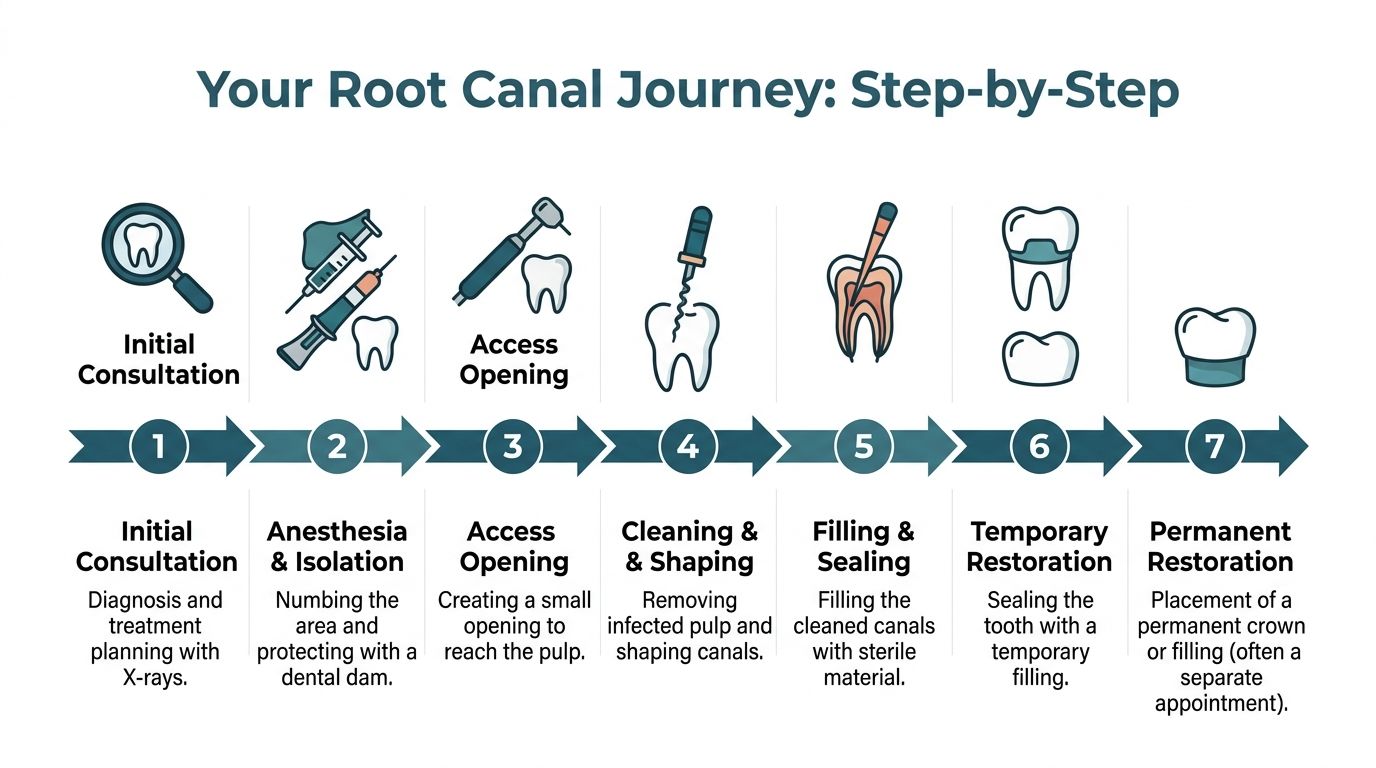
A typical appointment moves through a series of smaller, predictable steps. Some are clinical. Some are about comfort. Both affect how long the visit feels from the patient side.
What happens first
The first part is about getting oriented and making sure the team is working on the right tooth in the safest way. Your dentist reviews the area, checks the roots, and confirms the plan. Offices that use digital X-rays for a clearer, faster view of the tooth can make this step more efficient.
Then comes numbing.
This is often the moment patients build up in their heads, but once the tooth is fully numb, the rest of the visit is usually far more manageable than expected. If you are anxious, this opening stretch can feel longer than it really is because you are waiting, listening, and anticipating. That is one reason a calm explanation from the team matters so much.
The part patients often worry about
After the tooth is isolated and a small opening is made, the dentist removes the irritated or infected tissue from inside the tooth and begins cleaning the canals.
This is the most detailed part of the visit. The canals are narrow, curved spaces inside the roots, more like tiny hallways than one straight tunnel. Your dentist uses small instruments to clean and shape those spaces so they can be disinfected and sealed properly.
For many patients, this middle portion passes in one of two ways. If you are tense, you may notice every sound and pause. If you are comfortable and well numb, time often blurs together because the work is steady and uneventful.
A short video can make that sequence easier to understand.
How the visit ends
Once the canals are cleaned, the dentist fills them with a sealing material and closes the opening in the tooth. In some cases, a temporary restoration is placed first, with the final restoration completed later.
As noted earlier, many root canals are completed in one visit, while some teeth need more than one appointment. A tooth with active infection, difficult anatomy, or drainage may need medication inside the canal before it is sealed at a later visit. Patients sometimes hear that and assume something has gone wrong. Usually, it just means the tooth needs treatment in the right sequence, like cleaning a wound before closing it.
That step-by-step structure helps many anxious patients. You are not sitting through one mysterious event. You are moving through a set of planned stages, each with a clear purpose. And when comfort measures or sedation are part of the plan, the appointment may take longer on the schedule while feeling much shorter in your own memory.
Your Comfort and Care at Amanda Family Dental
Time in dentistry is not just about the procedure. It is also about how the patient moves through the appointment emotionally.
Why comfort changes the whole timeline
A nervous patient may arrive early, sit tensely through numbing, need pauses during treatment, and leave feeling drained. A calm patient often moves through the same visit with much less stress.
That difference is why comfort-focused care matters so much. Sedation may lengthen the appointment window, but it often improves the experience dramatically. As noted earlier, some patients need additional preparation time because anxiety itself changes how the appointment feels.
For patients who want that kind of support, Amanda Family Dental offers sleep dentistry options that can help make treatment more manageable.
What patients often need most
The most useful support is usually simple and practical:
- Clear time expectations: Knowing whether the visit is likely shorter or longer helps families plan work, school, and childcare.
- Same-day help when available: When a tooth hurts, reducing the wait often matters as much as reducing the treatment time.
- A calm environment: Patients who feel heard tend to need fewer breaks and less reassurance in the middle of treatment.
- Flexible planning: Some people want to move quickly. Others need a gentler pace.
A root canal appointment rarely feels shorter because someone says, “This will be quick.” It feels shorter when the team respects the patient’s fear, explains what is happening, and keeps the experience predictable.
Practical tip: The best scheduling question is not only “How long does a root canal take?” It is also “How long should be blocked for the whole visit, including comfort measures?”
After the Appointment What to Expect During Recovery
Once the procedure is done, most patients want to know whether the rest of the day is lost. Usually, recovery is simpler than feared.
The first day and the next few days
Mild tenderness or sensitivity can happen after the numbness wears off. The tooth and surrounding area may feel a little bruised from the treatment itself, especially if the tooth was already inflamed beforehand.
Soft foods, a lighter chewing load on that side, and following the dentist’s instructions usually make the first day easier. Many patients return to normal routines quickly, though comfort levels vary from person to person.
A practical recovery checklist helps:
- Eat carefully: Choose softer foods until the tooth feels less tender.
- Protect the tooth: Avoid chewing hard foods on a temporary restoration.
- Follow directions: Take any recommended medication exactly as instructed.
- Keep the follow-up visit: The final restoration is part of the success of treatment.
The long view matters
A root canal is not only a pain-relief procedure. It is also a tooth-saving procedure with strong long-term value.
According to the Regenstrief Institute report on tooth survival after root canal treatment, post-root canal tooth survival has a median of 11.1 years. Teeth restored with both a filling and a crown lasted 20 years, compared with 6.5 years when no restorative work is completed.
That is the part patients often miss when they focus only on the appointment length. The visit may take one morning, one afternoon, or sometimes more than one appointment. The benefit can last for many years.
The actual timeline is bigger than the chair time. A root canal can turn a painful, threatened tooth into one that keeps working for a long time.
Amanda Family Dental helps patients in Amanda and nearby communities get clear answers, gentle treatment, and practical options for saving natural teeth. For anyone wondering how long does a root canal take in a real-world setting, the team can walk through the expected timeline, comfort choices, and next steps before treatment begins. Learn more or request an appointment at Amanda Family Dental.