

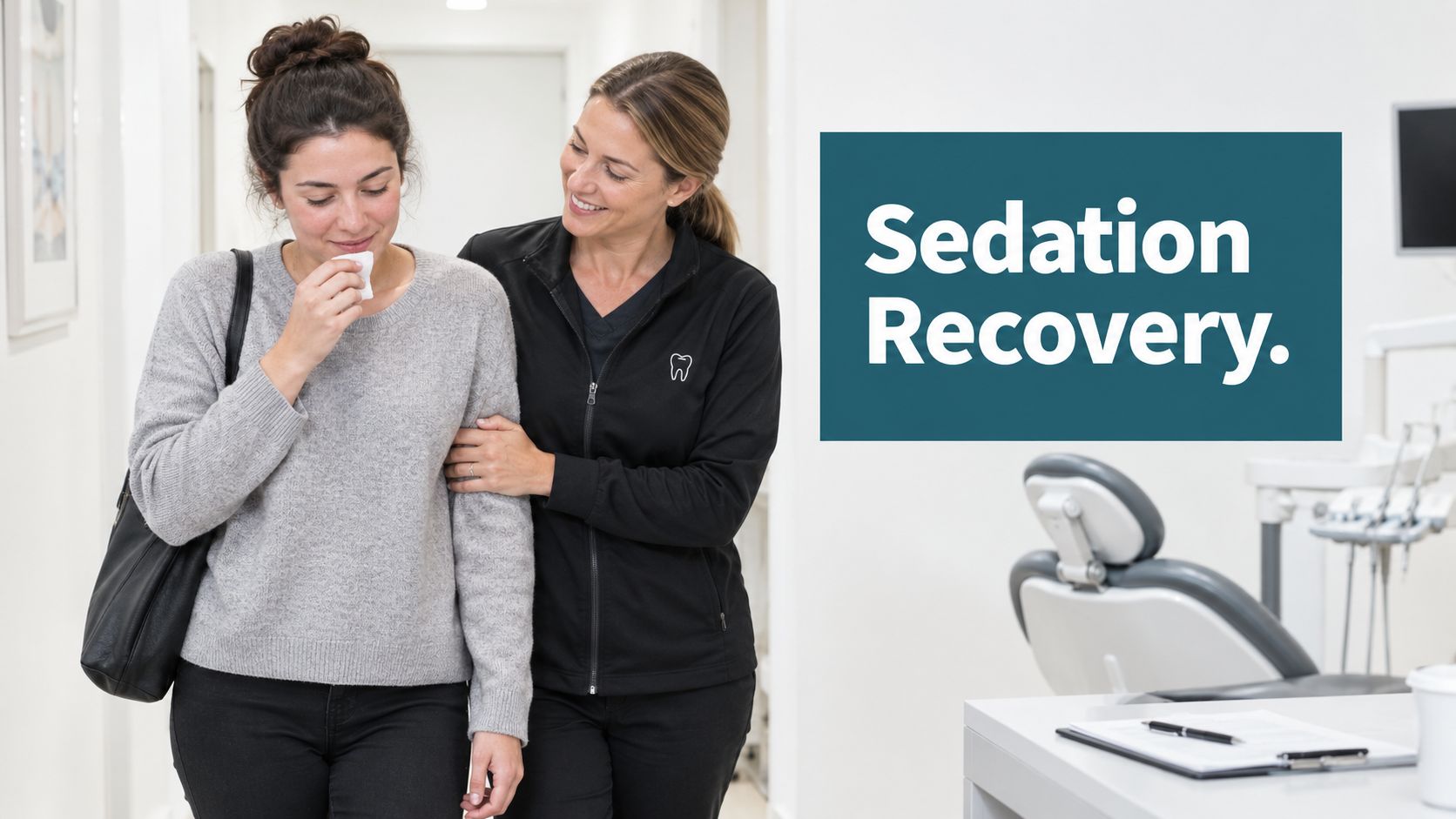
A patient may be searching “sedation recovery time” from the passenger seat on the way home, wondering whether the lingering fogginess is normal or whether tomorrow's workday needs to be canceled. That concern is common, especially after a tooth extraction, dental implant procedure, emergency dental care, or treatment planned for significant dental anxiety.
The most useful answer isn't one universal number. Recovery depends on whether the appointment used nitrous oxide, oral sedation, IV sedation, or general anesthesia, as well as the medication dose, the procedure, and the patient's health. A person can feel awake while reaction time, judgment, and memory are still affected. That difference matters for anyone comparing a dentist near me in Amanda, Lancaster, Circleville, or Carroll, Ohio, and planning safe transportation and aftercare.
Table of Contents
- What to Expect Right After Your Appointment
- Understanding Sedation Recovery Time as a Process
- Recovery Timelines for Each Type of Dental Sedation
- Factors That Can Change Your Recovery Timeline
- Safe Aftercare in the First 24 Hours
- Feeling Awake Versus Being Truly Safe
- Warning Signs That Need a Quick Call to the Office
- Common Patient Questions and Scheduling Care Nearby
What to Expect Right After Your Appointment
A nervous patient from Fairfield County may leave the operatory slowly, blinking as the bright parking lot comes into view while a friend steadies an elbow. There may be gauze between the teeth, a lingering taste from dental materials, and a numb lip or tongue that feels larger than usual. Those sensations can feel strange, but they usually become easier to manage as local anesthetic and sedation wear off.
Some patients feel light and clear after nitrous oxide. Others feel sleepy, wobbly, mildly nauseated, or unexpectedly tearful after deeper sedation. These reactions can be temporary, and they don't automatically indicate a problem. The dental team should treat the first minutes after treatment as a monitored transition, not a quick goodbye.
Before discharge, staff check vital signs, breathing, oxygen levels, and alertness. They also review written instructions, answer caregiver questions, and confirm that the required escort is present. A responsible adult should accompany a patient home after moderate sedation and remain available during early recovery because sleepiness or unsteadiness can continue after the procedure ends. (Dentsed explains escort and supervision needs after dental sedation)

The first signs of improvement
The patient may first notice easier conversation, steadier sitting, and better awareness of surroundings. Numbness from local anesthetic can still remain, so chewing, hot drinks, and accidental lip biting require care even when the mind feels clearer.
Practical rule: Leaving the office means discharge criteria have been met. It doesn't mean every effect has ended.
The exact duration varies by sedation type and office protocol. Some controlled dental outpatient patients reached recovery criteria quickly, while other sedatives produced substantially longer clinical recovery times. The care team's instructions remain more important than a general estimate found online.
Understanding Sedation Recovery Time as a Process
Sedation recovery time is a progression, not a single moment on a clock. A practical framework includes an immediate in-office phase, an intermediate period at home, and a later phase when normal judgment and coordination return.
Immediate recovery in the office
The immediate phase covers roughly the first 30 to 60 minutes for many outpatient experiences. Staff watch alertness, breathing, heart rate, oxygen levels, and the ability to respond appropriately. Dental recovery guidance describes immediate recovery as about 5 to 15 minutes, intermediate recovery as 15 to 45 minutes, and late recovery as extending from roughly 45 minutes to several hours. (Dentalpedia outlines monitored dental sedation recovery phases)
The patient doesn't need to calculate an Aldrete score independently. The clinical team uses discharge criteria, stable vital signs, adequate ventilation and circulation, and appropriate oxygen saturation before release. This is the period the office manages directly.
Intermediate recovery at home
The intermediate phase generally covers the first several hours at home. A patient may feel mostly normal but still have reduced coordination, slower responses, or incomplete memory. That's why a companion handles transportation, meals, medication reminders, and questions about the procedure.
Late recovery and functional readiness
The late phase can extend through 24 hours and beyond after stronger sedation. A Veterans Affairs discharge toolkit states that outpatient sedation and anesthesia regimens commonly target recovery within 1 to 4 hours, but some people may return to baseline cognition in about 1 hour while others can take as long as 24 hours. (The VA discharge toolkit describes broader post-sedation recovery expectations)
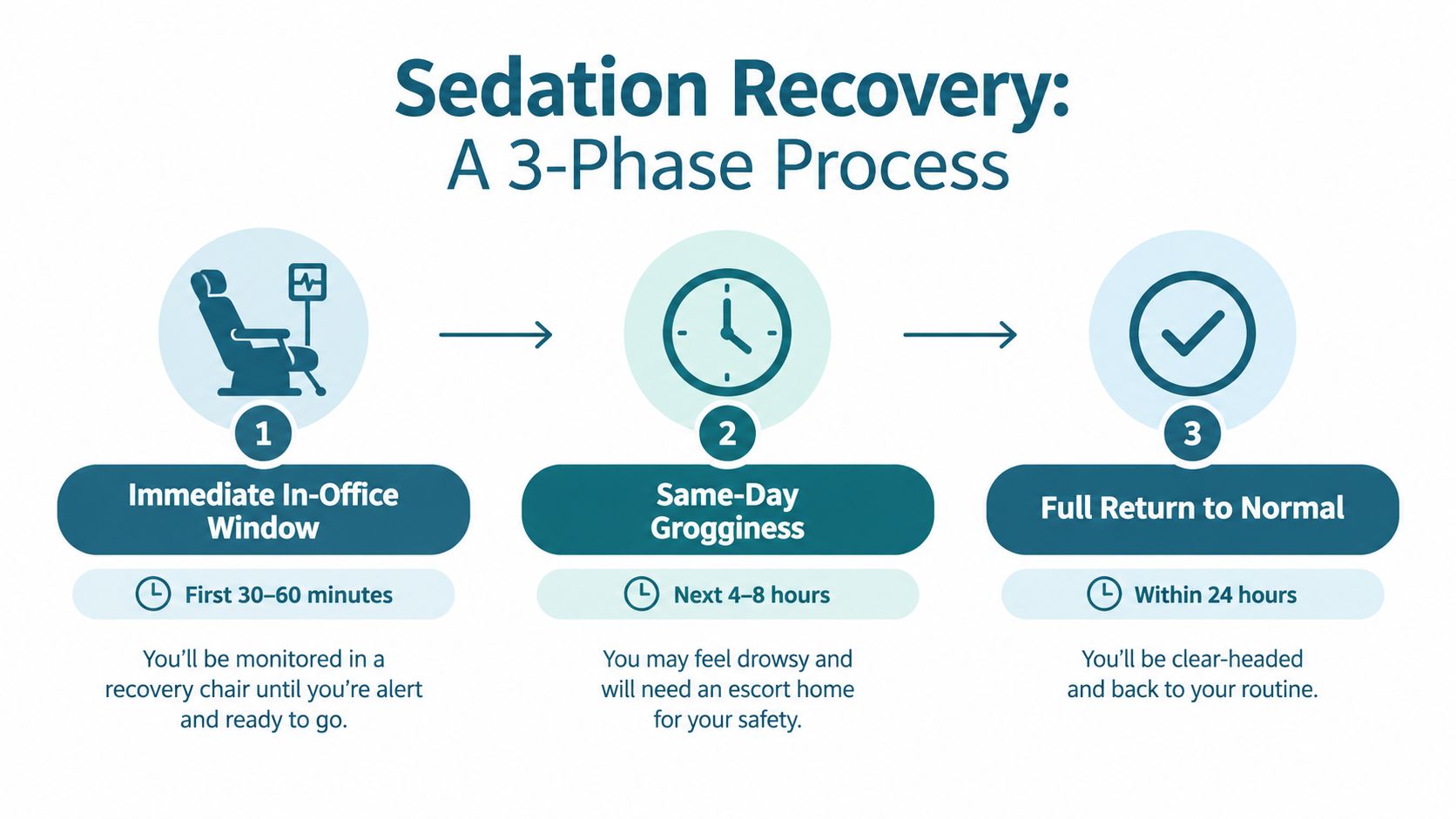
The three-phase model prevents a common mistake. Feeling awake belongs to the first part of recovery. Being safe to drive, work, make decisions, and operate equipment may require waiting through the later part.
Recovery Timelines for Each Type of Dental Sedation
Different sedatives create different recovery experiences. The following comparison uses the practical timelines commonly discussed with dental patients, but the treating team's instructions always control.
Nitrous oxide
Nitrous oxide, often called laughing gas, is inhaled through a mask. After the gas is stopped, the patient breathes oxygen and usually becomes clear quickly. Cleveland Clinic describes typical nitrous oxide recovery as 15 to 30 minutes, and patients can often drive home the same day once released. (Cleveland Clinic explains sedation dentistry recovery and driving precautions)
The experience may feel calm, light, or mildly floaty rather than sleepy. More information about this option is available through nitrous oxide dentistry.
Oral sedation
Oral sedation usually involves medication taken before the visit. It can create drowsiness, slowed responses, and limited memory of parts of the appointment. Patients need an escort and shouldn't drive, work in a safety-sensitive setting, or make important decisions until the next day unless the dental team gives different written guidance.
IV sedation
IV sedation allows the clinical team to adjust medication during treatment and can produce deep relaxation with partial or limited memory. Some patients feel alert within a couple of hours, but reduced coordination and slower reaction time can persist through the day. A quiet recovery period and a driver are essential.
Patients considering oral surgery may also benefit from the external resource safe sedation for dental surgery, which provides additional context about anesthesia planning and recovery.
General anesthesia
General anesthesia is reserved for selected complex or oral surgery situations. It creates a deeper unconscious state and can leave fatigue or mental fogginess after the procedure. Patients should plan for an adult caregiver, transportation, rest, and strict adherence to the anesthesia team's instructions.
| Sedation Type | Time to Feel Alert | Safe to Drive | Back to Normal Activities | Common Sensations |
|---|---|---|---|---|
| Nitrous oxide | Often within a short period after oxygen breathing | Often same day after release, if cleared | Often same day | Calm, light, relaxed |
| Oral sedation | Several hours may be needed | Usually the next day | Gradual return after rest | Sleepiness, grogginess, memory gaps |
| IV sedation | Alertness may return before full coordination | Not until the next day unless specifically cleared | Quiet rest for the remainder of the day | Deep relaxation, slowed responses |
| General anesthesia | Recovery is more extended | Not during the restricted recovery window | Often requires additional rest | Fatigue, fogginess, nausea |
Drug choice can materially change clinical recovery. In adult moderate-sedation studies, propofol produced an average recovery time 8.88 minutes shorter than midazolam, while another standardized IV sedation cohort reported an average recovery time of 19 minutes. (The adult moderate-sedation review compares propofol and midazolam recovery) These findings show why a dentist in Amanda, OH, won't promise the same timeline for every patient.
Factors That Can Change Your Recovery Timeline
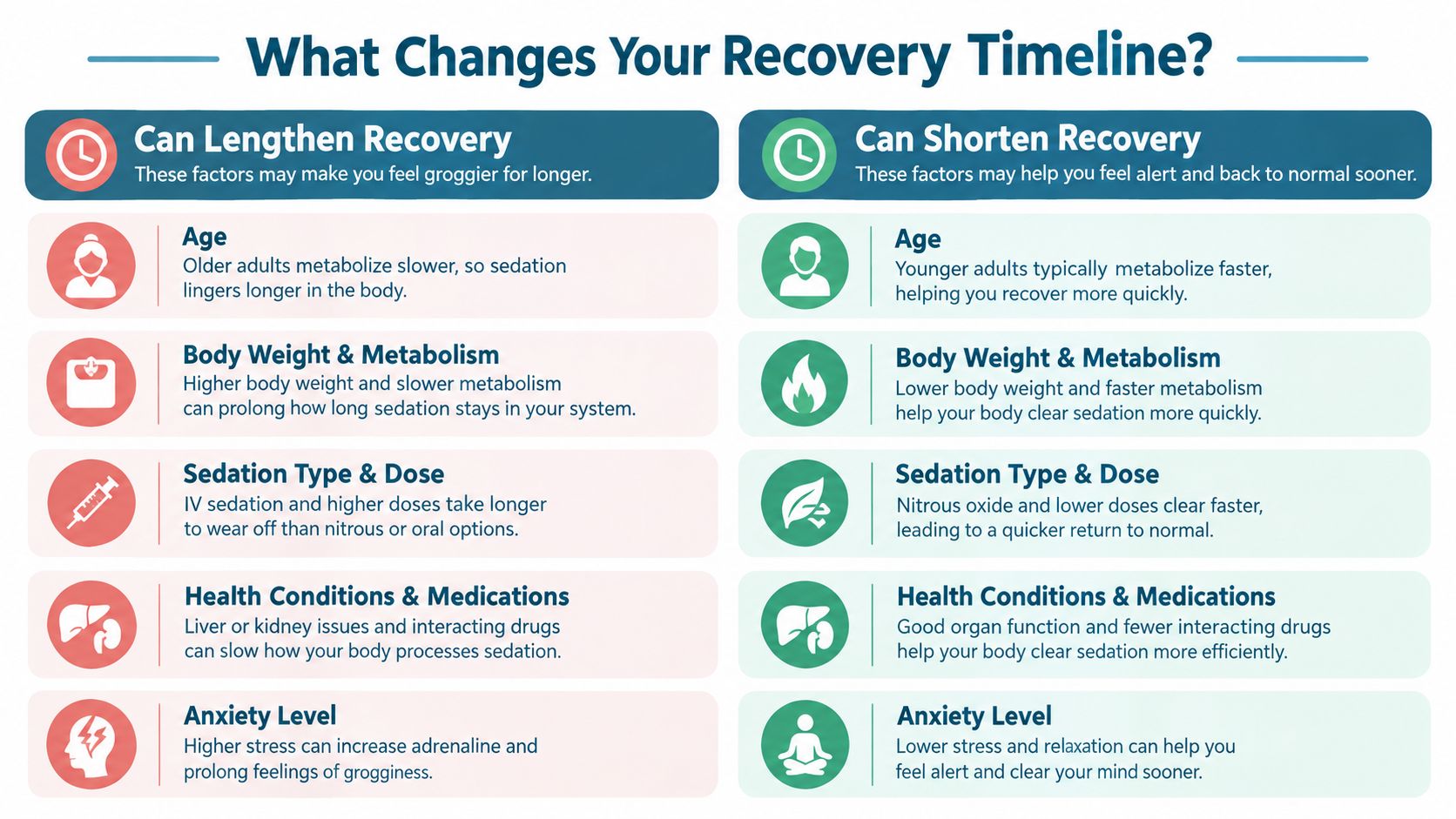
A healthy younger adult may feel substantially better after oral sedation within a few hours. An older adult taking several medications may need closer observation and a longer safety window. Those examples aren't predictions, but they show why the question “When can the patient drive or return to work?” requires a personal answer.
Age can affect how quickly the body processes sedatives. Body weight and composition may influence medication handling, while liver and kidney function can affect clearance. Current prescriptions, over-the-counter medicines, and supplements also matter because some can intensify drowsiness or change how the sedative behaves.
Procedure and preparation also matter
A brief appointment may require less medication than a longer or more invasive procedure. Combining sedatives can extend recovery compared with using one approach. Alcohol use, nicotine use, dehydration, fasting status, and anxiety can also affect how a patient feels after treatment.
Patients should provide a complete medication and health history during the consultation. A patient seeking a tooth extraction, restorative dentistry, dental implants, or cosmetic dentistry should mention prior anesthesia reactions, sleep concerns, liver or kidney conditions, and every medication or supplement.
The discussion should include non-IV choices when clinically appropriate. A dental team can explain non-IV conscious sedation and compare it with deeper options based on the procedure, anxiety level, health history, and recovery plans.
Safe Aftercare in the First 24 Hours
The safest first-day plan is simple: arrange supervision, remove driving responsibilities, rest, hydrate, and follow the written instructions. For oral, IV, and general anesthesia sedation, a responsible adult should stay with the patient for the first several hours and, when directed, remain available overnight.
A practical home plan
- Arrange supervision: Have a trusted adult provide transportation and observe the patient at home.
- Avoid driving: After anything beyond nitrous oxide, don't drive or operate machinery until the next day unless the care team gives different instructions.
- Start gently with fluids: Sip clear liquids first, then move to soft foods as tolerated and as the procedure allows.
- Avoid alcohol: Alcohol can worsen drowsiness and interfere with safe recovery.
- Take only approved medicines: Use medications exactly as prescribed. Don't add common pain relievers or supplements without checking the dental team, particularly after an extraction or surgery.
- Rest with the head slightly raised: A comfortable raised position may make rest easier and can support the aftercare plan.
- Postpone decisions: Avoid contracts, legal documents, financial decisions, power tools, and safety-sensitive work.
- Plan a quiet day: Arrange time away from work, childcare, strenuous activity, and other responsibilities.
Normal prescriptions should be resumed according to the office's instructions. The caregiver should track what was taken and when, especially if the patient is sleepy or has memory gaps. A patient may also want to postpone social media posting, since judgment can remain foggy even when conversation seems normal.
The following video offers another visual reminder of basic post-sedation planning.
Feeling Awake Versus Being Truly Safe
The brain and body don't always return to normal at the same moment. A patient may open the eyes, hold a conversation, and say that the sedation has worn off while reaction time, working memory, and judgment remain affected.
That gap explains why many providers recommend 24 hours of caution after oral or IV sedation, including no driving. Cleveland Clinic notes that oral or IV sedation may require precautions for up to 24 hours, even when the patient feels substantially more awake. (Cleveland Clinic discusses the difference between alertness and full recovery)
A rideshare driver isn't the same as a responsible adult who understands the discharge instructions and can observe the patient. Deeper sedation may require a driver and chaperone because the patient could become unsteady, confused, or unusually sleepy after leaving the office.
Everyday activities that should wait
Driving is the clearest example, but the same caution applies to operating machinery, caring for small children alone, using power tools, returning to safety-sensitive work, signing contracts, or making major financial decisions. Information about sedation safety and sleep dentistry can be reviewed through sleep dentistry safety guidance.
Being cleared is a clinical decision, not a feeling.
Warning Signs That Need a Quick Call to the Office
Most patients recover without serious difficulty. A calm checklist helps caregivers recognize when a question deserves a same-day call and when an emergency response is needed.
Call the dental office promptly for
- Unexpected drowsiness: Sleepiness continues beyond the timeline provided for the sedation type.
- Persistent nausea or vomiting: The patient can't keep fluids down after the first several hours.
- Unusual bleeding: Bleeding at the procedure site seems excessive or doesn't follow the written instructions.
- Increasing swelling or fever: Facial swelling, fever, or worsening discomfort needs clinical guidance.
- Possible medication reaction: New skin changes, rash, or other signs of an allergic reaction should be reported.
When calling, the caregiver should have the sedation type, dose if listed, procedure time, current medications, and a short description of symptoms. That information helps the team determine the next step without delay.
Seek emergency help immediately
Difficulty breathing, chest pain, loss of consciousness, or suspected overdose requires 911 or emergency department care. The caregiver shouldn't wait for a routine office callback when breathing or consciousness is affected.
The office can still be contacted for concerns that don't appear urgent. Most recoveries follow the expected course, and timely questions often provide reassurance before a minor concern becomes more difficult to manage.
Common Patient Questions and Scheduling Care Nearby
Must a companion stay for the entire appointment?
The companion may not need to sit in the operatory during the procedure, but transportation and post-discharge supervision must be arranged according to the sedation plan. Deeper sedation requires a responsible adult who understands the instructions and can remain available during early recovery.
How do insurance and sedation fees work?
Coverage and patient responsibility depend on the procedure, the sedation method, and the individual dental plan. The office should review estimates, insurance questions, payment arrangements, and any available membership or financing options before treatment so the patient isn't surprised on appointment day.
Do children and older adults recover the same way?
No. Children may be sleepy or irritable after discharge, and older adults may need more time and closer supervision. A pediatric or geriatric plan should account for medical history, medications, communication ability, and the caregiver's ability to monitor recovery.
How are pregnancy-related concerns reviewed?
Pregnancy status or the possibility of pregnancy should be discussed before medication is selected. The dental team can review the procedure, urgency, alternatives, and safety considerations before recommending sedation.
What should patients bring?
Patients should bring a current medication and supplement list, relevant medical information, identification, insurance details, and a responsible adult driver. Comfortable clothing and a plan for a quiet recovery period can also make the day easier.
Families searching for a dentist in Amanda, OH, or a nearby provider serving Lancaster, OH, Circleville, OH, and Carroll, OH, often want more than a quick estimate. They want clear answers about new patient exams, digital dental X-rays, cleaning and exams, emergency dental services, tooth extraction, dental implants near me, cosmetic dentistry, and treatment comfort.
A consultation allows the dental team to match sedation with the planned care, whether that involves preventive treatment, restorative dentistry, cosmetic concerns, or a more involved procedure. Patients with dental anxiety can ask about the expected recovery window before scheduling, then arrange transportation, time away from work, and home support with greater confidence.
Amanda Family Dental provides patient-focused sedation planning alongside preventive, restorative, cosmetic, implant, and emergency dental services for families in Amanda, Lancaster, Circleville, and Carroll, Ohio. Patients can visit Amanda Family Dental to request an appointment or consultation, discuss the right sedation option, and plan a safe recovery before treatment day.