

The appointment is on the calendar, but the patient is already dreading it. The waiting room, the needle, the smell of disinfectant, or even the sound of a dental drill can bring back an old experience that never felt resolved. For someone searching for a dentist for people with anxiety, the right question isn't whether a practice offers sedation. It's whether the team can match the comfort plan to the person, the procedure, and the level of fear.
Amanda Family Dental serves patients in Amanda, Lancaster, Circleville, and Carroll, Ohio, with preventive, restorative, cosmetic, emergency, and comfort-focused dental care. A calm visit can begin with a new patient exam, dental x-rays, or a conversation about tooth pain. It doesn't have to begin with treatment.
Table of Contents
- What Dental Anxiety Actually Feels Like and Why It Matters
- How to Find and Vet an Anxiety-Friendly Dentist Near You
- Matching Comfort Options to Your Anxiety Level
- Coping Strategies Before, During, and After Your Visit
- Insurance, Cost, and How to Avoid Surprise Bills
- How Amanda Family Dental Supports Anxious Patients Locally
- Your First Step Toward Calm Dental Care
What Dental Anxiety Actually Feels Like and Why It Matters
A nervous patient may sit in the waiting room with both hands clenched, replaying an appointment that went badly years ago. The memory might center on a painful injection, the vibration of a drill, or a dentist who continued after the patient felt overwhelmed. Even before anyone calls the patient's name, the body may react with a racing heart, tense shoulders, shallow breathing, or a strong urge to leave.
Common triggers include loss of control, needles, gagging, dental sounds, office smells, and fear of judgment. Some patients worry that a dentist will criticize years of missed cleanings or delayed treatment. Others fear being unable to speak, swallow, or signal for a break while lying back in the chair. These reactions aren't a character flaw. Dental fear and anxiety follow recognizable patterns, and dental teams can address them with deliberate communication and comfort planning.
The need is broad, not niche. A 2021 systematic review and meta-analysis pooled 31 studies involving more than 72,000 adults and estimated global dental fear and anxiety prevalence at 15.3%, with 12.4% classified as high anxiety and 3.3% as severe anxiety (systematic review of global dental fear and anxiety). A separate 2025 U.S. census-matched survey of 1,003 adults found that 72.6% reported fear of going to the dentist, including 45.8% with moderate fear and 26.8% with severe fear (ADA News coverage of the 2025 JADA findings).
Why avoidance creates a harder appointment
Avoidance may provide immediate relief, but it leaves dental problems without attention. Gum inflammation, cracked teeth, untreated decay, and infections can progress until the patient needs an emergency dentist for pain or swelling. A visit that might once have involved cleaning and exams can become a more complicated appointment involving restorative dentistry, a tooth extraction, or tooth replacement.
That cycle also affects confidence. Patients may hide their smiles, avoid conversations, or postpone photos because they feel embarrassed about missing or damaged teeth. Treatment can support oral health, comfort, chewing, speaking, and appearance, but the first step is finding a practice willing to respect the fear instead of dismissing it.
Four comfort paths deserve careful evaluation: behavioral techniques, nitrous oxide, oral sedation, and IV sedation. The right dentist near me search should lead to a team that can explain each option, screen the patient appropriately, and build care around a clear stop signal and treatment plan.
How to Find and Vet an Anxiety-Friendly Dentist Near You
A search for a dentist near me becomes more useful when it includes the patient's actual concern. Instead of searching only by location, try phrases such as “anxiety dentist near me,” “gentle dentist,” or “sedation dentistry.” Reviews can reveal whether patients felt listened to, whether the dentist explained procedures, and whether staff stayed patient during difficult visits. Words such as “calm,” “patient,” “comfortable,” and “explained everything” are more relevant than generic praise.
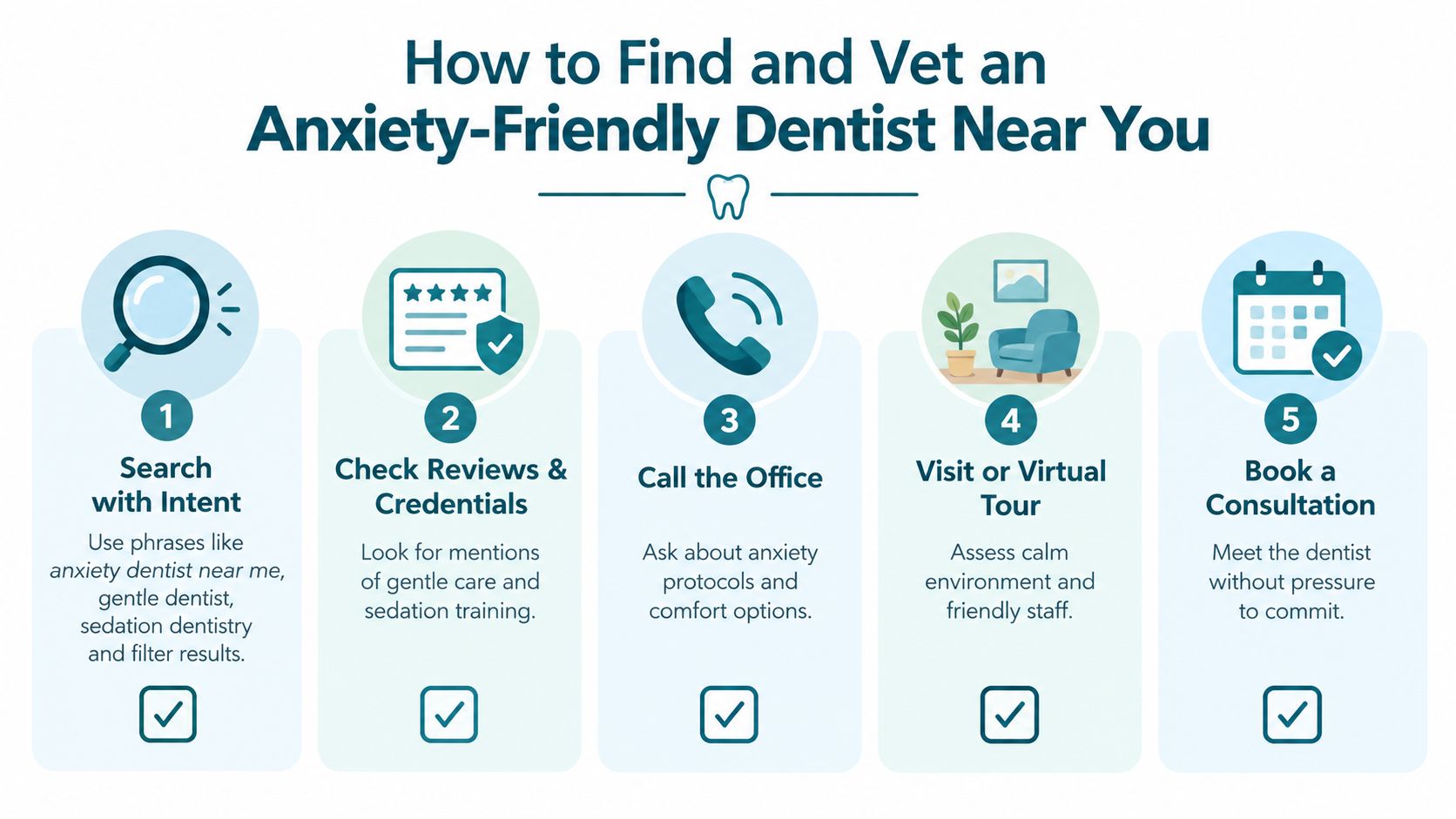
Five steps that reveal how a practice really works
1. Search with intent. A practice that discusses anxiety management, sleep dentistry, or sedation in clear language has made patient comfort part of its public communication. That doesn't prove the fit is right, but it gives the patient something concrete to investigate.
2. Read reviews and check credentials. Look for detailed comments about explanations, breaks, pain control, and sedation experiences. Patients should also confirm that the practice has appropriate training for the services it provides.
3. Call the office before booking treatment. The front desk should be able to answer three direct questions: Can the patient schedule a pre-visit consultation? Can the patient raise a hand or use another signal to stop treatment? Which sedation levels are available, and who evaluates whether they're appropriate?
4. Visit the office or request a virtual introduction. A calm environment isn't defined by décor alone. The patient should notice whether staff speak respectfully, answer questions without rushing, and explain what will happen next.
5. Book a consultation. A consultation-only visit lets the patient meet the team without committing to a filling, extraction, implant consultation, or cosmetic procedure. The practice should welcome that first low-pressure conversation.
Patients can also review this guide to choosing an ideal dentist before comparing local options in Amanda, Lancaster, Circleville, and Carroll.
Green flags: The team documents triggers, offers a stop signal, explains sedation screening, and provides written treatment and pricing information.
Red flags: Staff minimize fear, push treatment immediately, avoid questions about monitoring, or describe every patient as needing the same sedation.
Logistics matter, too. A convenient dentist in Amanda, OH, may be easier to visit consistently than a distant office, especially when anxiety already makes scheduling difficult. Patients should ask about hours, insurance handling, emergency dental services, and whether urgent appointments may be available when tooth pain or swelling makes waiting unreasonable.
Matching Comfort Options to Your Anxiety Level
Choose comfort support for the person and the appointment, not from a generic sedation menu. Someone uneasy about a cleaning may need a clear stop signal, breaks, and nitrous oxide. Someone who has avoided dental care for years may need behavioral support, oral medication, or a referral for IV sedation. The dentist should review medical history, treatment length, previous reactions, and transportation or recovery arrangements before recommending a method.
Behavioral care deserves a place at the start of the plan. A 2025 systematic review and meta-analysis found behavioral therapy reduced dental anxiety more than inhalational sedation, reporting an SMD of -0.87, with a 95% confidence interval from -1.29 to -0.45 and P < 0.0001. The review also found an effect in children, with an SMD of -0.64 and a 95% confidence interval from -1.16 to -0.11 (2025 review of behavioral therapy and dental anxiety interventions). Distraction can support a plan, but it should not replace communication and coping work. The same review found distraction techniques were not significantly better than tell-show-do, and virtual reality distraction did not demonstrate superiority.
Comfort Options vs. Anxiety Level and Visit Type
| Comfort Option | Best For | Typical Visits | Recovery | Verify With |
|---|---|---|---|---|
| Behavioral techniques | Mild anxiety, fear of judgment, and loss-of-control concerns | Cleaning and exams, new patient exams, simple restorative care | No medication recovery | Can the team use tell-show-do, breathing cues, breaks, and a stop signal? |
| Nitrous oxide | Mild-to-moderate anxiety, needle worry, and shorter procedures | Cleanings, fillings, dental x-rays, and brief restorative visits | Effects wear off quickly, with suitability for driving decided by the treating team | Is nitrous oxide available for this appointment, and what instructions apply afterward? |
| Oral sedation | Higher anxiety, longer visits, or strong needle fear | Longer restorative appointments, tooth extraction, and selected treatment plans | A responsible adult generally needs to drive the patient, and grogginess can continue afterward | Who prescribes the medication, what screening is required, and what recovery restrictions apply? |
| IV sedation | Severe anxiety, complex treatment, or extended avoidance | Complex restorative work, multiple procedures, or carefully selected cases | Requires arranged transportation and recovery support | Who provides the sedation, how is the patient monitored, and what emergency protocols are in place? |
For an appropriate mild-to-moderate case, nitrous oxide may be a practical first option. A 2026 systematic review reported 85% to 92% efficacy, onset within 30 to 60 seconds, recovery in about five minutes, and fewer than 5% minor complications such as nausea. It also reported 91% procedural success in randomized trials for short restorative procedures (2026 systematic review of dental sedation options). Use nitrous oxide dentistry options to prepare focused questions for a local consultation.
Oral sedation can fit a longer visit, though its effect is less predictable. The review reported 70% to 85% success, a 15-to-30-minute onset, and 5% to 10% paradoxical excitation with midazolam. IV sedation can reduce anxiety quickly, but it requires more clinical preparation and monitoring. Ask how the practice evaluates patients before minimal sedation, following sedation assessment guidance. Reserve stronger medication for cases where simpler options have failed or an assessment supports its use. Ask who provides the sedation, what monitoring is used, and what recovery support you must arrange before booking.
Coping Strategies Before, During, and After Your Visit
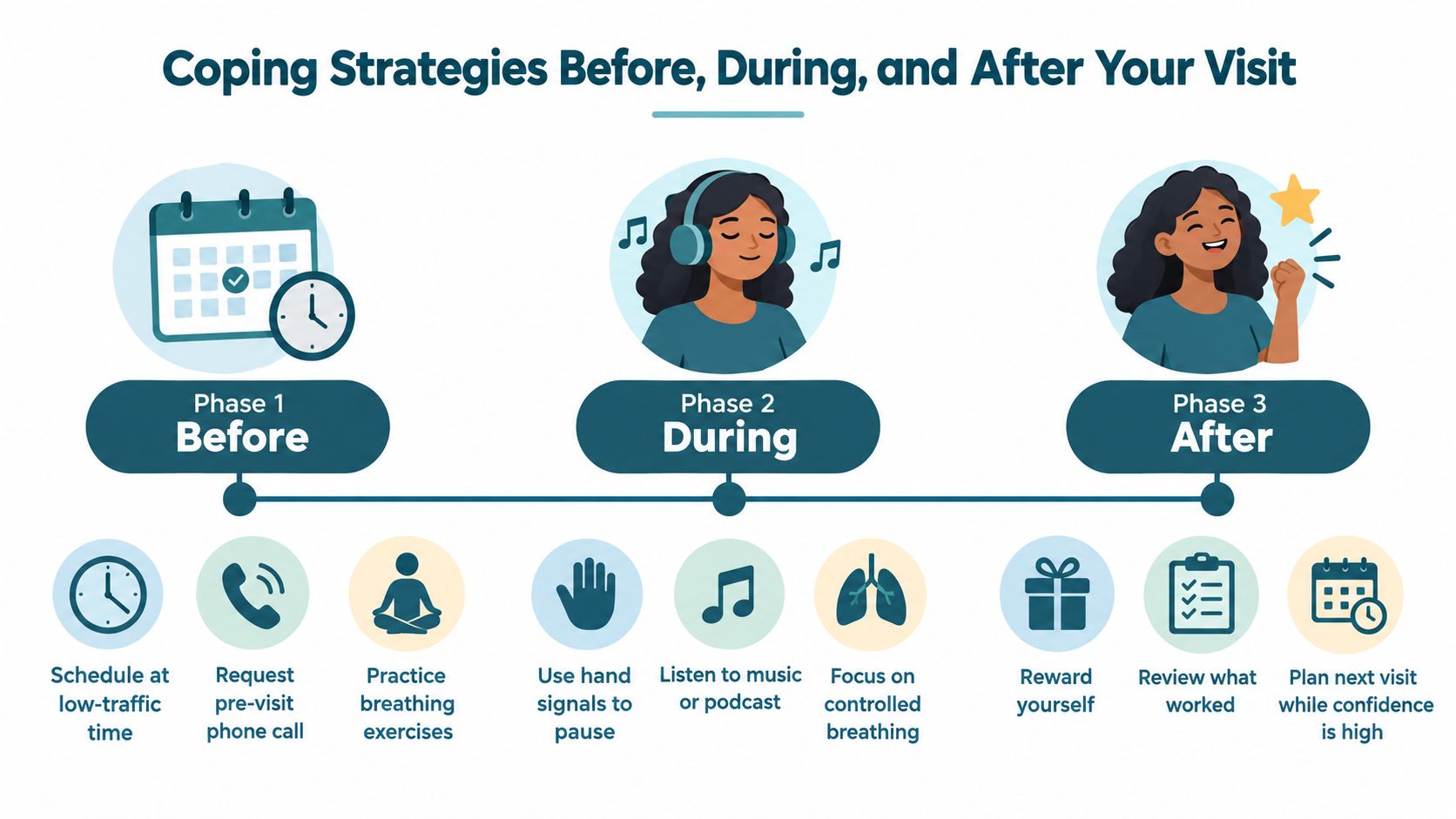
A comfort plan works better when it starts before the patient enters the office. Anxiety grows in uncertainty, so a short conversation with the front desk can remove several unknowns. The patient can request a pre-visit phone walkthrough, explain the main triggers, and ask whether the appointment can be scheduled during a quieter period.
Before the appointment
A written note can help when speaking feels difficult. It might say, “Needles and unexpected sounds cause anxiety. Please explain each step, use a stop signal, and allow breaks.” If sedation is planned, the patient should arrange transportation and confirm post-visit instructions rather than assuming normal activity will be allowed.
A patient can also prepare a small comfort kit:
- Audio support: Bring earbuds and a familiar playlist, podcast, or audiobook, after confirming that communication with the dental team will remain possible.
- Hand support: Ask whether a stress ball, blanket, or weighted item can be used safely during treatment.
- Breathing practice: Try box breathing before the appointment so the pattern feels familiar in the chair.
During the visit
The agreed stop signal should be simple, visible, and honored immediately. A raised hand can mean “pause,” while a second signal can indicate pain or a question. The dentist can also use tell-show-do, explaining the next step, showing an instrument when appropriate, and proceeding only after the patient understands what's coming.
Longer appointment blocks may help patients who become distressed when they feel rushed. Noise-canceling headphones, an eye mask, a ceiling-mounted screen, or a blanket can reduce sensory overload, but each item should be requested in advance because availability differs between practices.
The video below can help patients practice a calmer preparation routine before a dental visit.
After the appointment
A brief debrief makes the next visit more predictable. The patient can ask which strategies seemed effective, write down what felt manageable, and plan a small reward after completing care. Patients interested in sensory-based relaxation can also explore aromatherapy essentials for wellness centers, while confirming with the dental office that fragrances won't interfere with the patient's comfort or the clinical environment.
Insurance, Cost, and How to Avoid Surprise Bills
Money anxiety can sit beside dental fear, especially when a patient needs restorative dentistry, dental implants, a tooth extraction, or emergency care. The most useful protection is a written estimate that separates treatment from comfort services. Patients shouldn't accept a vague total when the office can explain expected insurance payments, patient responsibility, and separately billable sedation or amenities.
Typical Coverage for Anxiety-Focused Dental Comfort Options
| Comfort Option | Typical Insurance Coverage | Likely Out-of-Pocket Range | Notes for Anxious Patients |
|---|---|---|---|
| Behavioral techniques | Often part of the dental visit rather than a separate sedation benefit | Varies by examination or treatment fee | Ask whether consultation time or extended appointments carry a separate charge |
| Nitrous oxide | Frequently treated as an elective or non-covered comfort service | Varies by office and appointment | Ask whether the fee applies to the entire visit or each procedure |
| Oral sedation | May be covered when medically necessary, but plan rules differ | Varies by medication, evaluation, and treatment | Confirm prescription, monitoring, transportation, and recovery requirements |
| IV sedation | May be covered only for qualifying medical necessity or selected procedures | Varies substantially with the provider and clinical setup | Request pre-authorization and a complete estimate before booking |
The front desk can provide procedure codes, an estimate of insurance payment, and a list of likely extras. Patients should ask specifically about emergency exams, panoramic x-rays, post-operative medications, and any sedation fee. A pre-authorization can clarify benefits before a larger appointment, although it doesn't guarantee final payment.
Uninsured patients can ask whether the office offers an in-house membership plan that bundles cleanings and exams or reduces selected treatment and sedation fees. Financing and payment-plan information can also be reviewed through Amanda Family Dental's dental financing options. Patients who need support for anxiety beyond dental chair strategies may also consider Vernon anxiety therapy as a separate mental-health resource.
“Could the office send a written estimate showing the procedure codes, expected insurance contribution, comfort fees, emergency charges, x-rays, medications, and payment options before treatment begins?”
That script is direct without being confrontational. A trustworthy office should see financial clarity as part of patient care, not as an inconvenience.
How Amanda Family Dental Supports Anxious Patients Locally
An anxiety-friendly visit has visible steps. At Amanda Family Dental, the process can begin with a pre-visit phone conversation so the patient can explain triggers before sitting in the chair. The team can place a written comfort plan in the chart, which helps the clinical staff follow the same instructions at future visits instead of asking the patient to repeat a difficult history each time.
Longer appointments can give nervous patients room for questions, pauses, and gradual treatment. That matters for patients seeking a dentist in Amanda, OH, as well as families traveling from Lancaster, Circleville, or Carroll, Ohio. A new patient exam, digital x-rays, and treatment discussion can establish trust before the patient commits to fillings, crowns, root canals, tooth extraction, dental implants, or cosmetic dentistry.

Comfort matched to the appointment
Amanda Family Dental's sleep dentistry and sedation approach includes nitrous oxide, oral conscious sedation, and IV sedation for appropriate patients with different anxiety needs. Nitrous oxide may fit a shorter cleaning, exam, or restorative visit. Oral sedation may be discussed for greater anxiety or longer treatment, while IV sedation requires careful coordination with a qualified provider when clinical evaluation supports it.
The office also describes practical in-chair comforts, including noise-canceling headphones, blankets, eye masks, and ceiling-mounted screens. Behavioral support can include tell-show-do, guided breathing cues, planned breaks, and a stop signal. Local anesthesia remains the foundation of pain control in dental procedures, as noted in guidance on anxiety control and dental pain management.
Transparent pricing and membership options can help patients who are uninsured or worried about unexpected fees. Convenient scheduling and same-week availability for urgent needs, when available, can help patients address anxiety-driven avoidance before tooth pain becomes an emergency. The practice also provides broader family and cosmetic services, including cleanings and exams, fillings, crowns, root canals, dentures, dental implants, teeth whitening, veneers, Invisalign, and pediatric dentistry.
The key distinction is coordination. Behavioral techniques provide control. Nitrous oxide can support a shorter, moderate-anxiety visit. Oral sedation may help with longer care when a driver is available. IV sedation belongs in carefully assessed cases that need a higher level of clinical support. Patients don't have to guess which path fits. They can ask the team to evaluate the anxiety, procedure, medical history, and recovery plan together.
Your First Step Toward Calm Dental Care
The first appointment doesn't need to solve every dental problem. It only needs to create a safe starting point.
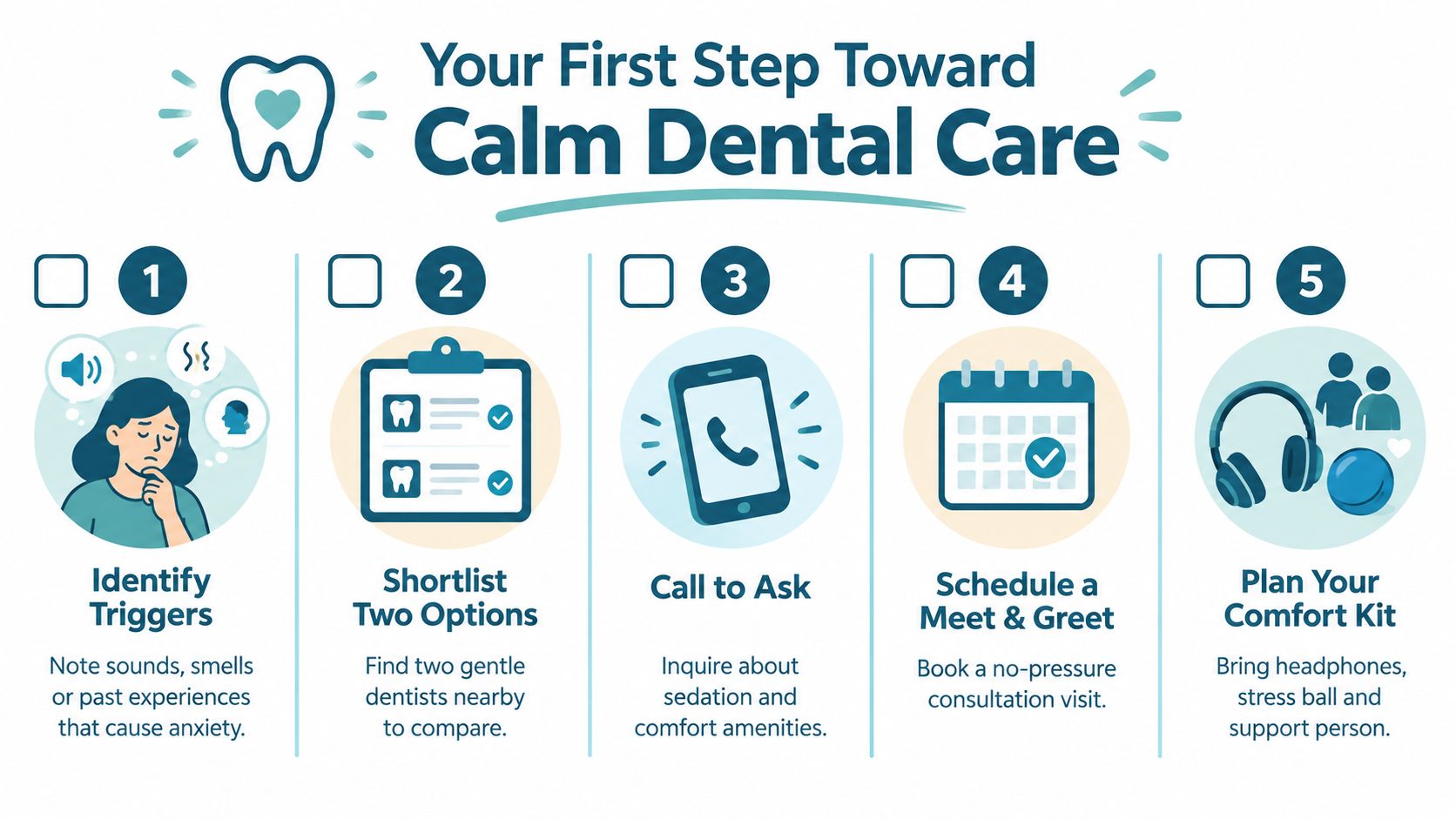
A patient can take these five actions today:
- Identify the triggers. Write down whether sounds, smells, needles, gagging, pain, loss of control, cost, or embarrassment creates the strongest reaction.
- Shortlist two or three practices. Search for an anxiety-friendly dentist near Amanda, Lancaster, Circleville, or Carroll, Ohio, and compare comfort services, reviews, location, and appointment access.
- Call with specific questions. Ask about a pre-visit consultation, stop signals, behavioral techniques, nitrous oxide, oral sedation, IV sedation, monitoring, transportation, and written estimates.
- Book a consultation-only visit. A no-pressure conversation can be the right first appointment for someone who isn't ready for treatment.
- Prepare two or three coping tools. Bring headphones, practice controlled breathing, write a trigger note, and ask about a support person, blanket, or stress ball.
Someone searching for a dentist for people with anxiety doesn't need to promise a full treatment plan over the phone. The next step can be a conversation about comfort, an exam, or urgent tooth pain. Choosing calm care starts with one low-pressure action, not a test of willpower.
Amanda Family Dental offers comfort-focused care, sleep dentistry options, clear treatment planning, and family, restorative, cosmetic, and emergency dental services for patients in Amanda, Lancaster, Circleville, and Carroll, Ohio. Visit Amanda Family Dental to request an appointment or consultation and tell the team about the anxiety support needed before the visit.