

A crooked front tooth can change how someone smiles, speaks, or appears in photographs. Many people begin searching for cosmetic dentistry for crooked teeth, a cosmetic dentist near me, or a dentist near me after years of covering their mouth or avoiding attention. Others notice crowding, trouble cleaning, tooth wear, or discomfort when the teeth meet.
Amanda Family Dental serves patients from Amanda, Lancaster, Circleville, and Carroll, Ohio, with dental care that considers both appearance and oral function. The right solution may involve bonding or veneers, but it may also involve Invisalign clear aligners, braces, restorative dentistry, or another carefully planned approach. The important question isn't only, “How quickly can the teeth look straighter?” It's also, “What treatment protects the teeth and bite over time?”
Table of Contents
- Finding a Trusted Dentist Near You for Crooked Teeth in Amanda Ohio
- Why Teeth Become Crooked and How It Affects Your Smile and Health
- Cosmetic Camouflage Versus True Alignment and When Each Makes Sense
- How Each Treatment Works Timelines Accuracy and What to Expect
- Costs Risks Maintenance and Choosing Based on Your Goals
- What to Expect at Amanda Family Dental From Exam to Personalized Plan
- Your Next Step to a Straighter Confident Smile Near Amanda Ohio
Finding a Trusted Dentist Near You for Crooked Teeth in Amanda Ohio
A patient from Amanda may arrive concerned about one tooth that sits behind the others. Someone from Lancaster may have mild crowding before a wedding. A patient in Circleville or Carroll may be less concerned about photographs and more troubled by uneven chewing or difficulty flossing. These situations can look similar in the mirror, but they don't always need the same treatment.
A consultation with Dr. Alyssa Jenkins at Amanda Family Dental can help separate a cosmetic concern from a bite or alignment problem. The practice provides cosmetic and orthodontic-related care in a local, patient-focused setting, so the conversation can include veneers, composite bonding, crowns, Invisalign, braces, and limited tooth contouring when appropriate. Patients can review options without assuming that the most visible or fastest-looking treatment is automatically the safest choice.
Crooked teeth are common across populations. A major global systematic review found that pooled worldwide data showed Class I malocclusion in 74.7% of cases, Class II in 19.56%, and Class III in 5.93%, with substantial geographic variation, including Class II prevalence from 1.6% in Nigeria to 63% in Belgium (global review of malocclusion patterns). Those findings help explain why alignment concerns appear so often in everyday dental appointments.
What the consultation should clarify
A useful appointment should answer practical questions, such as:
- What is crooked: Is the issue limited to tooth shape, or are several teeth crowded or rotated?
- Whether the bite is involved: Do the upper and lower teeth meet comfortably during chewing?
- How much enamel would be changed: Would veneers or reshaping require permanent alteration?
- Whether movement is needed first: Could limited orthodontic treatment create a more conservative cosmetic result?
- What maintenance will be required: Will the plan involve retainers, repairs, whitening, or replacement?
Patients looking for a cosmetic dentist near Amanda, Ohio can use those questions to guide a more informed discussion. A new patient exam, dental X-rays, and a careful bite evaluation provide a stronger foundation than choosing a procedure from a photograph alone.
Why Teeth Become Crooked and How It Affects Your Smile and Health
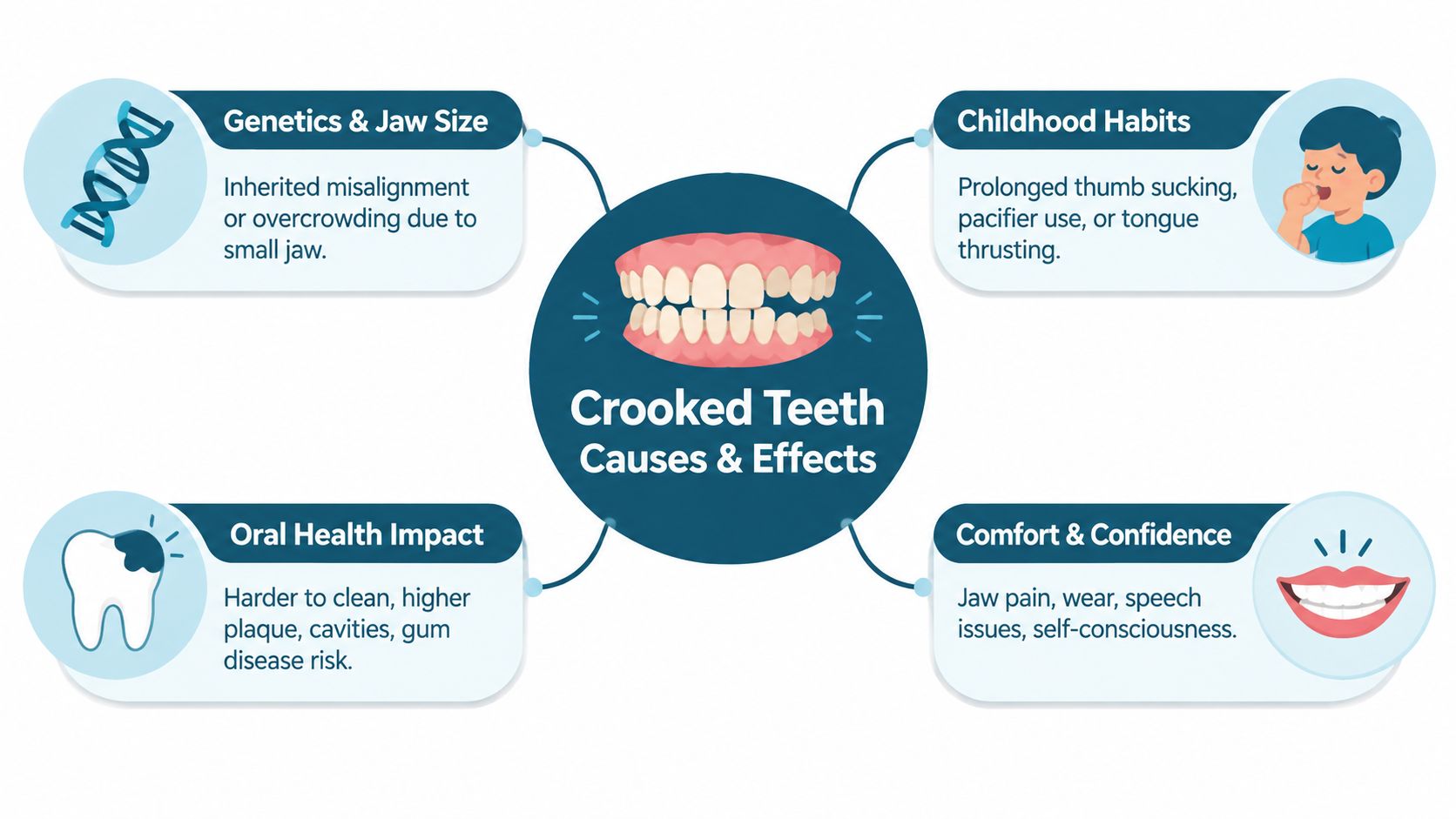
Crooked teeth usually develop from a combination of tooth position, available jaw space, growth patterns, and inherited traits. Some mouths have more teeth than the available space can comfortably accommodate. Other patients have spacing, tooth rotation, uneven eruption, or a difference between upper and lower jaw position.
Childhood habits can also influence developing alignment. Prolonged thumb sucking, pacifier use, or tongue thrusting may affect how the teeth and jaws develop. A patient's dental history, family pattern, and current bite all matter, so a visual inspection alone can't explain every case.
Appearance is only one part of the problem
A slightly rotated tooth may mainly affect confidence. More involved crowding can make brushing and flossing less predictable because some surfaces become difficult to reach. Plaque can remain in sheltered areas, contributing to cavities or gum irritation if home care and professional cleanings don't remove it effectively.
Misalignment can also affect function. Teeth that meet unevenly may contribute to uncomfortable chewing, uneven wear, speech changes, or pressure around the jaw. These symptoms don't prove that crooked teeth are the sole cause, but they deserve assessment before a cosmetic-only plan is chosen.
Why bite and jaw position matter
A veneer can cover the visible front surface of a tooth. Bonding can add composite material to change shape. Neither approach physically moves the jaw into a new position or reliably corrects a skeletal discrepancy.
That distinction is especially important with severe crowding, pronounced overbites, underbites, or jaw-related alignment concerns. In those situations, orthodontic care, and sometimes coordinated surgical care, may be more appropriate than masking the appearance with restorations. Patients who want a broader explanation of muscle patterns and oral function can review myofunctional therapy information as part of a discussion.
Practical rule: A straighter-looking smile and a corrected bite are related goals, but they aren't the same result.
Cosmetic Camouflage Versus True Alignment and When Each Makes Sense
The central choice is whether to change the appearance of the teeth or move the teeth into a healthier position. Cosmetic camouflage can be efficient for a small shape or spacing concern. Orthodontic treatment is generally more suitable when crowding, rotation, bite contact, or tooth position drives the problem.
| Treatment Approach | Best For | Enamel and Bite Consideration |
|---|---|---|
| Composite bonding | Small chips, minor shape differences, or limited spaces | Usually conservative, but it doesn't correct a significant bite or move the tooth |
| Veneers | Mild crookedness, uneven size, or visible shape concerns | Can require enamel alteration and may camouflage rather than correct alignment |
| Crowns | Teeth that are structurally weakened or heavily restored | More extensive tooth preparation, with bite planning required |
| Contouring and reshaping | Very small length or contour adjustments | Permanently removes a limited amount of enamel and has strict limits |
| Clear aligners | Mild to moderate crookedness when alignment is the main goal | Moves teeth gradually, but complex movements and rotations can be less predictable |
| Braces | More complex crowding, bite concerns, or movements requiring stronger control | Corrects tooth position and can address relationships that cosmetic restorations cannot |
When cosmetic treatment can be reasonable
Bonding may suit a patient whose tooth is only slightly irregular and whose bite is already comfortable. Veneers may be considered when tooth shape, color, and minor position concerns overlap, provided the tooth is healthy and the patient understands that treatment can be irreversible.
The key is restraint. A veneer-only plan for moderate or severe misalignment may require more enamel removal to make the front surfaces appear parallel. Future chipping, staining, repair, or replacement can become more complicated when the underlying position hasn't been addressed. The practical discussion of cosmetic bonding versus veneers can help patients compare those approaches.
When alignment should come first
Clear aligners or braces make more sense when the teeth need genuine movement, particularly when crowding affects cleaning or when the bite doesn't feel balanced. A systematic review found that clear aligners are effective for dental alignment but are consistently weaker than fixed appliances for anterior or posterior and vertical corrections (systematic review of clear aligners and fixed appliances).
That doesn't make aligners a poor option. It means case selection matters. Aligners can be a strong choice for mild-to-moderate cases where appearance and alignment are the primary goals, while braces may offer better control for complex three-dimensional movement.
Why a hybrid plan may be more conservative
Some patients benefit from limited orthodontic movement followed by small cosmetic refinements. Moving a tooth closer to its intended position can reduce the amount of enamel that must be changed later, while bonding or a veneer can address shape or color that orthodontics alone won't alter.
The fastest visible change isn't always the most conservative treatment. A careful plan balances enamel preservation, bite health, appearance, repair needs, and the smile's expected behavior over time.
How Each Treatment Works Timelines Accuracy and What to Expect
A small chip or uneven edge may need only bonding, while a tooth that sits outside the arch may need movement. The treatment should match the cause. Bonding and veneers change the visible surface, while aligners or braces change tooth position and can address bite-related concerns.
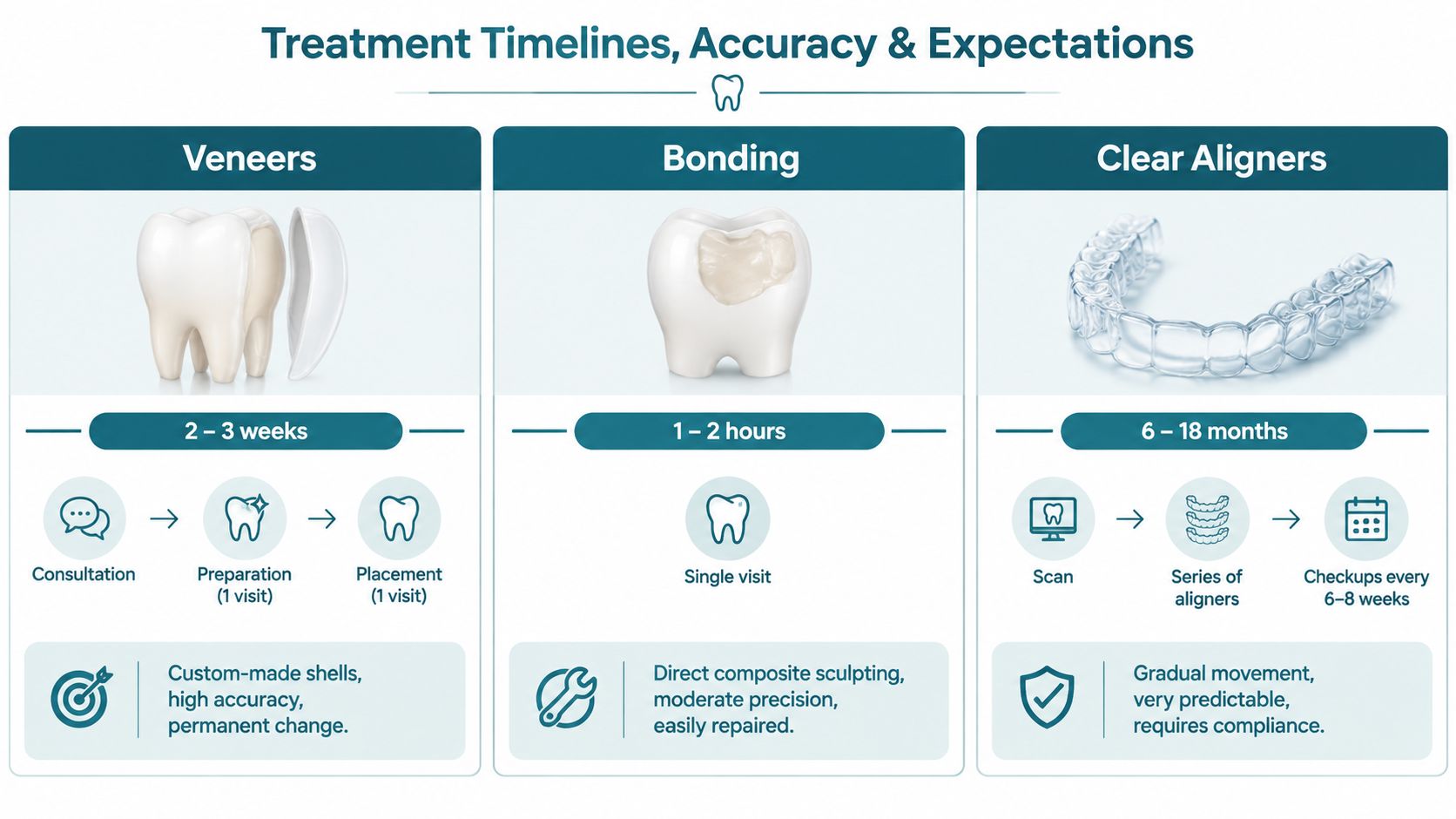
Bonding usually involves preparing the tooth surface, applying tooth-colored composite, shaping it, and hardening it with a curing light. It can often be completed in a focused visit. The result depends on shade selection, polishing, and how much reshaping the tooth needs. Because the material is added rather than used to move the tooth, bonding can preserve enamel when the concern is limited to shape, size, or a small gap.
Veneers require more planning. The dentist checks tooth health and the bite, designs the shape, prepares the tooth when indicated, and places a custom-made shell. Veneers can create a consistent appearance, but enamel may be altered, so the change is generally permanent. They camouflage selected irregularities rather than correcting the tooth's position.
Crowns cover more of the tooth and serve a different purpose. They may be considered when there is substantial structural damage, a large restoration, or another reason a veneer would not provide enough support. A healthy tooth with a minor cosmetic irregularity usually should not be treated as though it needs a crown.
What movement-based treatment involves
Clear aligners use a series of removable trays to apply planned pressure over time. Patients remove them for eating and cleaning, wear them as directed, and attend monitoring visits. Braces use brackets and wires that remain attached, giving the orthodontic team control over tooth movement without relying on tray wear.
A comparative study reported average treatment durations of 14.5 months for clear aligners and 16.2 months for conventional braces in comparable cases (comparative study of aligners and braces). Actual timing varies with crowding, rotation, bite involvement, cooperation, and refinements.
A review reported aligner appointments are typically spaced every 10 to 12 weeks, compared with 4 to 6 weeks for fixed appliances (review of clear aligner treatment). Fewer visits may fit more easily into a schedule, but they do not replace consistent wear or daily hygiene.
Accuracy matters most where movement is difficult. A 2019 systematic review reported Invisalign tooth-movement accuracy of about 55% to 72%, depending on the protocol and aligner-change interval (systematic review of Invisalign accuracy). Rotations, especially canine derotation, may require careful attachment design and refinements.
An orthodontic clinical summary states that aligner systems are often marketed for 6 to 18 months, while moderate malocclusions may require 18 to 24 months for more predictable outcomes. Severe crowding or skeletal discrepancies may take longer (clinical summary of orthodontic treatment duration). Adults should not assume treatment automatically takes longer than it does for adolescents. A meta-analysis found no statistically or clinically significant difference in fixed-appliance duration, with a mean difference of -0.8 month and a 95% confidence interval from -4.2 to 2.6 months (meta-analysis of treatment duration by age).
Costs Risks Maintenance and Choosing Based on Your Goals
Treatment decisions should reflect more than the initial quote. The plan also needs to account for enamel changes, repair needs, daily habits, retention, and whether the treatment addresses the source of the concern.
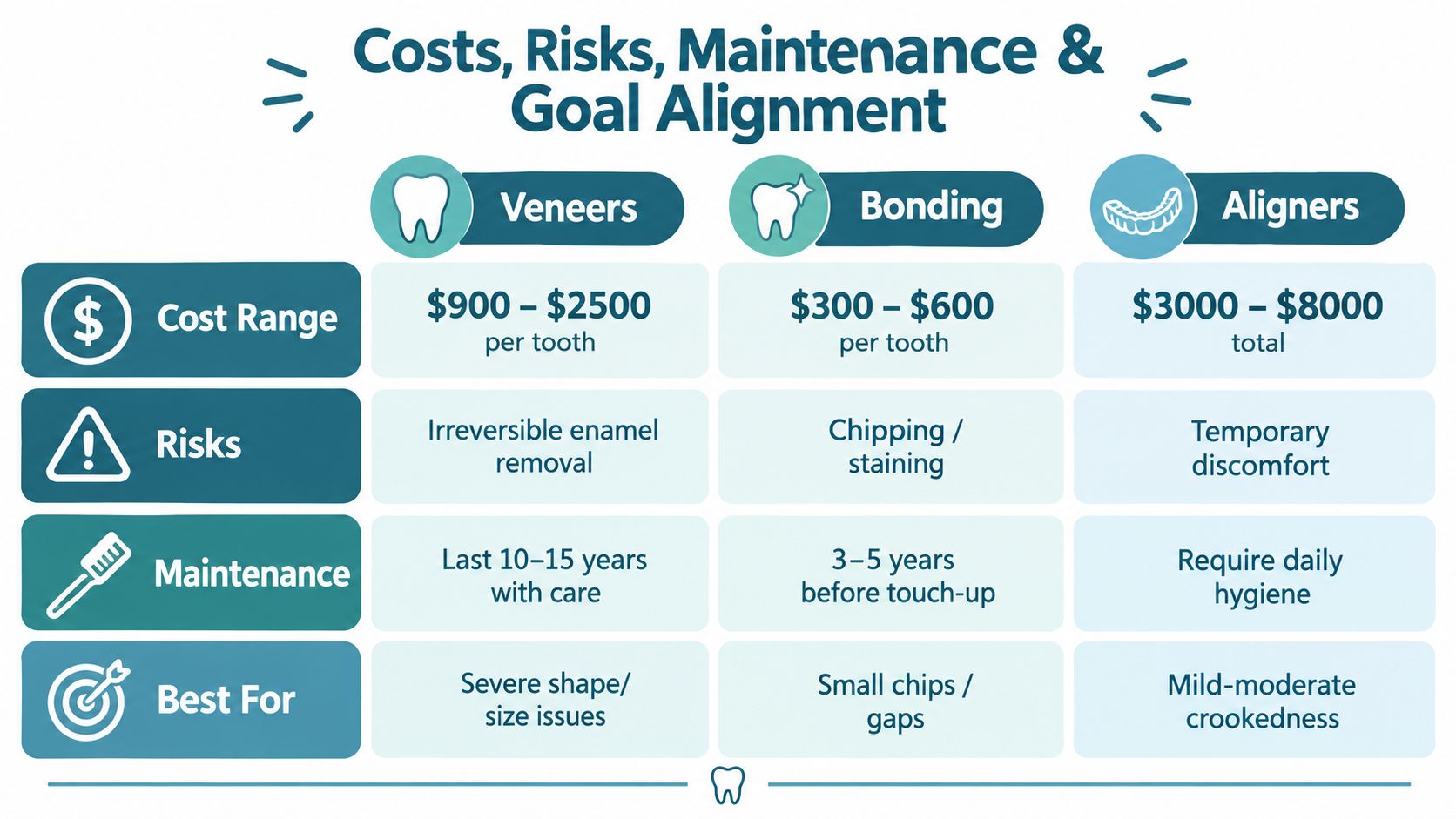
Veneers can create a polished, consistent appearance, but they may chip or require repair and replacement. Bonding is typically easier to repair and can be more conservative, although composite can stain or chip. Contouring is limited by the amount of healthy enamel available, so it isn't a substitute for orthodontics when teeth are substantially out of position.
Aligners require daily responsibility. Patients need to keep the trays clean, wear them consistently, and follow the planned sequence. Braces remain attached to the teeth, but brackets and wires can make brushing and flossing more demanding. After either orthodontic approach, retention is important because teeth can shift when the supporting tissues adapt to the new positions.
Match the treatment to the situation
A patient with a near-term event may value a visible cosmetic change, but a rushed veneer plan can create permanent trade-offs. Someone with mild crowding and strong enamel-preservation priorities may prefer alignment first, even if the result takes longer. A patient with bite discomfort or severe crowding should place function and tooth health before camouflage.
A simple decision checklist can help:
- Speed: Is the goal a quick change in shape, or is actual tooth movement needed?
- Conservation: Is preserving untouched enamel more important than completing cosmetic work sooner?
- Function: Do chewing, jaw comfort, tooth wear, or bite contacts need attention?
- Daily routine: Can the patient manage removable aligners, or would fixed braces provide more reliable treatment?
- Long-term care: Is the patient prepared for retainers, polishing, repairs, whitening, or restorative maintenance?
Cost varies by treatment, tooth count, preparation, materials, and case complexity. A responsible consultation should explain the recommended sequence and alternatives rather than presenting a cosmetic procedure as a universal fix. Patients also should ask what happens if a tooth chips, stains, needs a filling, or requires replacement later.
What to Expect at Amanda Family Dental From Exam to Personalized Plan
The process begins with a new patient exam and a conversation about what feels wrong or looks different. A patient may mention a hidden smile, difficulty flossing, tooth sensitivity, uneven chewing, or a desire for whitening alongside alignment. Those details help shape the examination.
Digital X-rays and a total health screening can reveal problems that aren't visible from the front. The dental team may assess cavities, gum health, existing fillings, tooth roots, bite contacts, jaw comfort, and the amount of space available. That information helps determine whether cosmetic dentistry, restorative dentistry, Invisalign, braces, or a combination makes sense.

A plan built around health and preferences
Dr. Alyssa Jenkins and the Amanda Family Dental team can discuss choices in plain language, including veneers, professional teeth whitening, composite fillings, Invisalign clear aligners, crowns, root canals, dental implants, dentures, and emergency dental services. Mercury-free filling options, fluoride-free choices, sleep dentistry, and myofunctional therapy may also be discussed when clinically appropriate and consistent with patient preferences.
Patients from Amanda, Lancaster, Circleville, and Carroll, Ohio, can ask about scheduling, same-day care when available, and payment options such as the Power Plan Membership. A patient searching for a dentist in Amanda, OH, a dentist in Lancaster, OH, a dentist in Circleville, OH, or a dentist in Carroll, OH should receive a plan that connects cosmetic goals with preventive and restorative care.
The evaluation may also identify needs unrelated to crooked teeth, including a damaged tooth requiring a tooth extraction, a missing tooth needing dental implants, or urgent pain requiring an emergency dentist. Treating those concerns first can make later cosmetic planning safer and more predictable.
Your Next Step to a Straighter Confident Smile Near Amanda Ohio
Cosmetic dentistry for crooked teeth works best when the treatment matches the problem. Bonding or veneers may suit a healthy tooth with a small shape concern. Invisalign or braces may be the better starting point when crowding, rotation, bite contact, or cleaning difficulty shows that the teeth need real movement.
A hybrid approach can sometimes protect enamel and improve the final appearance. Limited orthodontic correction may create better space and positioning before a conservative veneer or bonding procedure. Severe crowding, major overbites, underbites, or jaw-based concerns need a full evaluation because veneers alone may hide the appearance without correcting the function.
Patients don't need to choose between every option before the appointment. A new patient exam, digital X-rays, bite assessment, and discussion with Dr. Alyssa Jenkins can clarify whether the priority should be appearance, comfort, cleaning, chewing, or a combination of goals.
Amanda Family Dental offers examinations, digital X-rays, Invisalign, veneers, bonding, restorative dental care, and emergency evaluations for patients in Amanda and nearby communities. Schedule a consultation to discuss crooked teeth, ask about conservative alternatives, and receive a treatment plan based on the health and position of the teeth.
Amanda Family Dental provides personalized cosmetic, orthodontic-related, restorative, and preventive dental care for patients in Amanda, Lancaster, Circleville, and Carroll, Ohio. Visit Amanda Family Dental to request an appointment or consultation for crooked teeth and learn which option fits the smile, bite, and long-term oral health.