

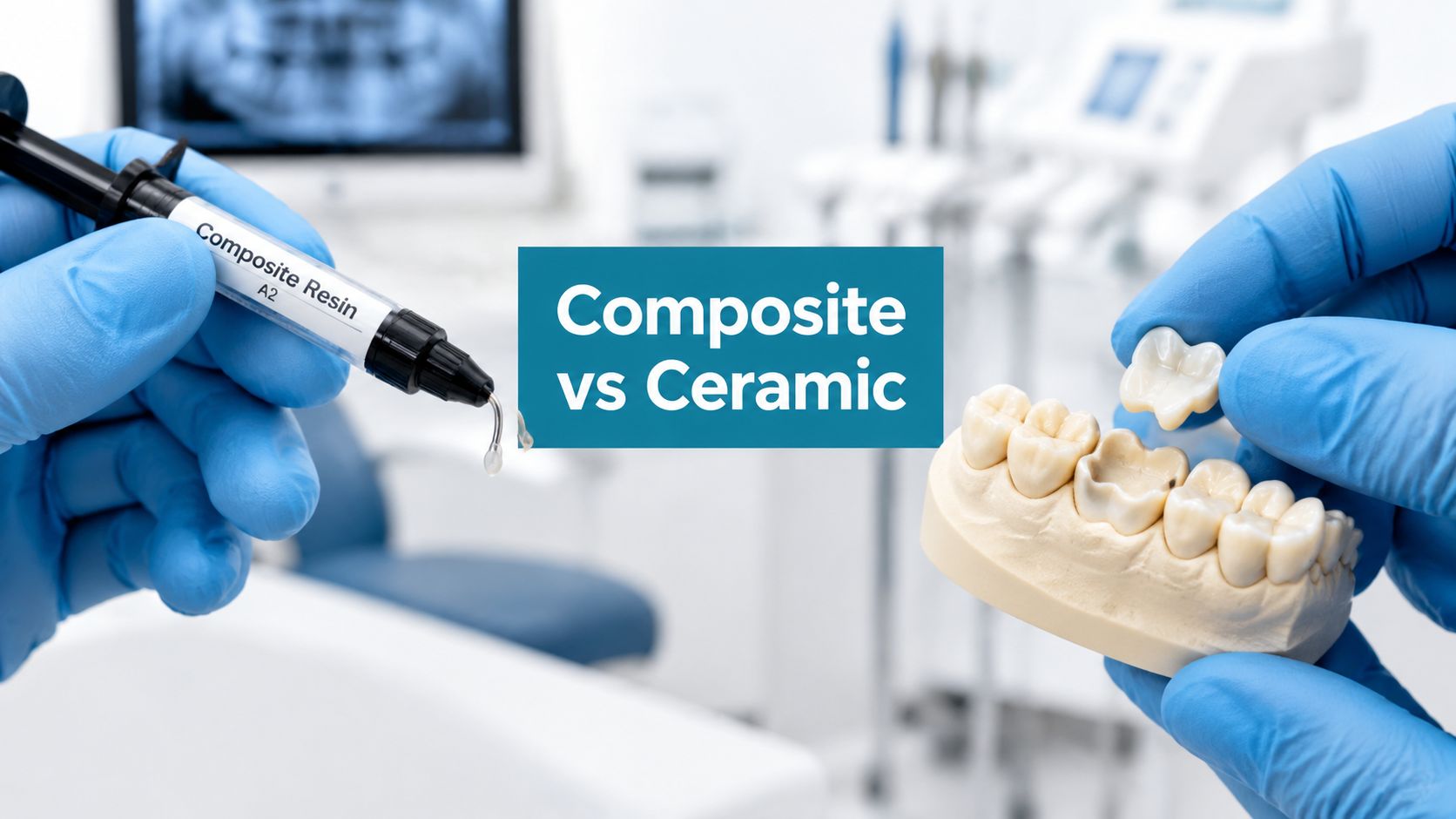
A cracked filling, a new cavity, or an old restoration that no longer feels right can leave patients wondering which material will protect the tooth for the long haul. The choice between composite fillings and ceramic restorations affects appearance, chewing comfort, repair options, and how much healthy tooth structure can remain.
For families searching for a dentist near me, a dentist in Amanda, OH, or a restorative dentist serving Lancaster, Circleville, and Carroll, Ohio, the decision shouldn't be reduced to “which material lasts longer?” Amanda Family Dental helps patients consider the tooth, the size of the repair, bite pressure, decay risk, cosmetic goals, and future maintenance. The right restoration should support a healthy, comfortable, confident smile.
Table of Contents
- Finding the Right Restoration for Your Smile
- Understanding Modern Tooth Colored Restorations
- Composite Fillings vs Ceramic Restorations Compared
- Real World Use Cases for Each Material
- Benefits of Advanced Restorative Dental Care
- What to Expect at Amanda Family Dental
- Choosing the Right Option and Scheduling Your Visit
Finding the Right Restoration for Your Smile
A patient may arrive expecting a routine filling and learn that an older restoration has weakened part of a back tooth. A small cavity might still be treated with a direct composite filling, while a larger area of damage could call for an indirect ceramic inlay or onlay. Both options can look natural, but they don't solve exactly the same problem.
Composite resin is usually shaped and bonded directly to the tooth during the appointment. Ceramic is commonly made outside the mouth, either in a laboratory or with a digital milling workflow, then bonded into the prepared tooth. That difference affects appointment planning, strength, repairability, and the amount of tooth preparation required.
The question matters because a restoration does more than cover a hole. It seals the treated area, restores the tooth's shape, helps the patient chew comfortably, and can prevent a damaged tooth from becoming more difficult to treat. A restoration that's too small for the forces on the tooth may wear or fracture. One that's larger than necessary may remove more natural structure than needed.
The choice depends on the tooth
A dentist evaluates several details before recommending composite or ceramic:
- Cavity size: Small and moderate defects may suit a direct filling, while extensive damage may need a stronger indirect restoration.
- Tooth position: Molars experience substantial chewing pressure, while front teeth place greater emphasis on appearance.
- Bite and grinding: Clenching or bruxism can change the material recommendation.
- Decay risk: A patient prone to recurrent decay may need a plan focused on cleaning, margins, diet, and regular exams.
- Future repair: Composite is generally easier to adjust or repair in the dental chair, while fractured ceramic may require replacement or laboratory involvement.
Families in Amanda, Lancaster, Circleville, and Carroll don't have to make that decision from a chart on the internet. A consultation can turn a confusing material comparison into a tooth-specific plan that protects comfort, function, and appearance.
Understanding Modern Tooth Colored Restorations
Tooth-colored restorations generally fall into two practical categories. A composite filling uses resin blended with fine glass particles. The dentist places it directly into the prepared tooth, shapes it, hardens it, and polishes it so the surface follows the natural anatomy.
Composite bonds to enamel and dentin through an adhesive process. That bond can allow a dentist to preserve more sound tooth structure than an approach that relies mainly on mechanical retention. The material can also be shaded to blend with neighboring teeth, which makes it useful for visible areas and many routine cavity repairs.
A patient considering the composite filling procedure can expect the dentist to remove infected tooth structure, clean the area, place the bonding materials, and build the filling in layers. The exact sequence depends on the tooth and the extent of decay.
Ceramic is an indirect restoration
Ceramic, often described as porcelain in patient conversations, is a hard, tooth-colored material fabricated outside the mouth. An inlay fits within the cusps of a tooth, while an onlay extends over one or more weakened cusps. This makes ceramic different from a small direct filling and also different from a full crown.
Ceramic can provide a highly natural appearance and strong resistance to surface wear and staining. It does require careful planning, precise bonding, and sometimes more than one stage of treatment. The dentist must assess whether enough healthy tooth remains to support the restoration and whether the patient's bite creates a high risk of fracture.
Mercury-free care and conservative treatment
Amanda Family Dental offers mercury-free, tooth-colored fillings, giving patients an option that aligns with families seeking modern restorative care. The material choice still needs to match the clinical situation. A tooth-colored composite filling may be appropriate for a modest defect, while ceramic may be more suitable when a posterior tooth needs broader structural support.
Neither material is automatically right for every cavity. The most conservative treatment is the one that removes diseased structure while restoring the tooth adequately for its daily demands.
Composite Fillings vs Ceramic Restorations Compared
Composite and ceramic may look similar after placement, but they behave differently under repeated chewing. Composite is versatile, conservative, and usually easier to repair. Ceramic is harder and more wear resistant, but a substantial fracture can be harder to manage.
A 2021 systematic review reported ceramic inlay and onlay survival of 90% at 5 years, 89% at 8 years, and 85% at 10 years, while composite resin inlays showed survival ranging from 79.3% to 92.0% after 5 to 10 years in clinical service. The same review found that ceramic inlay reports varied widely, from 51.4% to 96.0% over 5 to 15 years, showing why a single lifespan promise can mislead patients. (2021 review of composite and ceramic restorations)
A broader review of posterior onlays estimated overall survival at 94.2%, with composite onlays at 90%, hybrid materials at 99%, and disilicate materials at 98%. Its prediction intervals ranged from 84.0% to 100%, reinforcing that outcomes vary by material, case selection, follow-up, and clinical conditions. (Systematic review of posterior onlays)
| Feature | Composite Resin | Ceramic (Porcelain) |
|---|---|---|
| Appearance | Tooth colored and shade matched in the dental office | Natural looking, with strong color stability and enamel-like appearance |
| Placement | Usually placed directly during an appointment | Usually fabricated indirectly and bonded into the tooth |
| Tooth preservation | Often well suited to conservative preparation | May require more preparation to create space for the restoration |
| Strength | Performs well in many cases but can wear under heavy load | Generally stronger and more resistant to wear |
| Repairability | Often easier to repair or reshape chairside | A major fracture may require replacement or laboratory work |
| Best application | Small to medium cavities, visible teeth, and repair-focused treatment | Larger defects, weakened cusps, heavy chewing, and high esthetic demands |
| Main concern | Wear, marginal discoloration, or recurrent decay | Bulk fracture under excessive stress |
Mechanical testing also favors ceramic for load and wear resistance. One comparative study reported average fracture resistance of 1985.7 N for ceramic versus 1280.5 N for composite, with wear volume loss of 0.017 mm³ for ceramic versus 0.042 mm³ for composite. Those laboratory findings support ceramic when posterior durability and surface wear are major concerns, although laboratory results don't replace a clinical examination. (Comparative study of composite and ceramic materials)
Failure mode matters more than a simple winner
Ceramic restorations are often more vulnerable to bulk fracture when excessive force concentrates in a weakened area. Composite restorations more often face wear, marginal discoloration, or secondary caries. That distinction changes the recommendation.
Practical rule: If chewing stress is the dominant risk, strength deserves more weight. If future repair and conservative treatment are the priority, composite may offer a more forgiving path.
A clinical review reported mean annual failure rates of 2.9% for composite inlays, 1.9% for ceramic restorations, and 1.7% for CAD/CAM ceramic restorations in indirect posterior restorations. (Clinical review of indirect restoration failure rates) Those figures show a measurable durability advantage for ceramic in that review, but they don't mean every ceramic restoration will outlast every composite filling.
For patients reviewing cavity filling options, the most useful question is often, “What is most likely to fail on this particular tooth, and what happens if it does?”
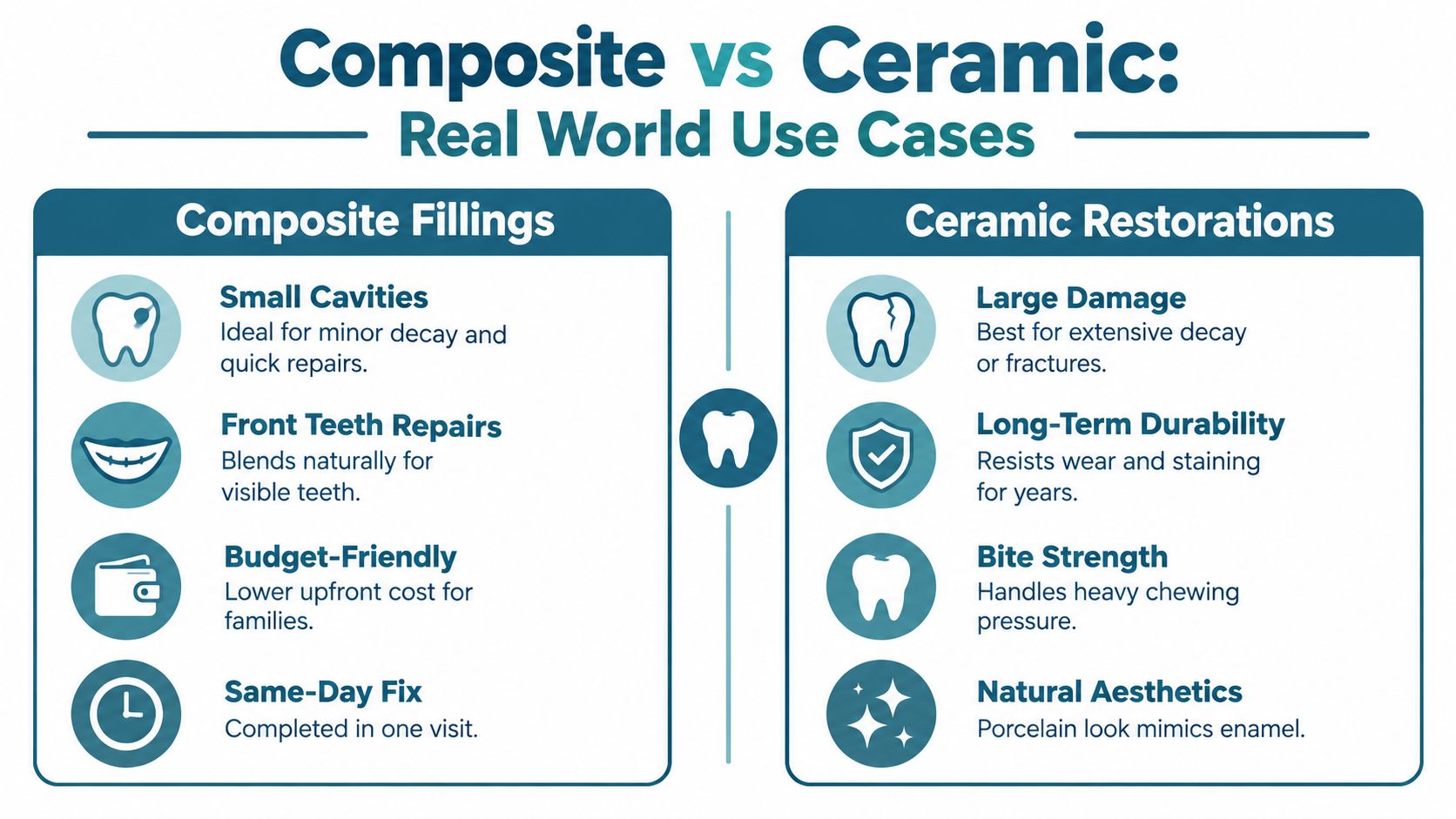
Real World Use Cases for Each Material
A material works best when its strengths match the patient's situation. A small cavity in a front tooth doesn't create the same demands as a broad restoration on a molar affected by grinding. Age, cooperation, hygiene, bite force, cosmetic expectations, and the amount of remaining enamel all influence the recommendation.
When composite makes practical sense
Composite is often a sensible choice for a small or moderate cavity, especially when the dentist can preserve substantial healthy tooth structure. The dentist can place and finish it directly, which may make treatment more convenient for patients who want a straightforward repair.
Composite can also suit:
- Visible teeth: Shade matching helps the restoration blend with the surrounding smile.
- Conservative repairs: The dentist may remove only the diseased or unsupported area.
- Chipped edges: Bonding can restore limited damage without automatically moving to a larger indirect restoration.
- Children and families: A direct, tooth-colored treatment may be easier to plan when a smaller repair is needed.
- Future maintenance: If a small portion wears or chips, composite is generally easier to add to or reshape chairside.
Posterior resin composite restorations have shown a mean annual failure rate of 1.8% at 5 years and 2.4% at 10 years in a meta-analysis of clinical studies, demonstrating that modern composite fillings can perform well in load-bearing teeth. (Meta-analysis of posterior resin composite restorations)
When ceramic may be the better fit
Ceramic becomes more compelling when a tooth has lost substantial structure, carries heavy chewing pressure, or needs long-term resistance to staining and wear. Inlays and onlays can restore a broader area while avoiding a full crown when the remaining tooth structure supports that approach.
Patients with significant bruxism or unusually strong bite forces need a careful risk assessment. Ceramic may offer greater resistance to wear, but the dentist must also evaluate whether the restoration design, bonding, and occlusion can reduce fracture risk.
The broader evidence remains mixed. One systematic review found composite inlay survival from 79.3% to 92.0% after 5 to 10 years and ceramic inlay survival from 51.4% to 96.0% after 5 to 15 years, with outcomes varying sharply across studies. (Long-term clinical performance review)
A ceramic recommendation shouldn't be based on appearance alone. The restoration must fit the tooth's structure, bite, cleaning access, and likely future needs.
Patients interested in how tooth-colored cosmetic materials differ can review how veneers work, although veneers address the front surface of a tooth and aren't a substitute for an inlay or onlay used to restore posterior damage.
Benefits of Advanced Restorative Dental Care
A successful restoration should do more than hide decay. It should help seal the treated tooth, restore a stable chewing surface, and reduce the chance that a small problem will progress into pain or more extensive treatment.
Repairing decay can relieve sensitivity and discomfort caused by exposed or infected tooth structure. It can also restore the shape needed for efficient chewing and help prevent food from repeatedly collecting around a damaged area. Patients often notice the functional improvement first, especially when biting on the affected side had become uncomfortable.
Health and function come first
A well-designed restoration supports daily habits that protect oral health:
- Comfortable chewing: A properly shaped surface helps distribute normal biting forces.
- Clear speech: Restoring damaged front teeth can support normal tongue and lip contact.
- Simpler cleaning: Smooth, well-fitted margins make home care more manageable.
- Tooth preservation: Conservative treatment can protect remaining natural structure when the defect allows it.
Longevity also depends on factors outside the material. Brushing, interdental cleaning, regular cleaning and exams, fluoride decisions, diet, bite forces, and prompt attention to a loose or chipped restoration all affect the result.
Appearance affects confidence
Composite and ceramic both offer tooth-colored treatment, which can help patients feel less self-conscious than they might with a visible metal restoration. Ceramic can provide especially stable color and surface appearance, while composite offers useful shade matching and convenient repair for many cases.
A well-rounded plan may include restorative dentistry alongside cosmetic dentistry, teeth whitening, veneers, or Invisalign when appropriate. The sequence matters. Active decay and gum concerns should be addressed before elective smile enhancements.
A natural-looking smile is valuable, but a comfortable, disease-free tooth is the foundation that makes cosmetic treatment worthwhile.
What to Expect at Amanda Family Dental
A new patient who arrives with a sore tooth or concern about an old filling can expect the visit to begin with questions, not assumptions. The dental team reviews symptoms, medical history, dental habits, grinding concerns, and the patient's goals before recommending a material.
A new patient exam may include an oral evaluation and digital dental X-rays when clinically appropriate. These images help the dentist assess decay between teeth, the depth of a lesion, existing restoration margins, and the condition of surrounding bone and tooth structure.

Clear planning supports better decisions
The dentist then explains whether the tooth appears appropriate for a direct composite filling, an indirect ceramic inlay or onlay, a crown, or another treatment. If the tooth is infected or the damage extends into the nerve, a root canal may be needed before the final restoration. If the tooth can't be predictably saved, tooth extraction and replacement options such as a dental implant or denture may enter the discussion.
Patients don't have to guess about the practical differences. The plan should cover:
- Treatment sequence: What needs attention first and whether more than one visit is expected.
- Material reasoning: Why composite, ceramic, a crown, or another option fits the tooth.
- Comfort measures: Numbing, anxiety support, and available sleep dentistry for appropriate patients.
- Financial planning: Available payment arrangements, including the Power Plan Membership, can be discussed with the office.
Amanda Family Dental provides family and cosmetic dentistry for patients in Amanda, Lancaster, Circleville, and Carroll, Ohio. Services include preventive care, composite fillings, crowns, root canals, dental implants, dentures, teeth whitening, veneers, and emergency dental services, with patient-centered choices such as mercury-free fillings and digital X-rays.
Choosing the Right Option and Scheduling Your Visit
The best choice in the composite fillings vs ceramic discussion depends on risk, not fashion. Composite often fits a smaller defect, a conservative repair, or a tooth where easy future adjustment matters. Ceramic may make more sense when a larger posterior area needs support, bite forces are high, or long-term color and wear resistance carry greater importance.
The decision also depends on what remains after decay is removed. A tooth with healthy walls and stable margins may support a direct filling. A tooth with weakened cusps may need an inlay, onlay, or crown to prevent the remaining structure from flexing under normal chewing.
Patients should ask practical questions during a consultation:
- How much healthy tooth structure remains?
- Is the main concern decay, chewing force, wear, staining, or appearance?
- Could this restoration be repaired if a small portion chips?
- Would the treatment require one appointment or an indirect fabrication process?
- What daily habits will help protect the result?
A systematic review of long-term tooth-wear rehabilitation reported median survival of 5.9 years for composite resin restorations versus more than 7 years for cast restorations, with fracture, wear, and marginal discoloration among common failure modes. (Systematic review of clinical performance) Those findings support individualized planning rather than a blanket promise about any material.
Patients in Amanda, Lancaster, Circleville, and Carroll who have tooth pain, a broken filling, a chipped tooth, or an urgent dental concern can contact the office for an evaluation. Amanda Family Dental can also discuss broader needs, including dental implants near me searches, cosmetic dentistry, tooth extraction, and emergency dentist appointments, when those services are clinically appropriate.
Amanda Family Dental offers personalized exams, digital X-rays, mercury-free composite fillings, ceramic and restorative treatment planning, and comfort-focused care for patients in Amanda, Lancaster, Circleville, and Carroll, Ohio. Visit Amanda Family Dental to schedule an appointment or request a consultation about the restoration that best fits the tooth, bite, and long-term smile goals.